GBP/JPY is extending its advance for a third straight session, trading around 211, its highest level since September 18. The move reflects two forces working in the same direction. The British pound is gaining on weakness in the euro, while the Japanese yen is struggling against most major peers even as the Bank of Japan sounds more hawkish.
The euro is under pressure after a weekend of unrest in France, where more than 2,000 people were arrested as protests over rising living costs and strained public services turned violent. EUR/GBP has slipped to about 0.8415, its lowest since June 2025. Capital leaving the single currency has found a home in sterling.
Strategists at DBS argue that the pound is emerging as a more attractive alternative to the euro. They point to a more favorable carry, the IMF’s upgraded UK growth forecast and international praise for the government’s efforts to cut debt and the deficit. DBS also says Chancellor John Healey’s commitment to fiscal discipline ahead of the October 28 Autumn Budget has eased fears of a repeat of the 2022 mid-budget crisis, which had been a key source of risk premium on sterling.
Rate expectations add a further tailwind. Markets increasingly price a Bank of England hike before year-end, and a Reuters poll last week found 54 of 63 economists expect a 25 basis point increase at the November 5 meeting. This week’s UK data could shape that view: employment figures on Tuesday, inflation on Wednesday and retail sales on Friday. Firm readings would reinforce hike bets and support the pound, while soft prints could unwind some of the premium.
On the other side of the cross, the yen is failing to benefit from a hawkish BoJ. Governor Kazuo Ueda said underlying inflation is near the 2% target and warned that a mismanaged policy rate could raise inflation concerns and push up long-term yields, leaving further tightening on the table. But the yen remains structurally weak because of Japan’s low interest rates and its heavy government debt burden. Prime Minister Sanae Takaichi said a robust economy can lift market confidence in the yen and that government bond issuance will be kept at an appropriate level. She gave no firm signal on an extra budget, which leaves the fiscal question unresolved.
The main risks to a bullish view are on the event calendar. A weak UK jobs or inflation report could cool BoE hike expectations, and the Budget on October 28 could revive fiscal worries if it disappoints on discipline. A sharper hawkish turn from the BoJ, or the threat of Japanese currency intervention, could also trigger a quick yen rebound. These are headline risks, so sizing and stops matter.
Overall, the fundamental backdrop favors further gains in GBP/JPY in the near term. Sterling has carry, growth upgrades and rate-hike expectations on its side, and the yen is held back by low rates and debt concerns. The bias stays bullish while UK data holds up and the Budget keeps the fiscal credibility that DBS highlights.
Technical Analysis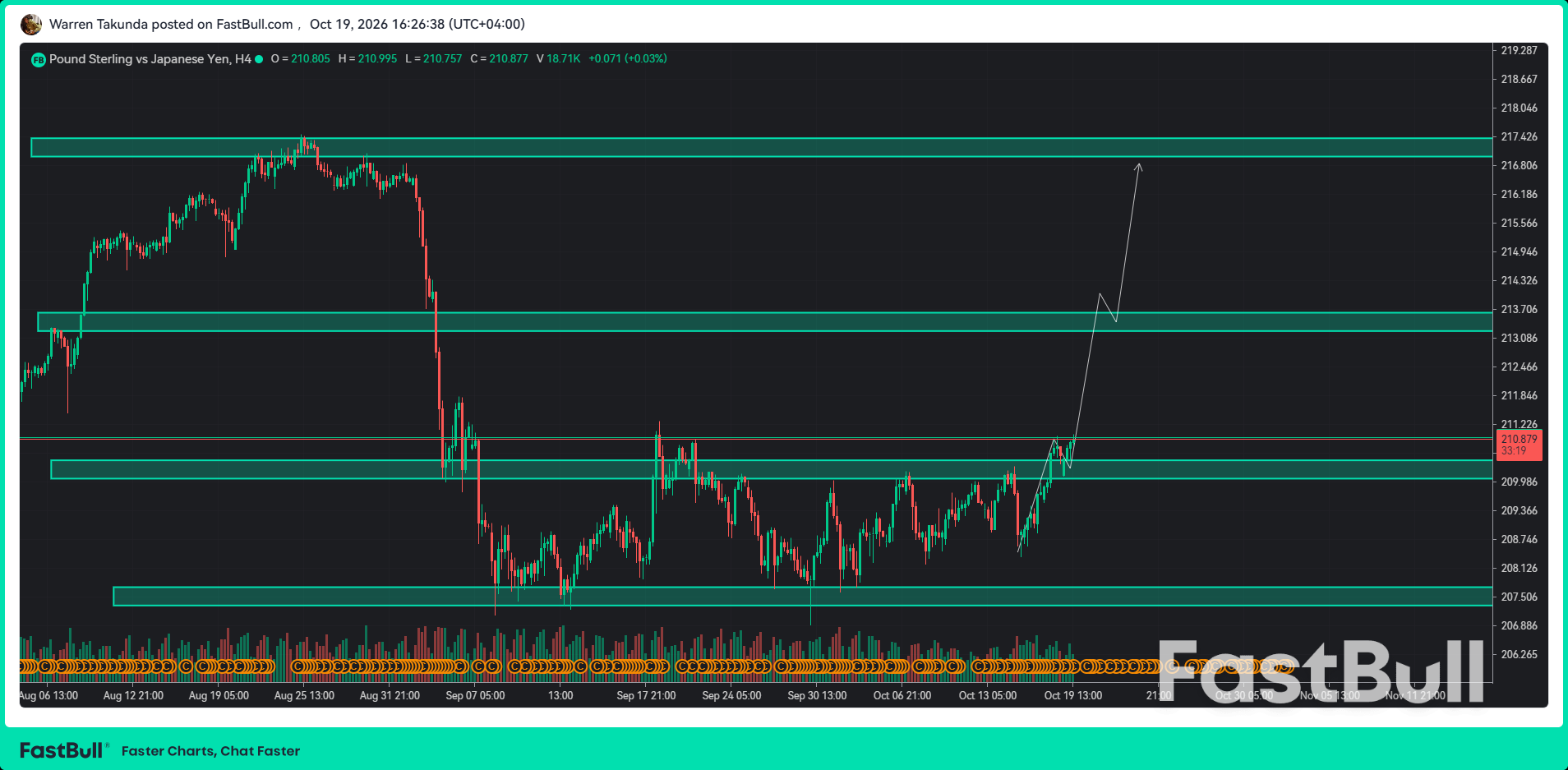
GBP/JPY is extending its advance for a third straight session, trading near 211, its highest level since the Sep 18 spike. The cross has broken above the 210.04-210.45 zone that capped rallies for six weeks and has climbed roughly 250 pips from the 208.40 higher low. The rebound has retraced only about 38.2% of the 216.8-207.2 collapse, so the broader structure still needs confirmation.
The immediate focus is on the 211.00-211.30 resistance region, where the Sep 17-18 spike high sits. A decisive H4 close above 211.30 could strengthen bullish momentum and open the door toward 211.80, then 212.00 (the 50% retracement), and 213.10-213.64. That last area combines the 61.8% retracement, a former support zone and the measured move of the six-week base. If buyers keep control, the August supply at 216.80-217.43 comes into view, and the early-September collapse left little price acceptance between 211.80 and 213.20, so moves through that area could be quick.
However, the cross remains vulnerable to a pullback if the breakout fails to hold. A rejection near 211.30 could send price back to 210.45-210.04, where the broken ceiling should now act as support. A close below 210.04 would invalidate the breakout and expose the 208.40 higher low, and a break of that level would put the 207.31-207.72 floor back in play.
GBP/JPY has a cautiously bullish short-term outlook, with a sustained break above 211.30 needed to confirm further upside toward 213.10-213.64. Until that breakout occurs, the advance could still represent a corrective rebound within the broader post-August downtrend.
TRADE RECOMMENDATION
BUY GBP/JPY
ENTRY PRICE: 210.80
STOP LOSS: 207.00
TAKE PROFIT: 213.20


