The British pound is staging a modest recovery against the Japanese yen to start the trading week, attempting to claw back some of the ground lost during the previous session’s risk-off volatility. The GBP/JPY cross advanced 0.33% to trade near the 209.30 handle during the European morning on Monday, finding a bid as the Japanese currency softened following the release of fourth-quarter gross domestic product figures that offered a muddled picture of the world’s third-largest economy.
The price action suggests a market in consolidation mode after a volatile week that saw the yen outperform on the back of domestic political clarity. However, with the technical bounce occurring on relatively thin early-week liquidity, traders are questioning whether this represents a genuine reversal or merely a temporary reprieve in a broader bearish channel for the cross.
Data released by the Japanese Cabinet Office earlier in the day revealed that the economy expanded by 0.1% quarter-on-quarter in the final three months of 2025. While this reading eked into positive territory, it offers little solace to policymakers at the Bank of Japan. The print represents a fragile rebound from the sharp 0.7% contraction logged in the third quarter. On an annualized basis, GDP rose a paltry 0.2%, narrowly escaping a technical recession after the previous quarter’s steep 2.6% decline.
While economic theory dictates that improving growth prospects should bolster a domestic currency, the reality of Japan’s situation is far more nuanced. The modest uptick in GDP does little to alleviate the structural challenges facing the economy, nor does it provide a clear mandate for the BoJ to aggressively normalize policy. The yen’s corrective move lower in the immediate aftermath of the data suggests that market participants view this growth figure as a "one-off" statistical adjustment rather than the beginning of a sustained, demand-led recovery. With domestic consumption and business investment still showing signs of lethargy, the data reinforces the view that the BoJ will likely maintain its ultra-dovish stance for the foreseeable future, keeping the yen under structural pressure.
The yen’s broader strength last week was primarily attributed to political dynamics rather than macroeconomic fundamentals. Prime Minister Sanae Takaichi’s ruling coalition secured a landslide victory in the lower house parliamentary elections, a mandate that significantly streamlines her ability to pass fiscal legislation. While this political stability is theoretically a positive for the currency, it also paves the way for continued heavy fiscal spending. For yen bulls, the key question remains whether this political capital will be used to pursue meaningful supply-side reforms or simply to fund further stimulus measures that could ultimately pressure the currency.
Across the pond, the British pound is trading in a relatively tight range against a backdrop of generalized US dollar strength. Sterling traders are decidedly on “wait-and-see” mode ahead of Tuesday’s critical UK labor market data for the three months ending December.
The upcoming release is arguably the most significant data point for the Bank of England this month. With inflation still sticky and the economy flirting with stagnation, the health of the jobs market will be the deciding factor in the Monetary Policy Committee’s next move. Market consensus expects the ILO Unemployment Rate to hold steady at 5.1%, a level that, while historically reasonable, represents a creeping increase from the multi-decade lows seen last year.
However, the headline unemployment figure is secondary to wage growth. Average Earnings Including Bonuses are forecast to have moderated to a year-on-year increase of 4.6%. A print significantly higher than this estimate would reignite fears of a wage-price spiral, effectively slamming the window on any speculation of imminent BoE rate cuts. Conversely, a sharper-than-expected deceleration could embolden the doves, potentially weighing on the pound as money markets price in a more accommodative path for the central bank.
Technical Analysis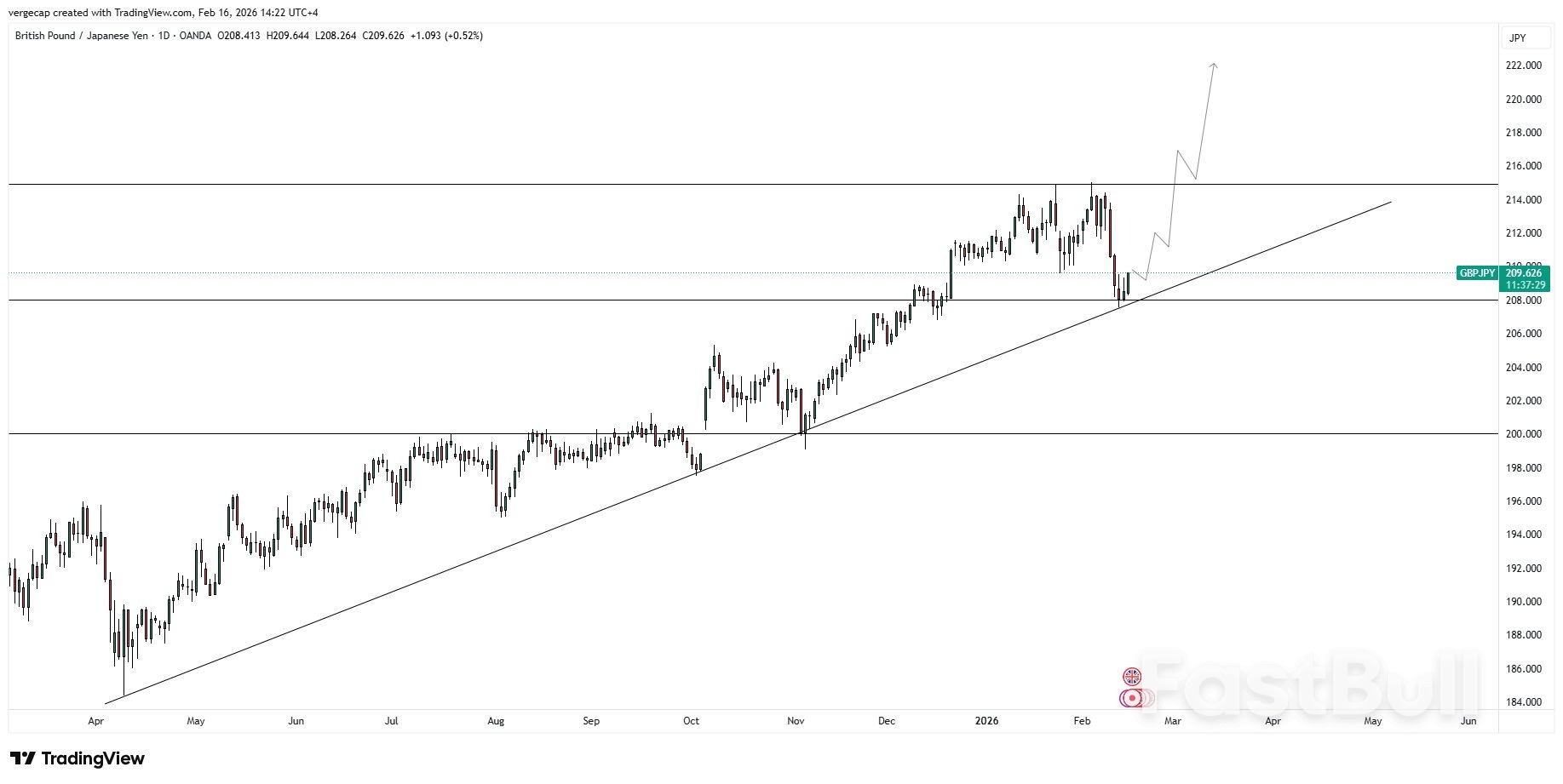
From a technical perspective, GBP/JPY remains entrenched in a well-defined bullish structure on the daily chart, with price action continuing to respect a long-term ascending trendline that has guided the advance since the April lows near 184.00. The broader market structure is characterized by a consistent sequence of higher highs and higher lows, reinforcing the dominant upward bias despite the recent pullback from February’s peak.
Price recently rejected from the 214.50–215.00 major horizontal resistance zone, an area that previously capped upside attempts and represents a significant supply barrier. The subsequent decline found support near the 208.00–209.00 demand region, which aligns closely with the ascending trendline. The market is now stabilizing just above this confluence, suggesting that the pullback may be corrective rather than the beginning of a larger reversal.
The ascending trendline support near 208.00 remains the key structural level to monitor. As long as daily closes hold above this dynamic support, the broader bullish structure remains intact. A decisive breakdown below 208.00, particularly if followed by sustained trade beneath the 205.00 horizontal support, would mark a deterioration in trend structure and open the door toward the 200.00 psychological level, which previously acted as a major consolidation base. A sustained move below 200.00 would signal a deeper corrective phase rather than a routine retracement.
On the upside, bullish traders are focused on a clean break back above 212.00, which would confirm renewed upside momentum. A sustained push through the 214.50–215.00 resistance zone would likely trigger continuation buying and expose the 218.00 level initially, with scope toward the 220.00–222.00 region as projected by the measured move illustrated on the chart. A breakout above 215.00 would represent a continuation of the long-term uptrend and potentially accelerate gains.
Structurally, the recent pullback appears orderly, occurring after an extended rally into resistance. The reaction into trendline support suggests buyers are defending higher levels rather than abandoning positions. This type of price behavior is typical within sustained trending environments, where corrections tend to be shallow and well-supported.
Overall, GBP/JPY maintains a constructive long-term outlook while above 208.00, with the current retracement potentially forming a higher low within the prevailing bullish cycle.
TRADE RECOMMENDATION
BUY GBP/JPY
ENTRY PRICE: 209.80
STOP LOSS: 206.80
TAKE PROFIT: 218.00


