In Canada, consumer activity exhibited a notable loss of traction as the fiscal year drew to a close. Retail Sales contracted by 0.4% on a monthly basis in December, and while this retreat was marginally less severe than the -0.5% anticipated by market participants, it was sufficient to offset a significant portion of the robust 1.2% expansion recorded in November. When excluding the volatile automotive sector, sales managed a modest 0.1% advance, defying forecasts of a 0.3% contraction. Nevertheless, the data underscored a pervasive cooling of consumer appetite, especially when contrasted with the previous month’s 1.6% surge, signaling an underlying deceleration in household discretionary spending.
Simultaneously, the latest Consumer Price Index (CPI) figures released on Tuesday pointed toward a gentle moderation in inflationary pressures within the Canadian economy. The annual inflation rate descended to 2.3% in January from 2.4% in December, while the monthly variation remained flat, underperforming the forecasted 0.1% increase. This trend reinforces the prevailing market perception that inflation is gradually stabilizing, potentially providing the Bank of Canada with the necessary breathing room to evaluate its current policy trajectory.
Across the border, the United States private sector continued its expansionary trend in February, albeit with a notable loss of momentum compared to the previous month. According to the preliminary S&P Global Composite PMI, the index retreated to 52.3 from 53.0, signaling a broader moderation across the economic landscape. Sector-specific data underscored this cooling effect: the Manufacturing PMI descended to 51.2 from 52.4, while the Services component dipped to 52.3 from 52.7. Both figures underperformed market consensus, highlighting a pervasive slowdown in domestic activity.
On the inflationary front, the latest Core PCE (Personal Consumption Expenditures) figures have reinforced the narrative that the Federal Reserve will likely maintain a restrictive policy stance for the foreseeable future. In December, the indicator advanced by 0.4% monthly, exceeding both the previous reading of 0.2% and the anticipated 0.3%. Annually, the rate accelerated to 3.0% from 2.8%, suggesting that underlying price pressures remain stubbornly persistent. Adding to the complexity, the preliminary Q4 2025 GDP estimate provided a significant negative surprise. The U.S. economy expanded at an annualized rate of 1.4%, a sharp deceleration from the robust 4.4% recorded in the third quarter and well below the 3.0% projected by analysts.
In the geopolitical and trade arena, the U.S. Supreme Court recently delivered a blow to the previous administration's trade policy, declaring tariffs imposed under the guise of "national security" by Donald Trump to be illegal. In response, Trump signaled during a White House press conference that his administration would seek alternative legal frameworks—such as Section 301 of the Trade Act of 1974—to implement even higher levies. This potential shift toward more aggressive protectionist measures continues to be a primary focus for market participants monitoring trade stability.
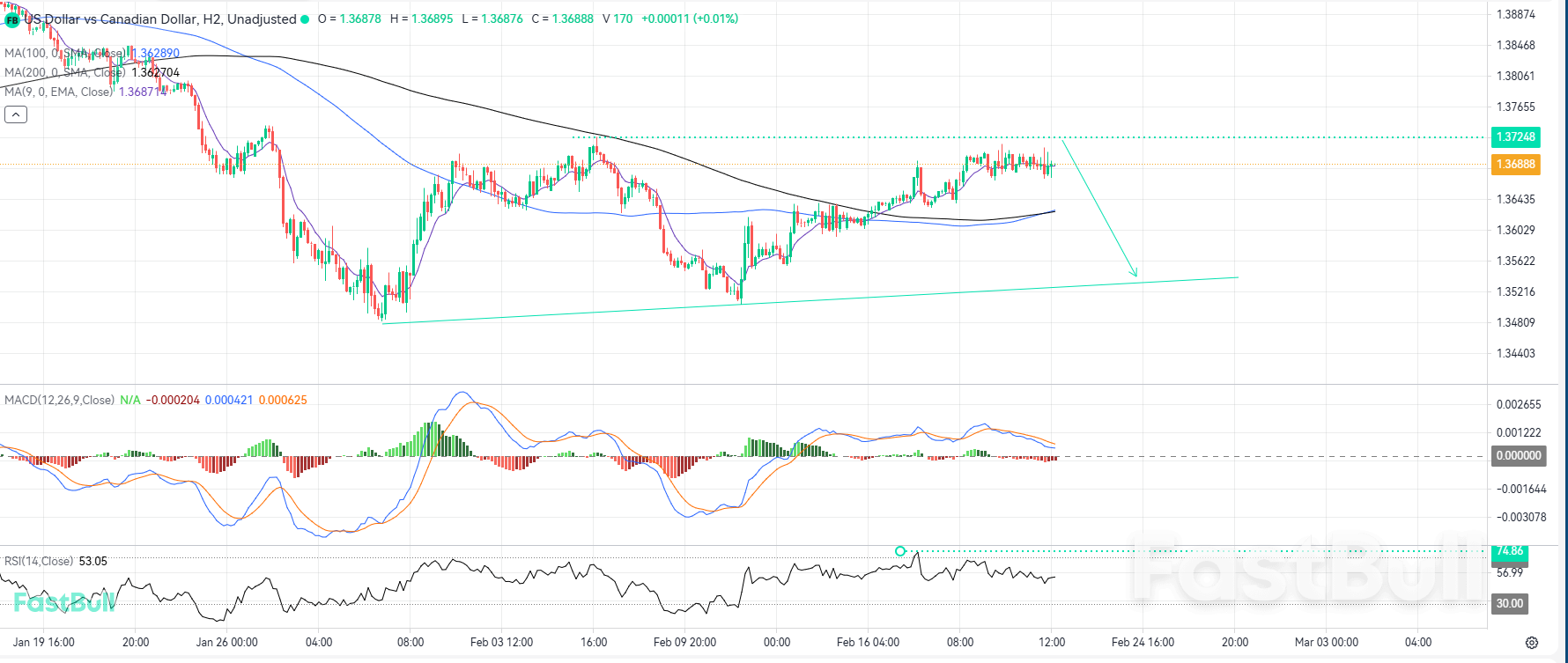
Technical Analysis
From a technical perspective, USD/CAD has recently encountered a formidable supply wall at the 1.3724 handle. The pair’s failure to establish a "Higher High" following the peak reached on February 5 suggests that the primary bullish impulse may be exhausting. If the price continues to reject this zone, a directional shift toward the primary ascending trendline, currently situated near the 1.3550 level, appears highly probable.
On the 2-hour (H2) chart, we are observing a significant technical development as the 100 and 200-period Moving Averages have converged at 1.3627 and 1.3626, respectively. This moving average confluence often acts as a pivot point; with the average price currently tilting lower, the likelihood of a technical correction has intensified.
Our momentum oscillators further support this bearish outlook. The RSI briefly touched overbought levels at 74 during the previous test of the highs but has since failed to replicate that strength. A return to the local peak without a corresponding surge in the RSI would confirm a bearish divergence. Simultaneously, the MACD signal lines remain above the neutral threshold, but the histogram has transitioned into negative territory with bars gaining structural depth. Should the signal lines cross beneath the zero line while the bearish histogram persists, it would provide the necessary technical validation for a sustained move toward the lower support targets.
Trading Recommendations
Trading direction: Sell
Entry price: 1.3725
Target price: 1.3550
Stop loss: 1.3810
Validity: Mar 05, 2026 15:00:00


