Fundamentals
Latest data shows Japanese exports have extended their growth streak to six consecutive months against a backdrop of resilient global demand. Total exports rose 4.2% YoY in February, significantly beating market expectations, primarily driven by robust Asian demand. However, export volumes edged down 0.5%, indicating some divergence in external demand structure. Meanwhile, front-loaded shipments to major East Asian economies ahead of Lunar New Year variations pushed January's YoY export growth to 16.8%, introducing volatility into recent readings.
By region, Japan's exports to the U.S. and the major East Asian economy declined 8% and 10.9% respectively in February, while shipments to other Asian destinations grew 2.8%. Despite decent external demand performance, escalating Middle East tensions are emerging as a critical uncertainty for Japan's economy. U.S. and Israeli strikes on Iran have driven international oil prices higher, sparking concerns over energy supply and industrial chain stability.
As a highly energy import-dependent economy, Japanese corporates are already feeling the pressure. Some chemical producers have reduced output due to constrained naphtha supply, with this impact likely to spread across more sectors in coming months and weigh on export industries such as automotive. Should Hormuz Strait transportation be disrupted, energy and commodity import prices would rise further in the near term, intensifying corporate cost pressures.
Meanwhile, Japan's economy remains in a modest recovery phase. Q4 2025 GDP growth was revised up to 1.3% annualized, primarily supported by business investment. However, rising oil prices are amplifying inflationary pressures and introducing stagflation risks. The Bank of Japan (BoJ) is expected to hold rates steady while maintaining a hawkish policy bias to address imported inflation stemming from yen weakness and higher energy prices.
The U.S. Producer Price Index (PPI) jumped 0.7% MoM in February, the largest increase in seven months, lifting the YoY rate to 3.4%. The gain was driven by both service costs and goods prices, with services rising 0.5%, notable increases were seen in hotel, transportation, and trade services, indicating businesses have not fully absorbed tariff and cost pressures.
On the goods front, food prices surged 2.4% with vegetable prices climbing sharply, while energy prices rebounded 2.3% amid Middle East conflicts. Additionally, uncertainty over energy and fertilizer supply is further pushing food prices higher through cost channels.
Against this backdrop, the Fed opted to maintain rates at 3.50%–3.75% and continued its cautious wait-and-see approach. While U.S. economic growth remains resilient, with 2026 GDP growth expectations revised modestly higher to 2.4% and unemployment steady at 4.4%, the inflation outlook has been markedly upgraded, with core PCE projected to rise to 2.7%.
The surge in energy prices is a key driver, with oil climbing rapidly from below $80 to approximately $108 per barrel, exerting sustained pressure on the overall price system. Divergence within the Fed over the future policy path has also widened. Some officials project no rate cuts this year, others anticipate just one reduction, while some argue for more substantial adjustments. This split reflects the increasingly complex policy trade-offs in an environment of sticky inflation alongside resilient growth.
Fed Chair Powell indicated the current rate level remains "appropriate," with future policy highly dependent on data performance. While the energy shock may boost inflation in the near term, its persistence remains uncertain and insufficient to alter the baseline view of medium-to-long-term disinflation.
Technical Analysis
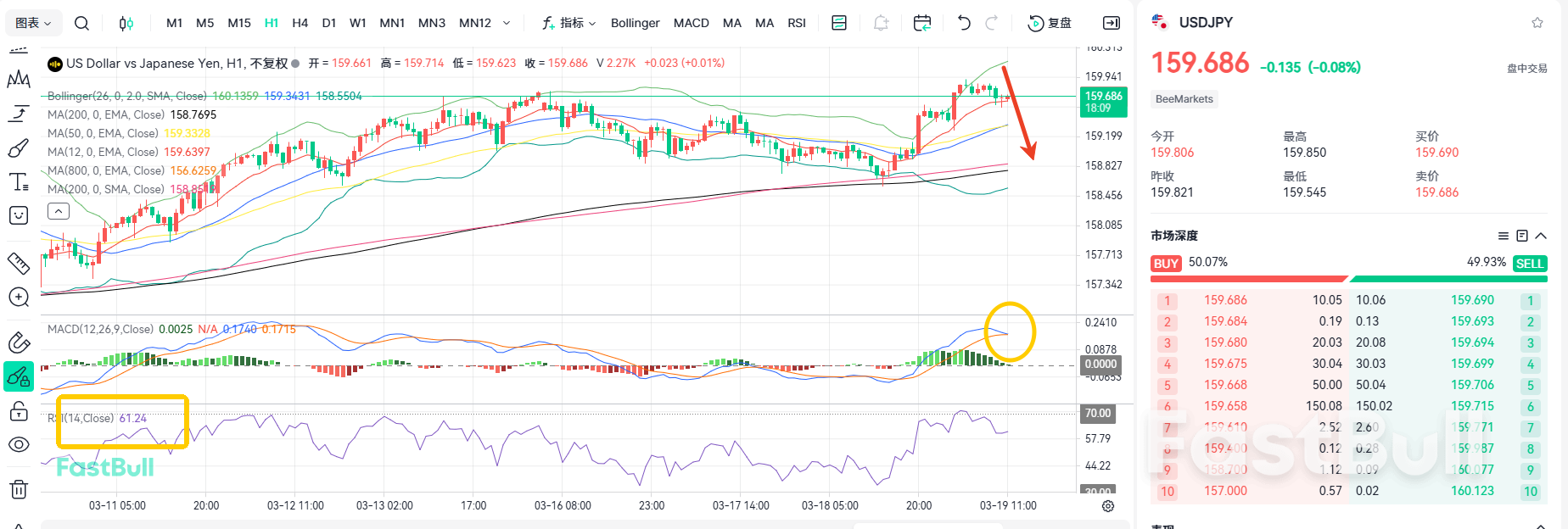
On the 1-hour chart, USDJPY displays upward-expanding Bollinger Bands with diverging MAs. Price is oscillating near the EMA12 and upper Bollinger Band. The MACD is on the verge of a bearish crossover, with the signal and trigger lines having remained above the zero line. Bullish momentum is gradually waning, though no reversal signals have yet materialized, indicating a pullback could occur at any time. The pair is likely to decline toward the middle Bollinger Band (159.3) and EMA200 (158.7). The RSI reads 61, reflecting predominant buying activity among market participants.
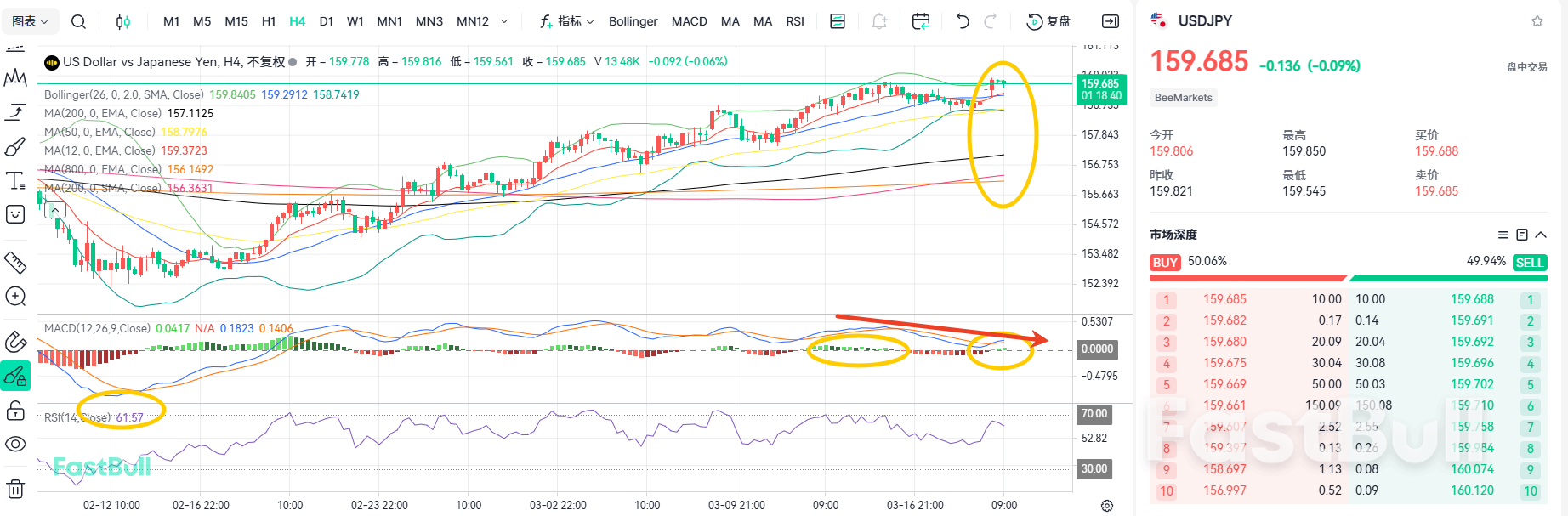
On the 4-hour chart, Bollinger Bands are contracting and narrowing with flattening MAs. Price is oscillating along the EMA12 and upper Bollinger Band. However, despite recording new highs, bullish momentum is diminishing. The bearish divergence signal suggests a potential trend shift is imminent. The RSI stands at 60, with declining highs, reflecting optimistic market sentiment.
At the moment, the trading strategy favors selling initially, then buying.
Trade Recommendations
Trade Direction: Sell
Entry Price: 159.6
Target Price: 157
Stop Loss: 161
Support: 158/157/155
Resistance: 160/161/162