Fundamentals
The marked resurgence in Canadian inflation is closely linked to the shock to energy prices caused by global geopolitical conflicts. Canada’s inflation rate rose to 2.4% in March, up from 1.8% in February, primarily due to disruptions to oil supplies caused by tensions in the Middle East (particularly conflicts involving Iran), which in turn drove up petrol prices. Data shows that petrol prices rose by over 21% month-on-month, marking the largest monthly increase on record, driving overall energy prices from a previous decline to a 3.9% increase. Excluding petrol, the inflation rate stood at 2.2%, indicating that energy remains the key driver of this current inflationary trend. Meanwhile, the continued rise in food prices has exacerbated the cost-of-living pressures on households. In March, retail food prices rose by 4.4% year-on-year, with fresh vegetable prices surging by 7.8% – the sharpest increase in nearly six months. This indicates that, beyond energy, supply chain and agriculture-related costs are also contributing to inflationary pressures. Against this backdrop, the Bank of Canada faces increasingly complex policy trade-offs. On the one hand, the Bank had previously judged the short-term oil price shock to be temporary and kept interest rates unchanged at 2.25% in March; on the other hand, the latest survey shows that the conflict in the Middle East has significantly raised inflation expectations among businesses and consumers. Businesses’ inflation expectations for the coming year rose from 3% in February to 3.8%, with two-year and five-year expectations also revised upwards. Over 80% of households expect the conflict to have a negative impact on the economy and to push up prices.
The monetary policy landscape in the United States also faces complex challenges. Kevin Warsh, the nominee for Chair of the Federal Reserve, is due to appear before the Senate for confirmation hearings, and his policy stance has become the focus of market attention. Against a backdrop of inflation remaining above target, rising oil prices due to the situation in the Middle East, and political pressure for interest rate cuts, the issue of the Federal Reserve’s independence has once again come to the fore. Calls from the government for substantial interest rate cuts, and even discussions regarding adjustments to the central bank’s institutional framework, have sparked market concerns over policy independence. Warsh’s stance has shifted in recent years, moving from that of a traditional inflation hawk towards the view that technological progress may support lower interest rates. He has long advocated for rules-based monetary policy, but has not yet made clear whether he supports specific rule-based instruments. At the hearing, he will not only need to address his views on the interest rate path and balance sheet policy, but also clarify whether he will resist political pressure and uphold central bank independence in order to build market confidence. Furthermore, his past record has become a point of contention. Some lawmakers have questioned his failure to adequately identify risks during the 2008 financial crisis and his involvement in pushing for bailout measures for financial institutions. Divisions within the Republican Party have also cast uncertainty over his nomination process.
Technical Analysis
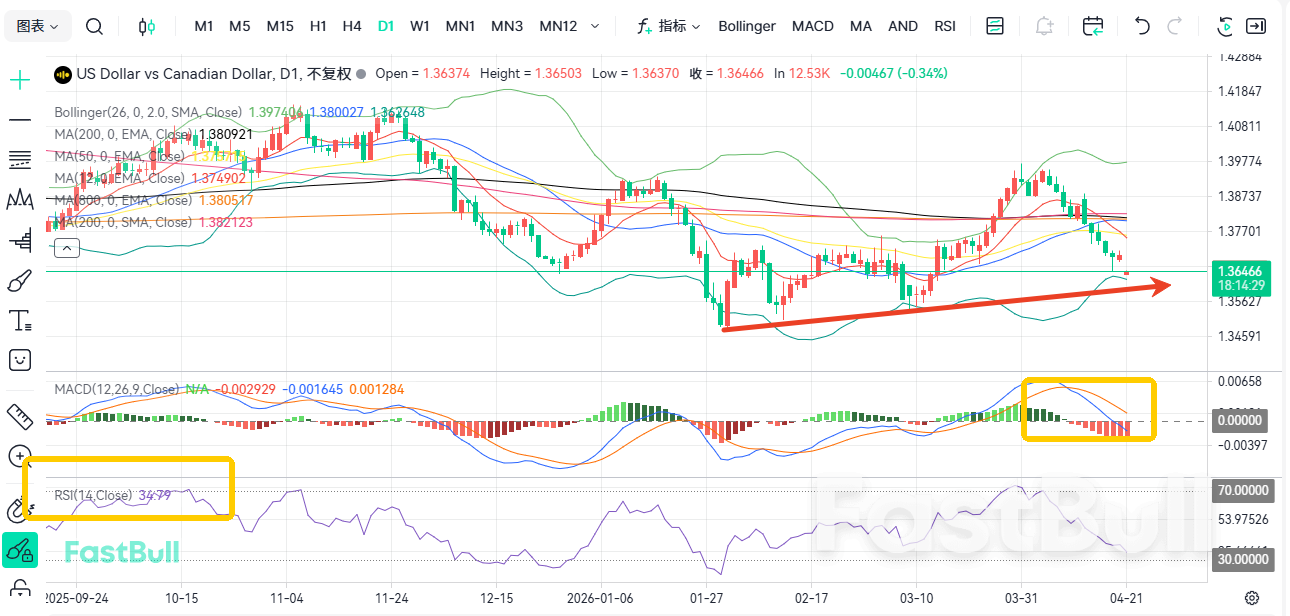
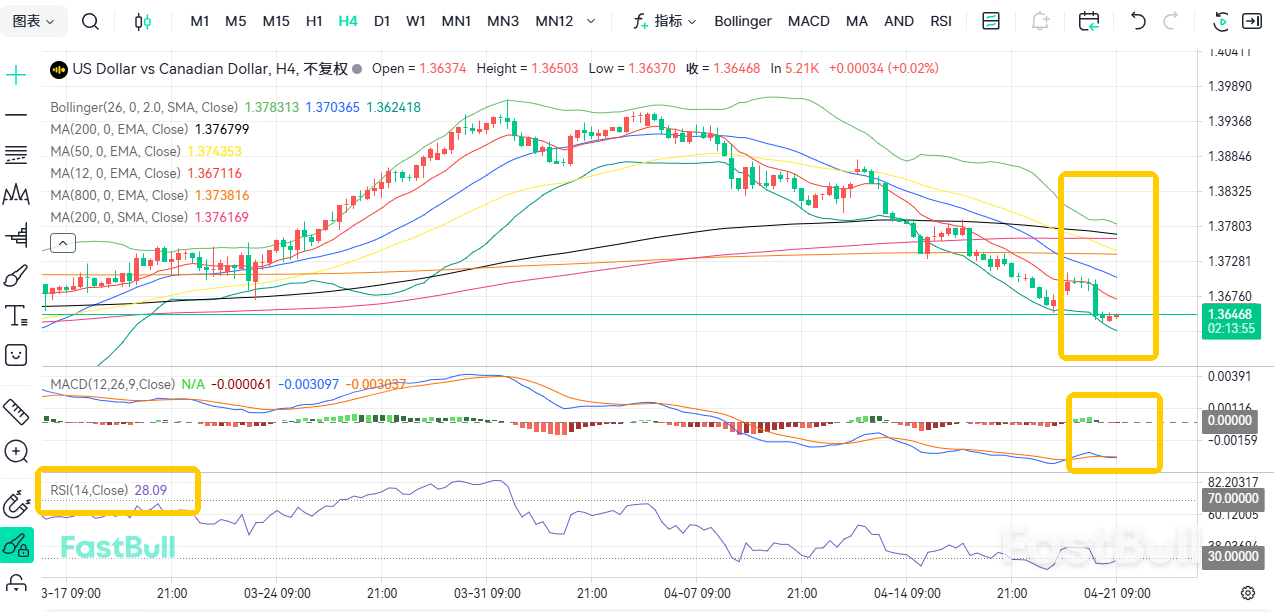
Looking at the USD/CAD on the four-hour chart, the Bollinger Bands are widening downwards and the moving averages are diverging downwards. The price is fluctuating lower around the 12-period EMA and the lower Bollinger Band, and the short-term downtrend has not yet been confirmed to have reversed. However, the MACD fast and slow lines have formed a golden cross, indicating that downward momentum is weakening and a rebound could occur at any time. Resistance lies near the middle Bollinger Band and the 50-period EMA, at 1.37 and 1.38 respectively. The RSI stands at 28, indicating that market sentiment is predominantly bearish. On the daily chart, the Bollinger Bands are narrowing and the moving averages are flattening out. The price has reached the support level of the trend line in the short term, making a rebound highly likely. The RSI stands at 35, suggesting that the market is dominated by pessimism. The recommended strategy is to buy on dips.
Trading Recommendation
Trading Direction: Buy
Entry Price: 1.364
Target Price: 1.41
Stop-loss: 1.35
Support Levels: 1.35, 1.325, 1.28
Resistance Levels: 1.4, 1.41, 1.42