Recent labor market data from the U.S. Department of Labor highlighted a nuanced shift in domestic employment dynamics. For the week ending February 7, initial jobless claims rose to 227,000, and while this figure represents a decrease from the prior week's 232,000, it notably exceeded the market consensus of 222,000. Despite this marginal uptick, the four-week moving average remains relatively stable at approximately 219,500. Although this average reflected a 7,000-claim increase relative to the previous reading, the broader labor market continues to display characteristics of structural stabilization.
This data follows the highly anticipated release of the Nonfarm Payrolls (NFP) report on Wednesday. Initially, the headline figures projected a robust image of the U.S. economy, with 130,000 new jobs created—nearly doubling the expected 70,000 and significantly overshadowing December’s revised figure of 48,000. However, the Bureau of Labor Statistics (BLS) annual benchmark revisions provided a more sobering perspective; total nonfarm employment for 2025 was adjusted downward by a staggering 898,000 positions. This massive revision effectively slashed the monthly job creation average for last year from 49,000 to a mere 15,000. Despite these structural headwinds, the unemployment rate edged lower to 4.3%, and average hourly earnings advanced by 0.4% month-over-month, suggesting that wage pressures remain a persistent concern for the Federal Reserve.
Against this complex backdrop, Federal Reserve rhetoric remains characteristically balanced. Kansas City Fed President Jeffrey Schmid recently advocated for a continued restrictive policy stance, noting that inflation remains near 3% and that aggregate demand continues to outpace supply growth. In contrast, Dallas Fed President Lorie Logan adopted a more moderate tone, emphasizing that the labor market is stabilizing and that the balance of risks to the downside has largely diminished.
Concurrently, investors are maintaining a vigilant watch on Swiss inflation data for January, scheduled for release this Friday. Analysts currently project that annual inflation will remain muted at approximately 0.1%. In a recent address, Swiss National Bank (SNB) President Martin Schlegel highlighted the structural challenges posed by persistently low inflation and a 0% policy rate, reaffirming the central bank’s steadfast commitment to price stability within its 0–2% target range. Schlegel further emphasized that the SNB is monitoring the Swiss Franc’s (CHF) volatility with precision, indicating a clear preference for intervening directly in the foreign exchange markets if necessary, rather than prematurely resorting to further interest rate cuts. This cautious stance is supported by the expectation of a gradual inflationary pickup in the coming months, even as the SECO Consumer Climate Index showed a moderate improvement to -30.
Technical Analysis
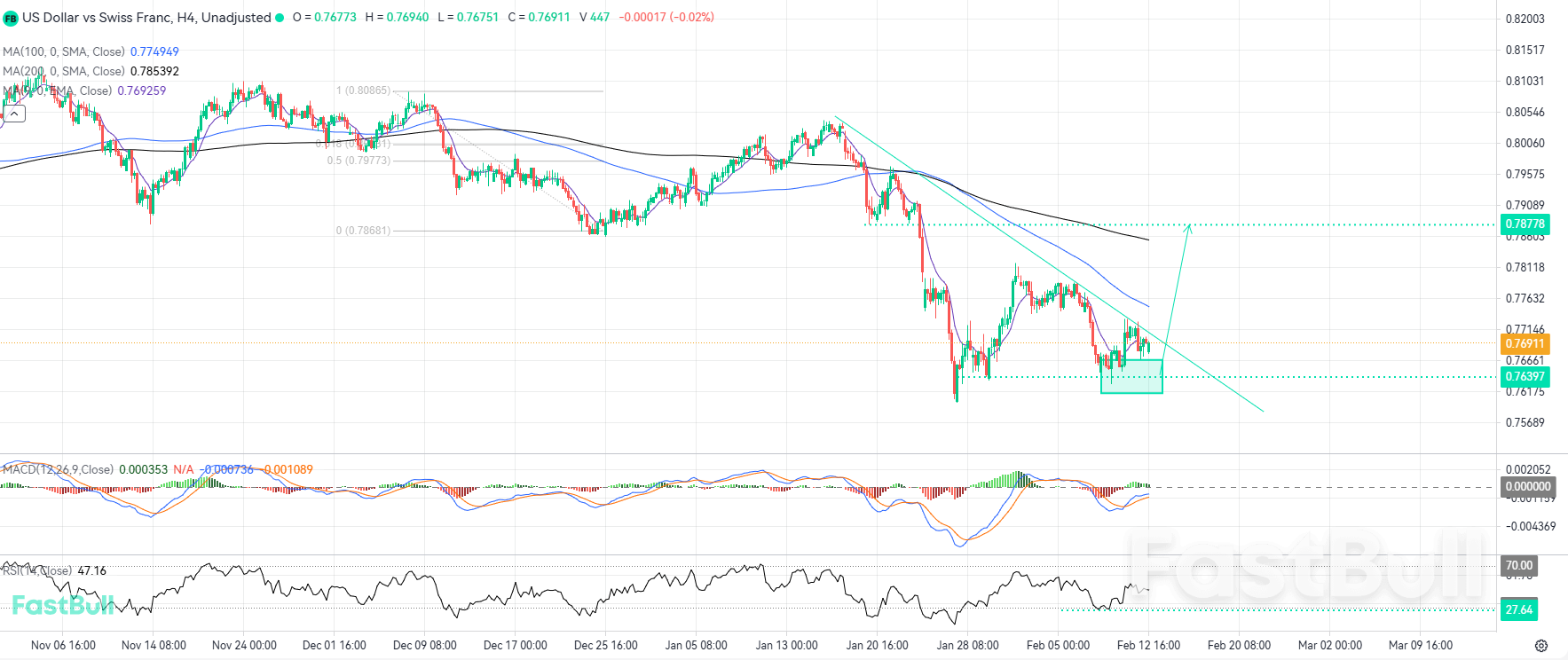
USDCHF appears to have initiated a nascent bullish move. However, the descending trendline originating from the 0.8035 peak on January 16 remains the primary obstacle for the bulls.
A decisive breakout above this trendline could catalyze an acceleration of the current impulse toward the 0.7877 handle, which stands as the next significant structural resistance. At present, the price is oscillating just above a critical support floor at 0.7639. It is entirely possible that the pair may retest this demand zone to accumulate the necessary liquidity before attempting a trendline breach.
Furthermore, the 100 and 200-period Moving Averages are currently situated at 0.7749 and 0.7853, respectively. These levels will likely function as formidable dynamic resistance during any potential bullish extension.
Our momentum analysis reinforces the possibility of a reversal. The MACD is currently printing bullish histogram bars, even as the signal lines remain marginally below the neutral threshold. Simultaneously, the RSI recently rebounded from the 27 level, having exited deeply oversold territory. This suggests that the preceding bearish momentum is rapidly exhausting. Provided the 0.7639 support remains intact, the technical bias shifts in favor of buy-side positions as the pair prepares to challenge its descending structure.
Trading Recommendations
Trading direction: Buy
Entry price: 0.7640
Target price: 0.7877
Stop loss: 0.7560
Validity: Feb 24, 2026 15:00:00


