The Pentagon recently confirmed the deployment of approximately 2,000 troops to the Middle East, a strategic move aimed at reinforcing the U.S. military presence as regional tensions escalate. Throughout the week, various diplomatic channels and high-stakes negotiations were initiated, yet they appear to have yielded little to no tangible progress. Simultaneously, the Strait of Hormuz remains effectively closed, a development that continues to severely disrupt global energy supplies and exacerbate market anxiety.
In an effort to stabilize the situation, President Trump announced a ten-day extension of the current pause, pushing the deadline to April 6. However, his rhetoric appears to have fallen on deaf ears within the international community. By the week’s close, West Texas Intermediate (WTI) crude oil is trading above the $100 handle, while the U.S. Dollar continues to gain strength as a safe-haven asset amidst renewed concerns over a protracted conflict.
On the domestic front, the United States continues to demonstrate remarkable labor market resilience. The Department of Labor reported that initial jobless claims for the week ending March 21 settled at 210,000, aligning with analyst consensus and following a previous print of 205,000. However, this employment stability is sharply contrasted by persistent inflationary headwinds. Import prices surged by 1.3% in February—the most aggressive spike since March 2022—primarily driven by escalating energy costs prior to the regional conflict. Compounding these concerns, S&P Global recently noted that U.S. enterprises are grappling with elevated input costs throughout March, exacerbated by volatile energy expenditures and localized supply chain bottlenecks.
Across the Atlantic, the European Central Bank (ECB) elected to maintain its interest rates, leaving the deposit facility rate at 2.00%. Nevertheless, the messaging accompanying the decision reflected a posture of significant caution rather than calm. The geopolitical climate in the Middle East has visibly altered the balance of risks, introducing fresh inflationary pressures while simultaneously clouding the region's growth prospects—a stagflationary duality that dominated the Governing Council's deliberations.
In this volatile environment, inflationary forecasts were adjusted upward—particularly for the 2026 horizon—while growth expectations continue to exhibit structural weakness. Given this uncertainty, the institution has placed greater emphasis on scenario analysis, highlighting downside risks to economic activity and upside risks to inflation, especially if further disruptions to energy supplies materialize.
Reinforcing this prudent tone, Yannis Stournaras warned earlier in the week that a prolongation of the conflict could significantly deviate the ECB from its baseline scenario. He emphasized that any evidence of second-round effects or a de-anchoring of inflationary expectations would compel the bank to act decisively. Despite this cautious official stance, markets are already pricing in further tightening, with approximately 70 basis points of hikes incorporated for the year-end and a significant probability of an adjustment as early as late April.
Technical Analysis
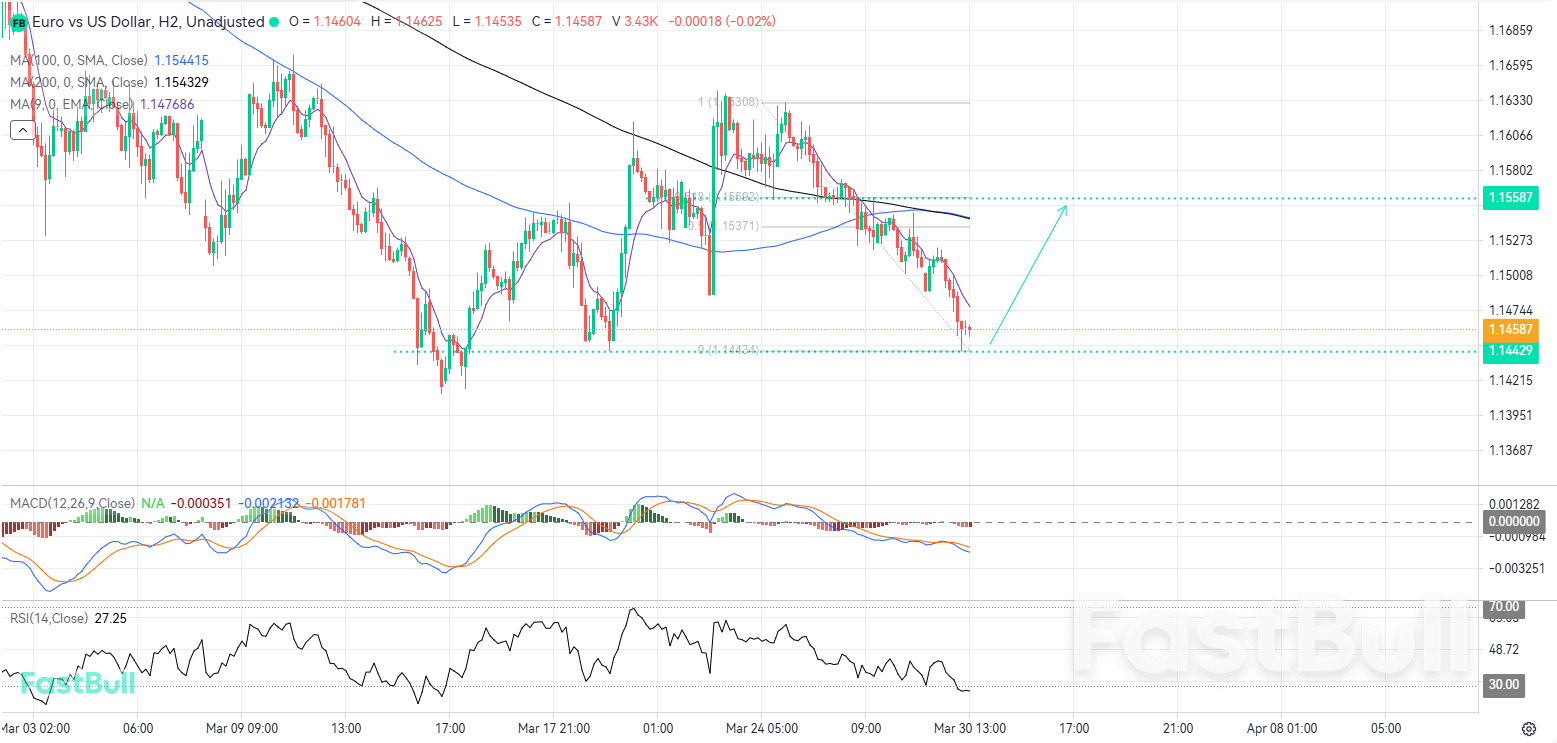
From a technical perspective, EUR/USD has undergone a powerful bearish impulse, descending from the 1.1632 peak on March 24 to a session low of 1.1442. As the pair reaches this critical support level, it is worth noting that price action has historically exhibited bullish rejections from these depths. Should this floor remain unbreached, we could witness the inception of a corrective upward move targeting the 1.1558 handle, which aligns with the 0.618 Fibonacci retracement level.
Furthermore, on the 2-hour (H2) chart, the 100 and 200-period Moving Averages (MAs) are currently situated at 1.1544 and 1.1543, respectively. The extreme proximity of these averages—coupled with their location near the primary Fibonacci target—creates a high-confluence zone that adds significant structural weight to a potential mean-reversion move toward this area.
Our analysis of momentum oscillators reinforces the case for a bullish pivot. The RSI recently struck the 26 level, moving deeply into oversold territory and signaling that the recent sell-off may be nearing exhaustion.
While the MACD still exhibits a bearish histogram, the bars show diminishing depth, suggesting that the downward momentum is overextended. A bullish crossover of the signal lines would provide the final technical validation required to confirm a resurgent bullish impulse from this support zone.
Trading Recommendations
Trading direction: Buy
Entry price: 1.1458
Target price: 1.1558
Stop loss: 1.1390
Validity: Apr 10, 2026 15:00:00


