In Australia, Reserve Bank of Australia (RBA) Governor Michele Bullock stated on Monday that inflation risks remain tilted to the upside, adding that oil prices could remain elevated for longer than previously expected. Her comments reinforce concerns about persistent inflationary pressures and the potential implications for the central bank's monetary policy decisions, particularly if higher energy costs continue to affect the broader economy.
Australia's October employment data will be released at 00:30 GMT on Thursday, with market expectations pointing to an increase of 25.2K jobs following the previous decline of 39.3K. Meanwhile, the unemployment rate is expected to return to 4.7%. These figures will be particularly relevant for assessing the resilience of the Australian labor market and determining whether employment conditions could influence the RBA's monetary policy outlook in the coming months.
China's retail sales increased by 0.4% year-on-year in October, falling short of the 0.8% expected by the market, while industrial production expanded by 4.8%, compared with forecasts of 5.3%. Meanwhile, fixed asset investment declined by 8.1% between January and October. Australia exports significant volumes of iron ore and coal to China, meaning that weaker-than-expected economic activity could reduce expectations for Chinese demand for Australian commodities. This could consequently weigh on the Australian dollar, given the importance of Chinese demand for Australia's export sector.
Canadian inflation maintained its upward momentum in October, with the headline Consumer Price Index (CPI) increasing by 3.1% year-on-year. The figure came slightly below market expectations of 3.2%, while matching the increase recorded in September. On a monthly basis, consumer prices advanced by 0.2%, indicating that inflationary pressures remain present despite the slight deviation from market forecasts.
Meanwhile, the Bank of Canada's (BoC) core inflation measure, which excludes more volatile components such as food and energy, increased by 2.0% over the past year and advanced by 0.4% compared with the previous month. The monthly increase suggests that underlying price pressures remain relevant, even as the annual measure continues to show a more moderate pace of inflation.
Bank of Canada (BoC) Governor Tiff Macklem appeared before the House of Commons, where he stated that further interest rate increases could become necessary depending on how economic conditions develop. His comments suggest that the central bank remains concerned about inflationary pressures and is not ruling out additional monetary tightening if price stability requires it. This leaves the possibility of further adjustments to monetary policy open, depending on how inflation evolves over the coming months.
Technical Analysis
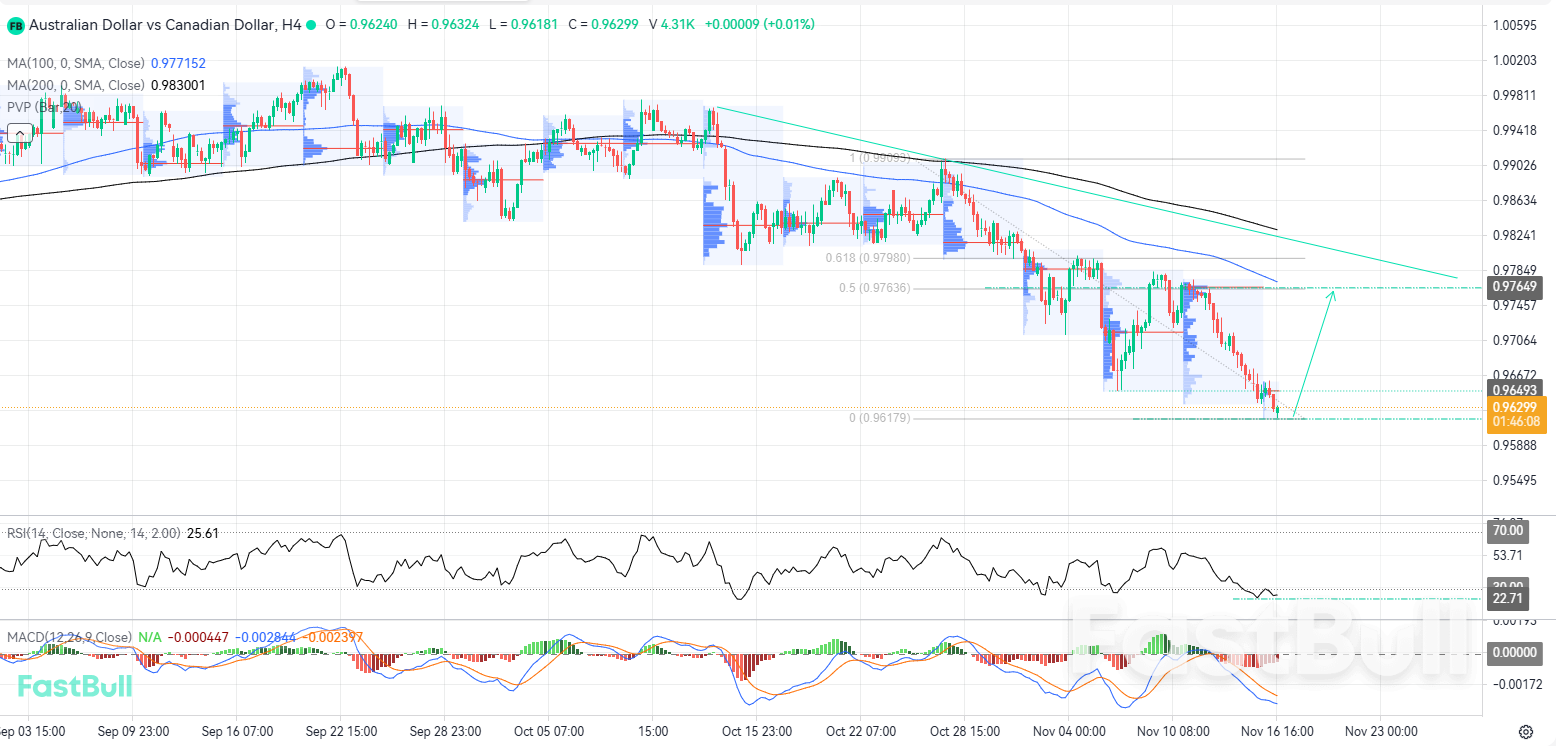
AUD/CAD recently reached a local low of 0.9617, a level not seen since April, experiencing an upward move from this area. If this local low manages to establish itself as support and continues to be defended by buyers, the pair could begin a bullish recovery toward 0.9764, which corresponds to the 0.50 Fibonacci retracement level. This area also coincides with an important volume zone, suggesting the presence of relevant market interest around these price levels.
Additionally, the 100-period and 200-period moving averages are located relatively close to this area, at 0.9771 and 0.9830, respectively. Both moving averages are following the descending trendline closely, creating a potential confluence of resistance levels that could attract price action like a magnet if the pair develops an upward movement. Therefore, this region could become a relevant target for a potential bullish retracement, particularly if the current support level remains intact.
Regarding the oscillators, the RSI recently declined to 22, clearly entering oversold territory. Such extreme readings could indicate that selling pressure is becoming increasingly stretched, potentially causing bearish momentum to weaken and allowing buyers to regain some control over the movement. Meanwhile, the MACD displays a bearish histogram that is gradually losing depth, although both signal lines remain firmly positioned within negative territory. This suggests that despite the early signs of weakening selling momentum, the broader bearish structure remains in place. Consequently, any upward movement should currently be considered a corrective retracement rather than a confirmed trend reversal.
Trading Recommendations
Trading direction: Buy
Entry price: 0.9630
Target price: 0.9764
Stop loss: 0.9575
Validity: Nov 27, 2026 15:00:00


