Fundamentals
The money market has already priced in the ECB's expectation of a 25 basis point rate cut in February 2026, and the euro remains below 10%. Signals indicating the imminent end of the ECB's easing cycle may help curb further euro depreciation. Currently, the euro's exchange rate is influenced by two primary factors: on one side, recent statements from ECB policymakers have provided short-term market reassurance. Executive Board member Isabel Schnabel recently clarified in an interview that, although she anticipates the next policy move will involve an interest rate hike, this is unlikely to occur "in the foreseeable future." Her comments continue the ECB's recent tone of policy patience, easing concerns about premature tightening and offering some support to the euro. On the other side, policy uncertainty emanating from the U.S. exerts an opposing pressure. Recently, President Trump's tariff remarks have heightened market safe-haven flows, bolstering the dollar's status as a safe-haven asset and indirectly restraining the euro's upward potential. Additionally, unresolved geopolitical risks, such as the Russia-Ukraine situation, remain potential external threats to the Eurozone. France's fiscal dynamics warrant particular attention. Reports suggest that France's 2025 budget may be deferred for review until next year. This technical postponement could temporarily ease pressure on French government bonds and somewhat alleviate broader pressures within the European fixed income markets. However, in the long term, it does not address the fundamental divergence between fiscal discipline and economic growth within the Eurozone. Data shows that Germany's import prices increased by 0.5% month-on-month, exceeding the forecasted 0.1%, with a smaller-than-expected annual decline, implying that imported inflationary pressures may not be easing as quickly as anticipated, adding complexity to the ECB's policy outlook.
On December 23, preliminary data released by the U.S. Bureau of Economic Analysis (BEA) indicated that the real GDP growth rate for the third quarter expanded at an annualized quarterly rate of 4.3%, exceeding the forecast of 3.3% and the previous quarter's 3.8%. The core Personal Consumption Expenditures (PCE) Price Index advanced at an annualized quarterly rate of 2.9%, matching expectations and up from 2.6%. These figures reflect a robust expansion driven by strong consumer and corporate spending, coupled with a more stable trade environment, marking the fastest growth pace in two years. This delayed economic report highlights the economy's resilience amid the reversal of tariffs implemented during the Trump administration. Due to a record-long government shutdown, the BEA canceled the initial GDP estimate scheduled for release at the end of October. Typically, the agency releases three quarterly growth estimates, with minor adjustments as data is finalized; however, this quarter will see only two updates due to the shutdown. While economists anticipate that the government shutdown may exert downward pressure on fourth-quarter growth, market sentiment remains cautiously optimistic about the outlook through 2026. Analysts project that with household receipts of tax refunds and a potential Supreme Court ruling anticipated to overturn President Trump's extensive global tariff policies, the economy is expected to experience a moderate rebound next year. Robust economic data aligns with the Federal Reserve's latest outlook. Fed Chair Jerome Powell emphasized that accommodative fiscal policies, expenditures on artificial intelligence data centers, and sustained household consumption are the primary drivers for the central bank's forecast of accelerated economic growth in the coming year. However, some officials remain hesitant to pursue further significant reductions in borrowing costs, citing persistent inflation above the Fed's 2% target. The report indicates that the favored inflation indicator, the core Personal Consumption Expenditures (PCE) Price Index—excluding food and energy—rose by 2.9% in the third quarter. Due to the government shutdown, the Bureau of Economic Analysis has yet to reschedule the release dates for October and November PCE data. Based on current inflation and growth trends, policymakers now expect only one cut in interest rates in 2026 after three consecutive rate reductions earlier this year.
Technical Analysis
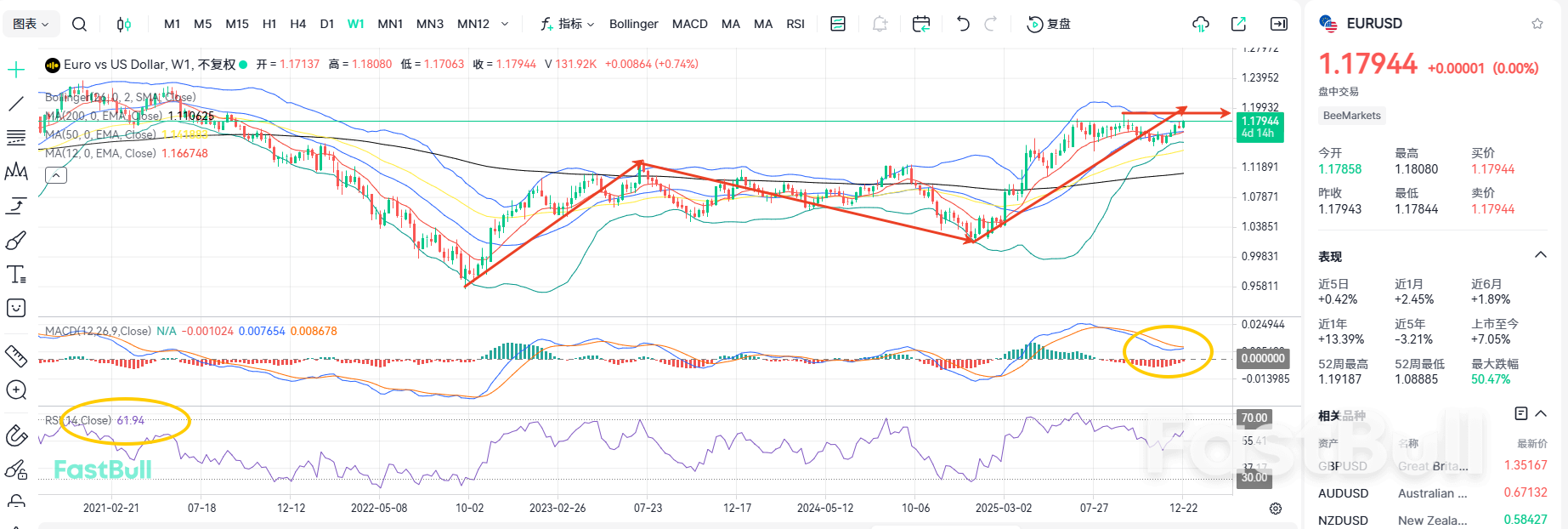
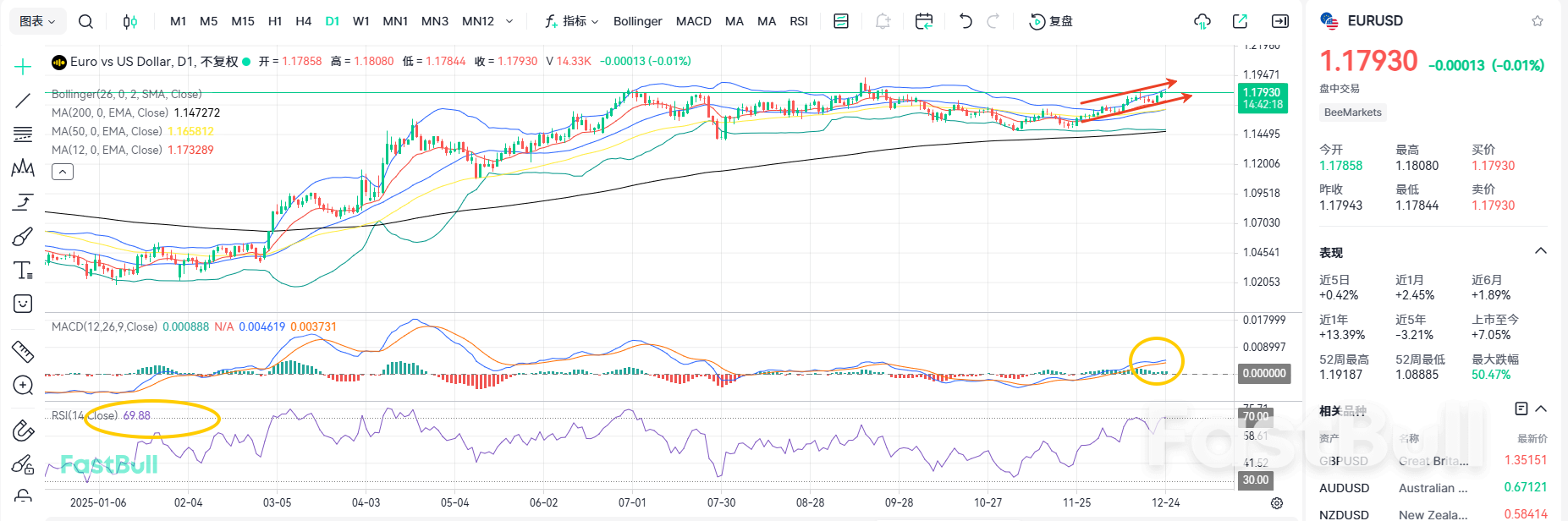
In the 1D timeframe, Bollinger Bands for EURUSD are expanding upward with the bands opening higher, and the SMAs are diverging upward. After the MACD generates a golden cross signal, the price has surged strongly along the upper Bollinger Band, indicating an ongoing bullish trend. However, in the short term, approaching the 1.18 psychological level has increased selling pressure, suggesting a potential pullback to the EMA12 support at around 1.173 before another upward move. The RSI is currently at 69, reflecting strong bullish market sentiment. Resistance levels are identified near the psychological 1.18 mark and previous highs at approximately 1.192. In the 1W timeframe, the Bollinger Bands are narrowing, with the EMA12 flattening and the MACD's MACD line and signal line reverting toward zero-axis, signaling a potential trend reversal. The MACD is approaching a golden cross; if confirmed, the price is likely to break through 1.20. The RSI stands at 61, indicating an optimistic market outlook. As long as the price remains above the EMA12 in the short term, the bullish trend is expected to persist. It is recommended to go long at the lows in the short term.
Trading Recommendations
Trading Direction: Buy
Entry Price: 1.174
Target Price: 1.2
Stop Loss: 1.15
Support: 1.166, 1.16, 1.15
Resistance: 1.18, 1.192, 1.2


