The Euro struggled to find direction against the US Dollar on Friday, leaving EUR/USD around the mid-1.1200s and dangerously close to Thursday’s 16-month low of 1.1210. Hotter Eurozone inflation has strengthened the argument for additional European Central Bank tightening, but that support is being overwhelmed by fiscal concerns in France, elevated energy costs and persistent demand for the US Dollar.
Preliminary Eurozone inflation data showed headline HICP accelerating to 3.8% YoY in September, sharply above August’s 3.2% reading and exceeding the 3.6% expected by markets. Core inflation increased more modestly to 2.5% from 2.4%, matching forecasts. The divergence suggests food and energy costs were major contributors to the latest inflation surge.
The numbers place additional pressure on the ECB to maintain a restrictive policy stance. However, higher rates are proving insufficient to attract meaningful demand for the Euro as investors remain concerned about the broader economic consequences of elevated borrowing and energy costs.
Oil has offered some temporary relief, with Brent slipping back below $100 per barrel on reports of stronger Gulf supply during September. Nevertheless, crude remains more than 30% higher over the past three months, leaving the Eurozone vulnerable to another inflationary shock.
France has emerged as another major obstacle for the single currency. Growing anxiety surrounding the country's debt burden has pushed the spread between French and German government bond yields above 140 basis points, its widest level in 14 years.
French 10-year borrowing costs climbed by more than 70 basis points during September, reaching their highest level since 2002. The deterioration is reviving concerns about fiscal fragmentation within the Eurozone and discouraging investors from taking advantage of the Euro's recent decline.
Across the Atlantic, the Dollar continues to benefit from the global bond selloff, with long-term US Treasury yields reaching 24-year highs. That combination of elevated yields and defensive demand has kept the Greenback firmly supported.
Attention now turns to US Nonfarm Payrolls, where economists expect 90,000 new jobs in September and unemployment to remain at 4.1%. A stronger labour report could reinforce expectations for additional Federal Reserve tightening and place fresh pressure on EUR/USD.
EUR/USD remains fundamentally vulnerable despite hotter Eurozone inflation. The ECB may face increasing pressure to tighten further, but France's fiscal problems and elevated energy costs are creating significant headwinds for the Euro. Unless US employment data substantially weaken the Dollar, the 1.1210 area remains exposed to another test, with a break potentially opening the door to fresh lows.
Technical Analysis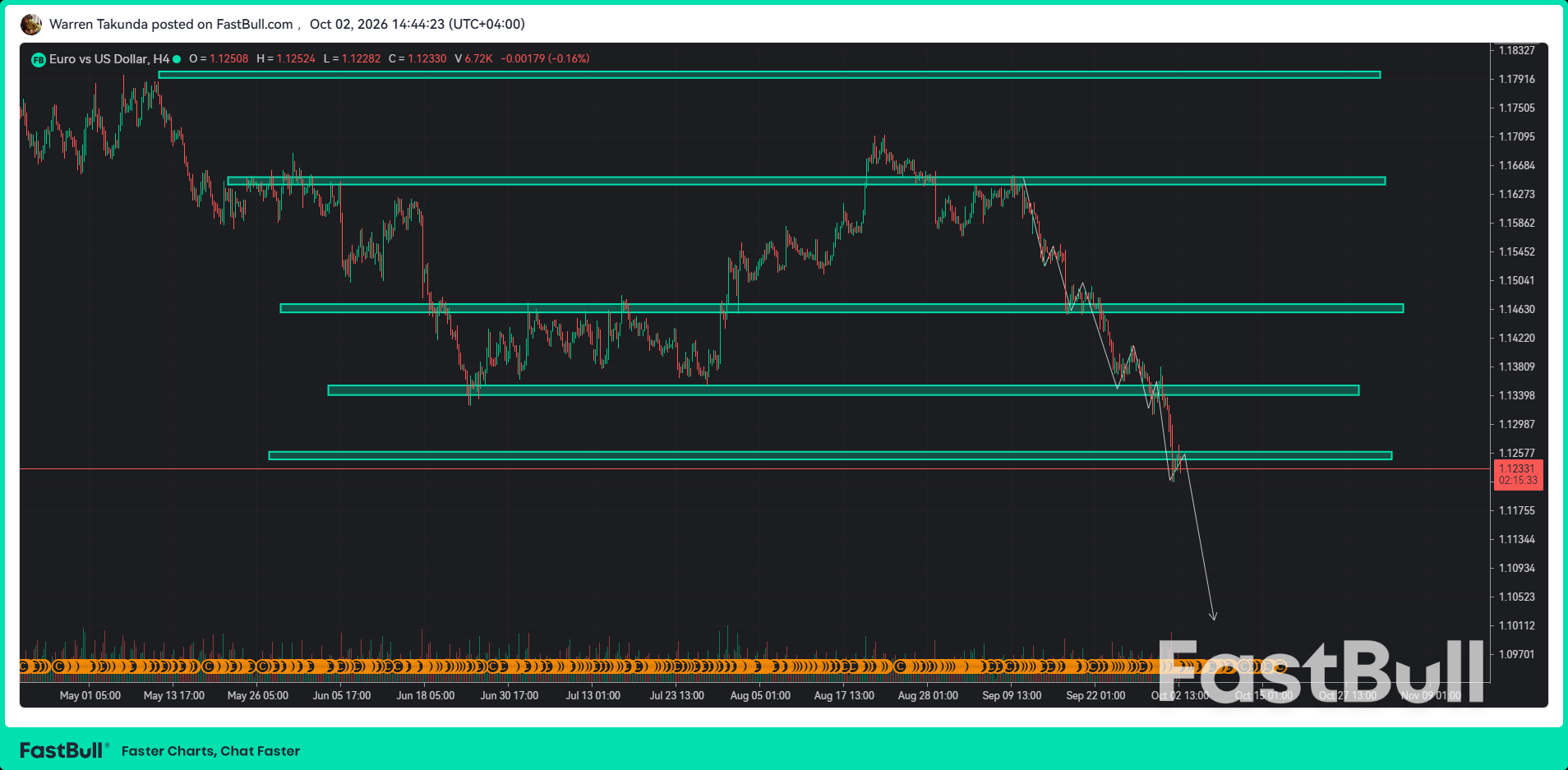
EUR/USD remains firmly controlled by sellers on the 4-hour chart, with the latest decline extending an established sequence of lower highs and lower lows. Price has broken through several previously important support zones during the slide from the September highs, confirming that bearish momentum remains dominant.
The pair is currently trading around 1.1233, directly beneath the 1.1240–1.1260 zone. This area previously acted as support but has now been breached, making the current rebound particularly important. The modest recovery following the sharp selloff looks corrective rather than a convincing reversal, and a rejection around this former support area could provide the next bearish continuation signal.
If sellers maintain control below 1.1260, attention shifts back toward the recent low around 1.1210. A decisive break beneath this level would confirm another leg lower and leave relatively limited visible support on the chart. The next downside objectives sit around 1.1150–1.1100, followed by the broader projected target near 1.1020–1.1000.
The bearish argument is also reinforced by the way previous support levels have repeatedly transformed into resistance. The 1.1340–1.1350 region is now the first substantial recovery barrier, while 1.1450–1.1470 represents a stronger resistance zone above. EUR/USD would need to recover above these areas and begin forming higher highs before the present bearish structure could be seriously challenged.
For now, the technical setup continues to favour selling corrective rebounds rather than chasing temporary recoveries. As long as EUR/USD remains beneath 1.1260 and, more importantly, 1.1350, the path of least resistance remains lower.
TRADE RECOMMENDATION
SELL EUR/USD
ENTRY PRICE: 1.1230
STOP LOSS: 1.1350
TAKE PROFIT: 1.1020


