The Euro recovered modestly against the US Dollar on Monday, with EUR/USD rising around 0.2% to trade near 1.1185 as European markets opened. Easing oil prices and a softer Greenback helped the pair withstand disappointing German consumption data, although the recovery remains contained within Friday’s trading range.
Germany’s latest retail figures highlighted continued weakness in consumer demand. Sales declined 2.0% in September after increasing 1.2% in August, sharply missing expectations for a 0.4% rise. The annual measure also deteriorated, showing a 2.3% contraction compared with a 0.3% decline previously. The figures reinforce concerns about the strength of domestic spending in Europe’s largest economy and limit the extent to which the Euro can draw support from its regional fundamentals.
However, falling energy prices have offered some relief. Brent crude dropped more than 2%, moving below $110 per barrel as diplomatic efforts led by Qatar continued to create hopes of renewed US-Iran peace negotiations. Lower oil prices are particularly important for the Eurozone, given its exposure to imported energy. A sustained decline could ease some of the pressure on regional inflation and economic activity, providing a more supportive environment for the single currency.
The US Dollar, meanwhile, began the week on the defensive as investors turned their attention to Tuesday’s US midterm elections. Recent polling points to the possibility of Democrats making significant gains in Congress, reflecting voter frustration over the cost of living and higher energy expenses. A shift in congressional control could complicate the administration’s policy agenda, particularly around AI infrastructure investment and negotiations over the debt ceiling, which is expected to become a major issue in 2027.
Although the election outcome remains uncertain, political risks are adding another variable to the Dollar’s near-term outlook. Investors will also assess whether a potential change in congressional control could create greater uncertainty around fiscal policy and government funding. This could encourage some caution toward the Greenback, although the election result alone may not be enough to establish a sustained bearish trend.
Economic releases will provide another important source of direction throughout the week. In the United States, the ISM Manufacturing PMI is due on Monday, followed by the Services PMI on Wednesday and the latest Nonfarm Payrolls review on Friday. These releases should help investors assess the resilience of economic activity and the direction of the labour market.
In Europe, attention will turn to the HCOB Manufacturing PMI later on Monday, followed by unemployment figures on Tuesday and Services PMI alongside consumer inflation data on Wednesday. European Central Bank President Christine Lagarde is also scheduled to speak on Thursday, while September retail sales figures will close the regional calendar on Friday.
For EUR/USD, the combination of softer oil prices and election-related uncertainty has provided near-term support, but the weak German retail figures underline the challenges facing the Euro. The pair’s ability to extend its recovery will likely depend on whether upcoming US data reinforces Dollar weakness and whether European activity indicators offer more convincing signs of economic improvement.
Technical Analysis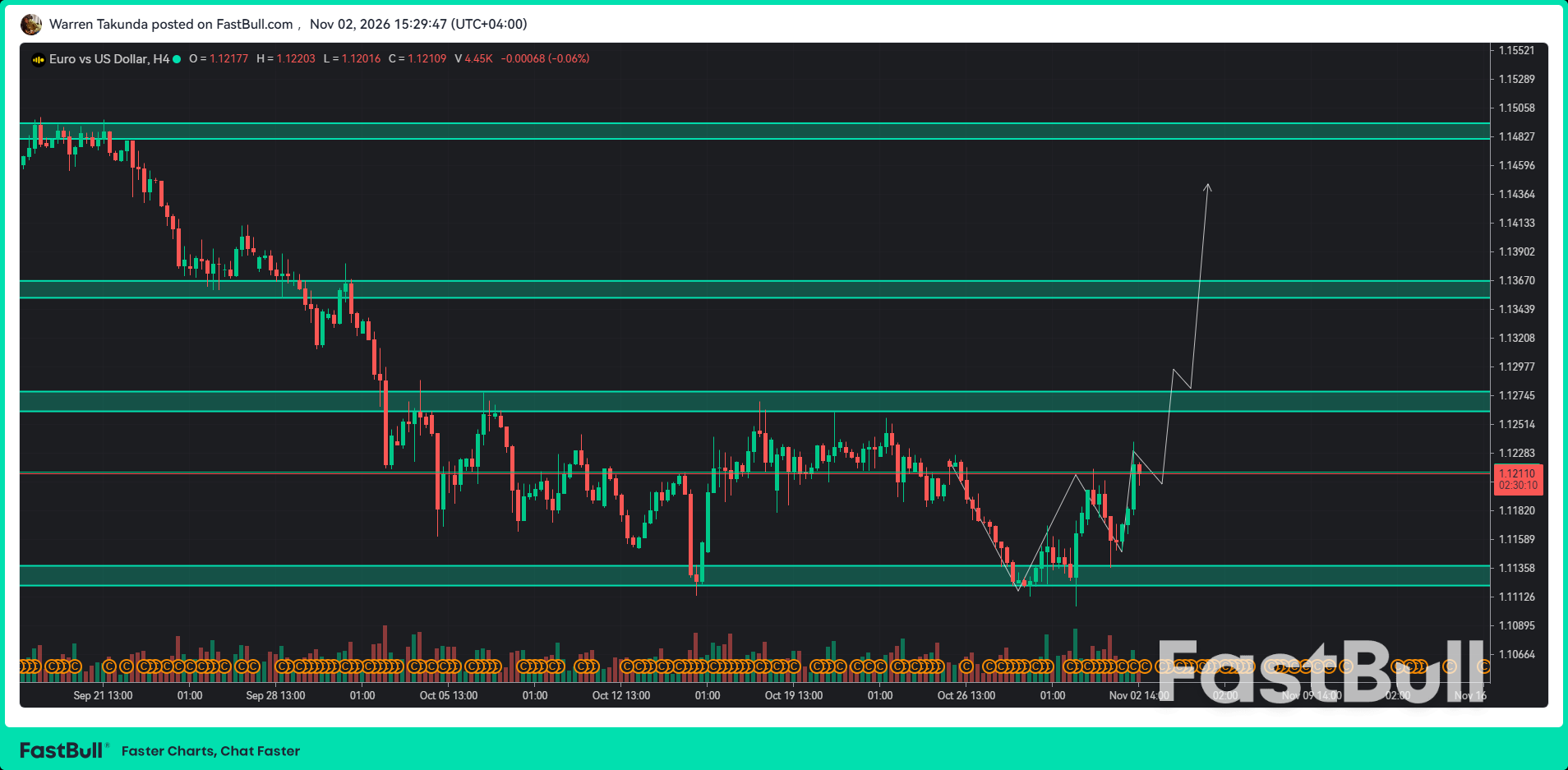
EUR/USD is showing signs of a bullish recovery after an extended bearish move from the 1.1480 region. The pair found strong buying interest around the 1.1125–1.1135 support zone, where sellers struggled to push prices lower. The subsequent rebound has produced a sequence of higher lows, suggesting that buyers are gradually gaining control of the short-term structure. Price is now trading around 1.1210, an important area that previously acted as support and resistance during the consolidation phase.
The immediate focus is whether buyers can establish a sustained break above 1.1210–1.1220. A successful breakout could strengthen the recovery and expose the next resistance region around 1.1260–1.1275. This is a significant supply area, so some hesitation or a temporary pullback would not be surprising. However, a decisive move through this zone would open the way toward 1.1350–1.1365, where the next major resistance sits.
The bullish setup remains dependent on the recent recovery structure holding firm. A pullback toward 1.1200 followed by renewed buying would offer further confirmation that the former resistance area is turning into support. On the downside, the 1.1130 region remains the key demand zone; a break beneath it would weaken the recovery and bring the broader bearish structure back into focus. For now, the technical picture favours a cautiously bullish continuation, provided EUR/USD maintains support above the recent breakout area.
TRADE RECOMMENDATION
BUY EUR/USD
ENTRY PRICE: 1.1210
STOP LOSS: 1.1100
TAKE PROFIT: 1.1275


