The euro extended its decline against the US Dollar on Thursday, with EUR/USD trading around 1.1673 at the time of writing and edging dangerously close to the 1.1660 region, a level that marks its weakest territory in nearly four months. The pair’s inability to find meaningful support highlights a market environment where modest risk aversion continues to favor the Greenback, while positive surprises from the Eurozone economy have so far proven insufficient to reverse bearish sentiment toward the single currency.
From a macro perspective, the US Dollar is benefiting from its traditional safe-haven appeal, even in the absence of clearly hawkish signals from the Federal Reserve. Investors remain cautious ahead of key US labor market data, preferring to maintain Dollar exposure while volatility remains compressed and directional conviction limited. This has kept EUR/USD under steady pressure, despite data that, on paper, should have offered some relief to the Euro.
In the Eurozone, the latest unemployment figures surprised to the downside, signaling a healthier labor market than previously expected. This was reinforced by a series of marginally stronger economic sentiment indicators, which pointed to tentative stabilization across parts of the bloc. Under normal circumstances, such data would help the Euro regain ground. However, the market reaction has been muted, suggesting that traders remain unconvinced about the sustainability of the Eurozone recovery, particularly against the backdrop of sluggish growth momentum and lingering concerns over future monetary policy divergence with the United States.
Across the Atlantic, Wednesday’s batch of US economic releases painted a mixed but ultimately Dollar-supportive picture. Employment-related indicators confirmed that the US labor market is losing momentum, with signs of stagnation rather than outright deterioration. While this could argue for a more cautious Federal Reserve, the impact on the Dollar has been offset by stronger-than-expected activity in the services sector. The upbeat services data hinted at a notable rebound in economic activity toward the end of the fourth quarter of 2025, reinforcing the narrative that the US economy remains more resilient than many of its peers.
Crucially, these mixed signals have done little to clarify the Fed’s near-term policy path. As a result, markets are reluctant to price in aggressive easing, keeping US yields relatively supported and limiting downside pressure on the Dollar. This uncertainty has translated into range-bound trading conditions, but with a clear downside bias for EUR/USD.
Looking ahead, attention on Thursday turns to weekly Jobless Claims and Nonfarm Productivity figures from the US. While these releases could provide short-term direction, their impact is likely to be limited, as investors are expected to remain largely on the sidelines ahead of Friday’s Nonfarm Payrolls (NFP) report. The NFP release is widely seen as the next major catalyst that could reshape expectations around Fed policy and inject fresh volatility into the FX market.
Technical Analysis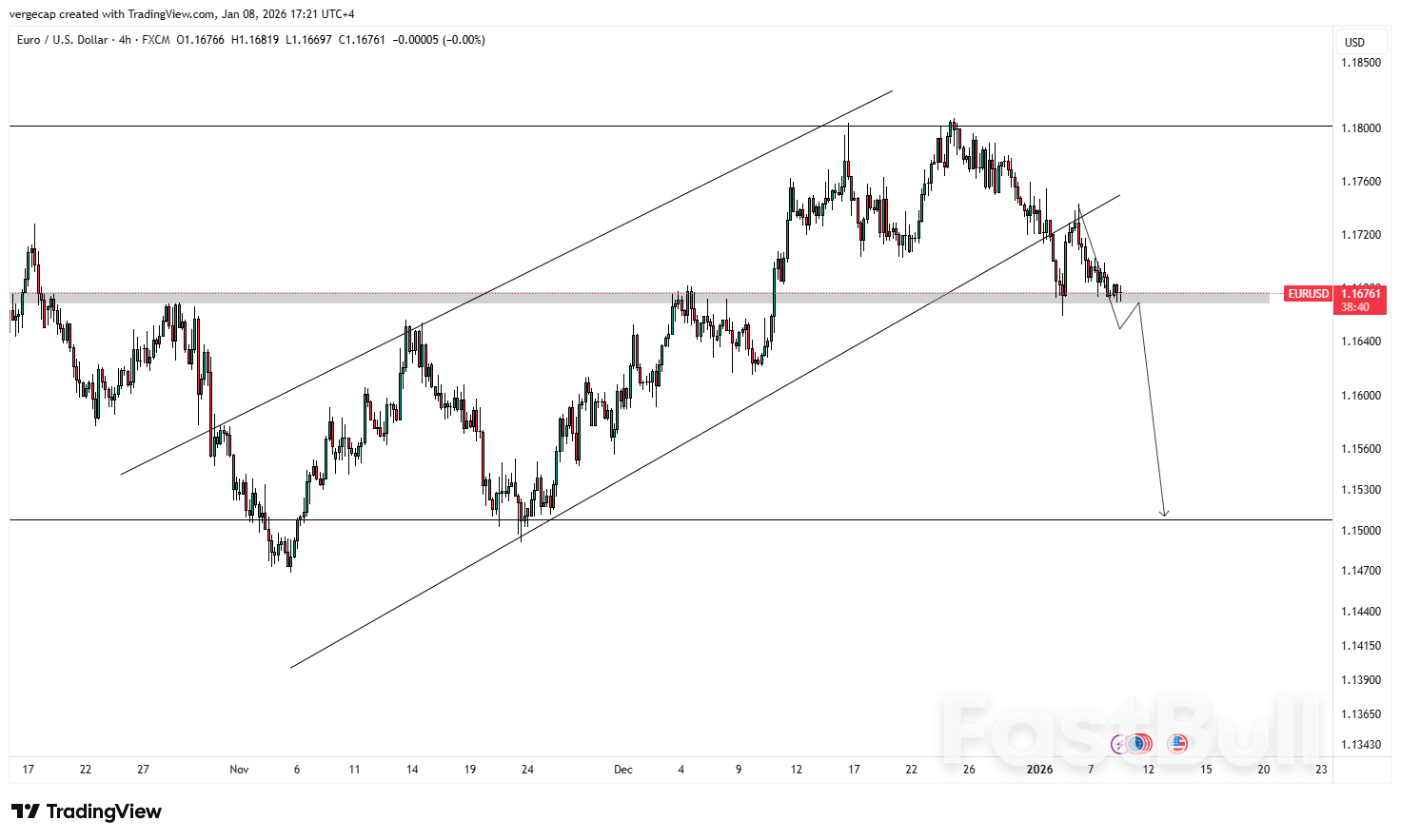
From a technical standpoint, the short-term picture continues to favor the bears. EUR/USD has declined in recent intraday trading, remaining firmly below the 50-period Exponential Moving Average (EMA50). This reinforces the prevailing bearish corrective structure and confirms that downside pressure remains dominant, particularly as the pair continues to respect a descending trendline drawn from December highs.
That said, the downside momentum is not particularly aggressive. Relative strength indicators are beginning to flash early warning signs for bears. The Relative Strength Index (RSI) is holding at oversold levels, suggesting that selling pressure may be losing intensity and that a temporary pause or shallow corrective rebound cannot be ruled out.
On the 4-hour chart, indicators remain mildly negative but lack strong conviction. The MACD histogram is hovering around the zero line, signaling an absence of clear momentum, while the RSI has flattened below the 40 level, consistent with a weak but stabilizing bearish trend.
The broader bearish move from the December high at 1.1808 remains intact. Immediate support at 1.1660 has so far managed to contain further losses. A decisive break below this zone would expose the January 5 low at 1.1659, which, if breached, could open the door toward the December 8–9 lows near 1.1615.
TRADE RECOMMENDATION
SELL EURUSD
ENTRY PRICE: 1.1660
STOP LOSS: 1.1750
TAKE PROFIT: 1.1615


