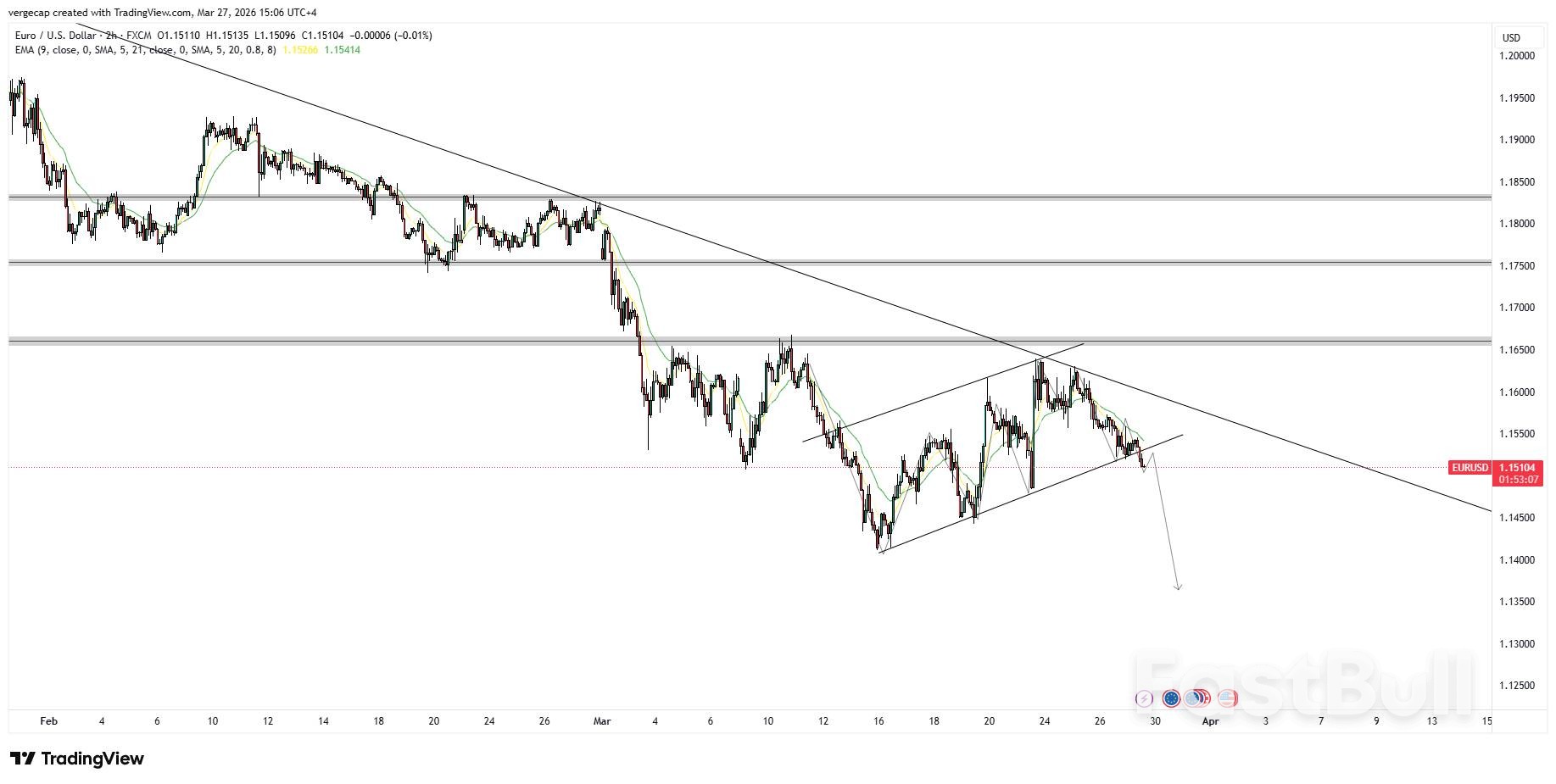
The Euro is bleeding out. Four sessions of consecutive losses against the US Dollar — a streak that began as early optimism about a swift resolution to the Iran conflict gave way to grim geopolitical reality — has pushed EUR/USD to 1.1520 in Friday's European session, a meaningful retreat from the weekly high of 1.1640 registered on Monday. And in my view, the pair is not done falling yet.
Let me walk you through exactly why this matters, because the story behind this move is far bigger than a simple risk-off trade.
When the US and Israel launched joint strikes on Iran on February 28, most market participants assumed the disruption to energy markets would be sharp but short-lived. They were wrong — badly wrong. Global oil prices have surged by more than 25% since the start of the war, driving up fuel prices for consumers worldwide, with the conflict already leading to the suspension of roughly a fifth of global crude and natural gas supply as Tehran targets ships in the vital Strait of Hormuz.
For the United States, that is painful. For Europe — and specifically the Eurozone — it is an existential economic headache. Unlike the US, which has domestic energy production as a buffer, the Eurozone imports a disproportionate share of its energy needs from the Gulf region. The ECB's own March projections flagged that disruptions to shipping through the Strait of Hormuz, together with attacks on energy infrastructure, have led to significant volatility in global energy markets and pushed oil and gas prices sharply higher. The ECB now projects quarterly average oil prices peaking around $90 per barrel in Q2 2026 before gradually declining — but that baseline assumes the conflict does not escalate further. A ground invasion, which markets are now beginning to price in, could blow those assumptions out of the water entirely.
The clearest sign yet that energy inflation is seeping dangerously into the Eurozone's consumer price fabric came Friday morning from Madrid. Spain's consumer prices rose at their fastest rate since 2024, reaching 3.3% year-on-year in March, driven by surging energy costs linked to the ongoing Iran conflict, according to the Spanish national statistics agency. That is a jarring acceleration from the 2.3% reading in February — a full percentage point jump in a single month — and it represents the highest inflation reading in nearly two years for one of the Eurozone's four largest economies.
Higher fuel and energy costs are already feeding into transport and food prices, potentially eroding the real wage gains that have supported domestic consumption in recent quarters. Spain's government has already responded — Prime Minister Pedro Sánchez's cabinet approved a €5 billion emergency package comprising 80 measures aimed at shielding households and businesses from the Iran war's economic effects, including VAT reductions on energy bills and direct support for fuel prices.
That is an emergency fiscal response from one of the bloc's major economies. Let that sink in.
The implications for the ECB are profound and immediate. ECB President Christine Lagarde has warned that while the central bank is assessing the economic impact of the conflict, it stands prepared to adjust policy "at any meeting" if the energy price surge risks fueling broader inflation. Markets now expect two to three ECB rate hikes by year-end — a dramatic pivot from where expectations were positioned just weeks ago, when the dominant narrative was one of a cautious ECB holding rates steady while the Fed gradually cut. The Iran war has flipped that script almost overnight.
Thursday offered a brief glimmer of hope. President Trump announced he was extending the deadline to strike Iran's energy sites into April and characterized negotiations as going "very well." For a few hours, risk appetite returned, the Euro bounced, and crude retreated sharply. WTI dropped below $89 a barrel, while Brent lost more than 10% in European afternoon trading, falling just above $100 from intraday highs near $113.
But the relief was brutally short-lived. Iranian leaders were quick to pour cold water on the optimism, stating they are waiting for Washington to respond to their conditions for a ceasefire — conditions that, by all accounts, remain a long way from being met. And then came the Wall Street Journal report that the Pentagon is considering the deployment of 10,000 additional troops to the Middle East for a potential ground offensive. A sustained blocking of the Strait of Hormuz obstructs not only trade routes but the very ability of producers to export, pushing markets beyond adjustment mechanisms into forced demand destruction and structural reconfiguration. In plain English: if US boots hit the ground in the region, the Strait stays closed — possibly for months — and energy prices stay elevated, or go even higher still.
The Euro slipped below $1.16 as investors simultaneously weighed weaker-than-expected PMI data alongside the ongoing Middle East tensions. The latest business activity survey revealed Eurozone growth at a ten-month low in March, with costs surging at the fastest pace in over three years due to soaring energy prices and supply chain disruptions caused by the war. That combination — slowing growth and rising prices — is the Eurozone's worst-case scenario, a stagflationary trap that gives the ECB no clean policy options. Hike to fight inflation and you crush an already-slowing economy. Hold and you risk letting energy-driven price pressures become entrenched.
In my view, the technical and fundamental picture for EUR/USD is deteriorating. The pair has now lost the 1.1640 weekly high convincingly, and the psychological 1.1500 level is the next critical line in the sand. A clean break below that level opens the door toward 1.1450 and potentially 1.1400, especially if next week's broader Eurozone flash CPI data confirms what Spain's reading is already telling us — that the Iran war is reigniting inflation across the bloc in a very real and sustained way.
The medium-term story for EUR/USD is arguably still constructive. Most major banks continue to forecast EUR/USD between $1.18 and $1.24 by year-end 2026, driven by expectations of further Fed cuts and Germany's ambitious infrastructure and defense spending programs boosting Eurozone growth. But those forecasts were built on assumptions that did not include a protracted Middle East war reshaping global energy markets from the ground up.
Right now, the near-term path is lower. The Euro does not have a credible catalyst to stage a meaningful recovery until either a genuine ceasefire framework emerges — one that markets can actually believe in, not the diplomatic smoke signals we have seen this week — or until energy prices show a sustained and convincing retreat that gives the ECB room to breathe and Eurozone growth data room to recover.
Neither of those things looks imminent on a Friday morning, as bombs continue to fall across the Middle East and the Strait of Hormuz remains effectively closed.
Watch 1.1500. If it breaks, this move has considerably further to run.
EUR/USD remains firmly entrenched in a well-defined bearish structure. On the 2-hour chart, the pair has been carving out a sequence of lower highs since peaking near the 1.1950 region in early February, establishing a clear descending channel that has consistently guided price action lower over the past several weeks. The broader trend is unambiguously bearish, and the most recent price action has done nothing to challenge that narrative — quite the opposite.
The most significant development on the chart is the completion and breakdown of a symmetrical triangle that formed between approximately March 12 and March 27, with price oscillating between a falling upper trendline around the 1.1640–1.1660 area and a rising lower trendline providing temporary support near 1.1480–1.1500. This type of pattern, when formed within a prevailing downtrend, almost always resolves to the downside — and that is precisely what has occurred. The price has broken cleanly below the triangle's lower boundary, a technically significant event that signals the resumption of the dominant bearish trend.
The 9-period EMA and 21-period SMA, both of which are visible on the chart and are sloping decisively downward, have been acting as dynamic resistance on every attempted recovery throughout the decline. Notably, the most recent bounce in mid-March failed to meaningfully breach these moving averages before sellers reasserted control, confirming that short-term momentum remains firmly in the hands of the bears. Price is currently trading below both moving averages, adding further weight to the bearish thesis.
The projected breakdown targets drawn on the chart point to an initial move toward the 1.1400 level, a zone that represents the next meaningful area of prior structure support. Should selling pressure persist and bulls fail to mount a credible defense at that level, the chart projection extends further toward the 1.1350 region — a level that would represent a full retracement of the recovery leg seen in late February and early March. A sustained move below 1.1350 would expose the pair to a deeper corrective decline toward the 1.1300–1.1280 area, a major psychological and structural support zone.
On the upside, any recovery attempt faces a formidable wall of resistance. The broken triangle lower trendline, now flipped to resistance, sits near 1.1520–1.1530 and represents the first hurdle bulls must clear. Above that, the 1.1550 area and then the more significant 1.1600 level — where the triangle's upper boundary converges with the descending channel resistance — would need to be convincingly reclaimed before any meaningful bullish reversal could be entertained. A daily close back above 1.1640 would challenge the current bearish setup, though that scenario appears unlikely given the weight of the current macro and technical backdrop.
Momentum is aligned with the downside. While the chart does not display traditional oscillators such as the RSI or MACD, the price action itself tells the story clearly — every rally is being sold into, higher timeframe momentum is pointing lower, and the pair has failed to post a meaningful higher high in over six weeks. The breakdown from the symmetrical triangle is the final confirmation that the corrective bounce is over and the primary bearish trend has reasserted itself.
TRADE RECOMMENDATION
SELL EUR/USD
ENTRY PRICE: 1.1510
STOP LOSS: 1.1605
TAKE PROFIT: 1.1350