Market Overview
EUR/USD is approaching a technically important area after recovering from recent lows. The latest available market data places the pair near 1.1196, with intraday resistance around 1.1193–1.1205 and additional resistance near 1.1217. The pair's short-term rebound contrasts with its weaker medium-term structure, creating an opportunity for sellers if the recovery loses momentum.
Monetary policy remains central to the outlook. On 29 October, the European Central Bank kept interest rates unchanged. Its assessment highlighted tighter financing conditions and risks to economic growth, even as elevated energy costs continued to threaten inflation. Markets interpreted the decision as relatively dovish, weighing on the euro. Meanwhile, the Federal Reserve also held rates steady, but disagreement among policymakers and concerns about persistent inflation have kept expectations for future US rate increases alive.
This creates an important distinction between the fundamental backdrop and immediate price action. Although the euro faces economic headwinds, the dollar has recently weakened as investors moved toward US Treasuries amid technology-sector concerns. Consequently, a SELL position at 1.1190 should not assume that negative euro fundamentals will immediately translate into lower prices.
The key question is whether EUR/USD can sustain a move above 1.1200. If the pair fails to establish acceptance above 1.1205–1.1217, sellers may regain control and push prices toward 1.1160, followed by the 1.1110 region. However, a sustained breakout above 1.1217 would weaken the immediate bearish setup and increase the risk of a further corrective rally.
Market Sentiment
Investor sentiment is divided between the euro's deteriorating economic outlook and temporary weakness in the US dollar. The eurozone's October composite PMI fell from 53.1 to 51.9, a four-month low, while France returned to contraction. These figures suggest that economic momentum is slowing, potentially limiting the euro's ability to sustain a recovery without stronger growth or a more hawkish ECB outlook.
Nevertheless, selling EUR/USD immediately at 1.1190 carries a significant timing risk. The intraday technical picture remains constructive, with the latest available 30-minute analysis showing RSI near 66 and MACD above its signal line. This indicates that buyers still have momentum despite the broader bearish trend.
For sellers, the most important signal is not simply that EUR/USD has reached 1.1190, but whether buyers fail to push through the 1.1205–1.1217 resistance region. A bearish rejection, followed by a lower high and a break beneath the latest M15 swing low, would suggest that the recovery is losing strength. Without these conditions, an early short position could be caught in a continuation of the rebound.
The US dollar's response to upcoming economic information also matters. Stronger-than-expected US inflation could reinforce expectations of tighter monetary policy and support the SELL thesis. Conversely, softer inflation or falling Treasury yields could extend dollar weakness and force EUR/USD higher. The preferred strategy is therefore to sell a confirmed rejection rather than anticipate one.
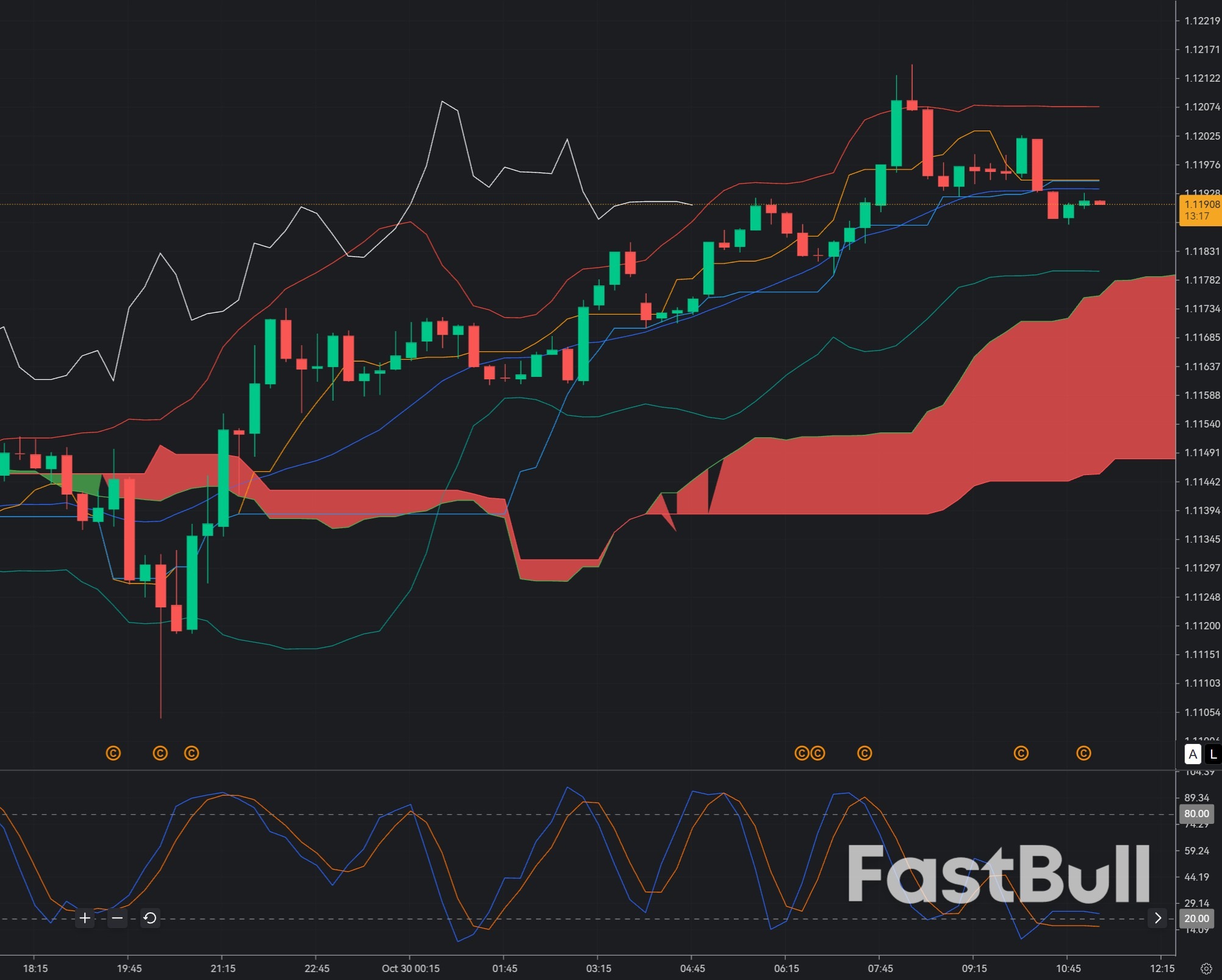
Bollinger Bands (20,0,2): The primary objective is to identify whether EUR/USD is rejecting its upper intraday range or breaking into a new bullish leg. A failure near 1.1205–1.1217, followed by a close back toward the middle band, would support a short-term reversal. If the bands expand upward and successive candles hold above the middle band, the SELL becomes less attractive because bullish momentum may still be developing.
Ichimoku Kinko Hyo (9,26,52): The SELL setup strengthens if price falls below the Tenkan-sen and Kijun-sen, with the cloud acting as overhead resistance. A bearish crossover combined with price remaining beneath the cloud would indicate that the recovery is losing structural support. If price remains above the cloud and the Kijun-sen continues rising, the immediate bearish thesis lacks sufficient confirmation.
Stochastic (5,3,3): A bearish crossover from above 80 would be a useful warning that the rebound is becoming exhausted. The signal becomes more convincing if price simultaneously forms a lower high near resistance. However, an overbought reading alone is insufficient: Stochastic can remain elevated during a sustained rally, so a downward crossover without bearish price action should not automatically trigger a short.
The broader structure favours caution toward the euro, but the M15 entry must be justified independently. Recent technical references identify 1.1193, 1.1205 and 1.1217 as important resistance levels, with downside references near 1.1160 and 1.1110.
Borearis The strongest scenario is a rejection near resistance followed by a breakdown through local support. I cannot verify the live M15 Bollinger Bands, Ichimoku lines or Stochastic readings, so these are confirmation criteria rather than asserted current signals.
Trade Recommendation
Entry: 1.11900
Take Profit: 1.11400
Stop Loss: 1.12200