Fundamentals
The market widely anticipates that the ECB will maintain its policy rates at the upcoming December policy meeting on Thursday. Since July, the ECB has kept its key deposit rate steady at 2%. Investors generally believe that the ECB has halted its rate cuts, which may provide short-term support for the euro. Speeches by ECB policymakers Isabel Schnabel and Philip Lane have sparked speculation about a potential rate hike by the end of next year. However, most economists surveyed by Reuters expect the ECB to keep rates unchanged through 2026 and 2027, with a broader forecast range for 2027 rates between 1.5% and 2.5%. Ahead of this week’s rate decision, key inflation data has been released. The November Consumer Price Index (CPI) indicates that inflation in the Eurozone remains slightly above the ECB’s medium-term target, reinforcing market expectations that the central bank will remain on hold. The latest data shows the Eurozone’s November CPI increased by 2.1% year-over-year, unchanged from October and slightly below the initial estimate of 2.2%, just above the ECB’s 2.0% medium-term inflation target. Month-over-month, prices experienced a modest decline, with November CPI falling 0.3%, following a 0.2% rise in October. Excluding volatile items such as food and energy, core inflation remained stable. Over the past 12 months through November, core CPI increased by 2.4% year-over-year.
The CME FedWatch tool indicates a 73.4% probability that the Federal Reserve Funds futures market is pricing in a hold on interest rates at the upcoming January meeting. Federal Reserve Board Member Christopher Waller is considered a leading candidate for the Fed chair. He reaffirmed his dovish stance on monetary policy during a CNBC forum, stating, “Given the persistently high inflation, we can proceed gradually—we don’t need to rush to cut rates. We can steadily bring the policy rate down to a neutral level.” On Tuesday, the U.S. Bureau of Labor Statistics released data showing that non-farm payroll employment increased by 64,000 in November, beating market expectations of 45,000, after a decrease of 105,000 in October, which was larger than the anticipated 25,000 decline. The unemployment rate rose to 4.6% in November, exceeding the expected 4.4% and reaching the highest level since September 2021. Additionally, average hourly earnings increased by only 0.1% month-over-month, below the market forecast of 0.3%, while year-over-year growth slowed to 3.5%, the smallest increase since May 2021. Economists describe the current labor market as characterized by “low layoffs and low hiring” activity. While most companies have refrained from significant layoffs, they are also cautious about aggressively hiring new staff, partly due to the perception that many tasks can be automated through artificial intelligence. Historically, companies tend to accelerate temporary staffing during this period, but this year, they have adopted a cautious stance. However, Federal Reserve Chair Jerome Powell warned last week that, due to incomplete data collection in October and the first half of November, policymakers will interpret upcoming economic indicators with "a relatively cautious attitude." Powell also stated that official statistics might overestimate non-farm employment growth by as much as 60,000 jobs per month. If this assessment proves accurate, the U.S. economy may have actually experienced a monthly decline of approximately 20,000 jobs since April. His concern centers on the Labour Department's employment data, which must estimate new job creation from startup companies and job losses from closures. Since these figures cannot be captured instantly and precisely, they rely on modeling techniques, which, in the current economic climate, risk rendering employment estimates overly optimistic.
Technical Analysis
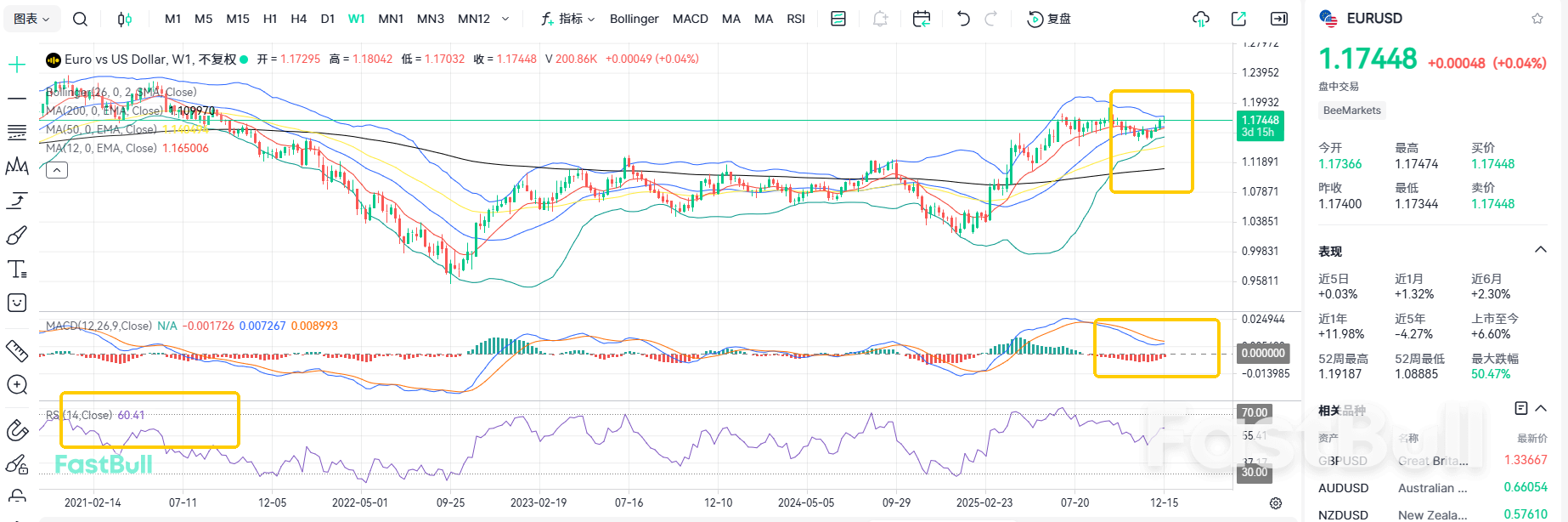
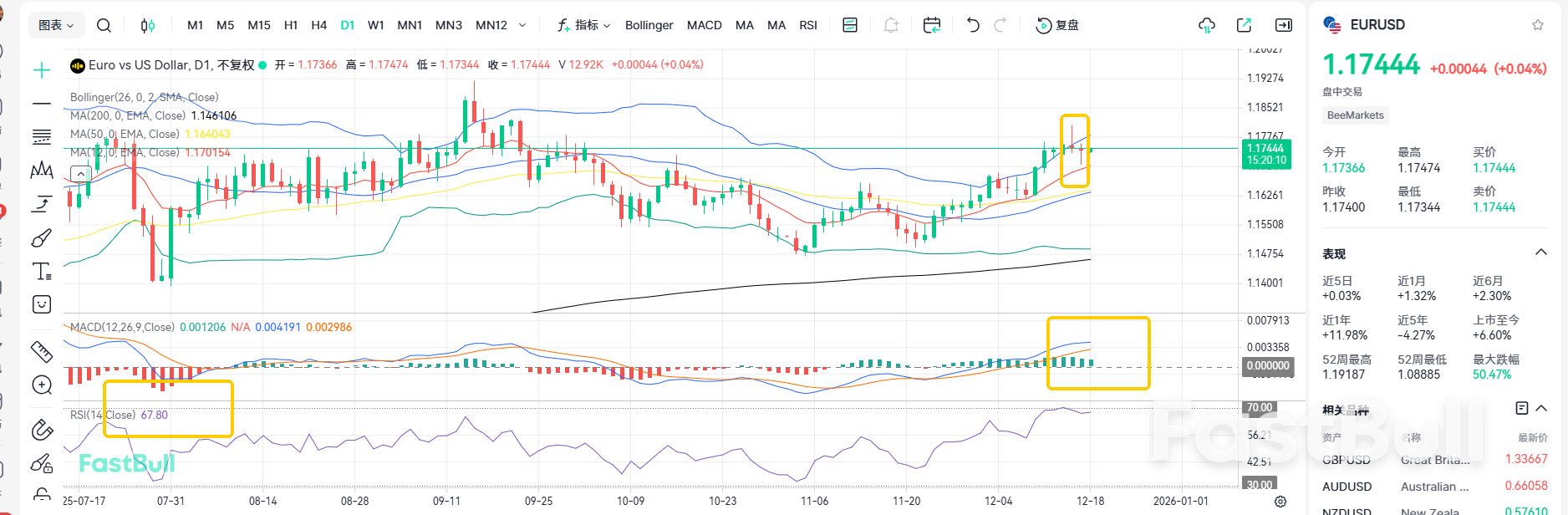
For the EURUSD in the 1D timeframe, Bollinger Bands are expanding upwards with the upper band opening higher, while the SMAs are diverging upwards. After the MACD generated a golden cross, the price has been strongly ascending along the upper Bollinger Band. Overall, the bullish trend remains intact. The 1D candlestick shows a long upper shadow followed by a long lower shadow, indicating strong bullish momentum. The RSI stands at 67, reflecting a market with strong bullish sentiment, likely pushing the price towards key psychological levels and previous highs at 1.18 and 1.192. In the 1W timeframe, Bollinger Bands are narrowing, and the EMA12 is leveling off. The MACD’s MACD line and signal line are near the zero-axis, signaling potential trend reversal. A golden cross on the MACD is imminent; if confirmed, a breakout above 1.2 is highly probable. The RSI at 60 suggests a market entering optimistic territory. As long as the price remains above the EMA12 in the short term, the bullish trend will persist. It is recommended to go long at the lows in the short term.
Trading Recommendations
Trading Direction: Buy
Entry Price: 1.17
Target Price: 1.2
Stop Loss: 1.15
Support: 1.166, 1.16, 1.15
Resistance: 1.18, 1.192, 1.2


