The global financial markets have been thrust into a state of heightened anxiety to kick off the trading week, as a geopolitical flashpoint in the Middle East triggers a violent repricing of risk. The euro is under heavy siege, sliding to within a hair’s breadth of the critical $1.15 handle against a resurgent US dollar, while the price of crude oil has detonated higher, posting its most significant single-day jump in recent memory as supply concerns reach a fever pitch.
The common currency opened the Sunday session with a significant bearish gap and immediately slumped toward the psychological support level of $1.1500. Although it has managed a tepid recovery in early European hours, the single currency remains deeply entrenched in negative territory. At the time of writing, EUR/USD is trading at $1.1525, representing a bruising loss of approximately 0.8% on the day. The move reflects a brutal reality for the euro bloc: a toxic cocktail of a soaring dollar and the looming threat of imported inflation via skyrocketing energy prices.
The epicenter of today’s market tremor is undeniably the crude oil market. Despite diplomatic overtures from Tehran, where President Masoud Pezeshkian signaled a desire to avoid direct aggression, stating the nation "will not strike unless they attack first," the physical reality of disrupted trade routes is overwhelming any sense of detente.
The critical chokepoint, the Strait of Hormuz, remains in a state of effective paralysis. Market sources indicate that the de facto blockade—or the extreme risk premium attached to traversing it—has brought energy transit to a standstill. The knock-on effect has been swift and severe. Major oil producers within the Gulf region, including the United Arab Emirates and Iraq, have been forced to declare force majeure or implement sharp production cuts. Industry insiders cite a critical lack of storage capacity as tankers remain idle, refusing to navigate the strait. Consequently, the barrel of West Texas Intermediate (WTI) has shattered the $100 barrier, last seen trading near a staggering $103, marking a meteoric rise of more than 13% in a single session.
This explosive move in energy markets has triggered an immediate and powerful flight-to-safety. The US Dollar Index (DXY), the benchmark for the greenback against a basket of six major peers, is surging, last seen up 0.7% on the day at 99.50. Investors are piling into the world’s primary reserve currency as a hedge against global instability, a move that inherently weighs on the euro and other risk-sensitive assets.
The anxiety gripping the market is palpable. US stock index futures are pointing to a sharply lower open, tumbling approximately 1.5% in European dealings, while the Euro Stoxx 50 Index is suffering even steeper losses, shedding more than 2.5%. The market narrative has pivoted violently away from central bank policy spreads and is now singularly fixated on geopolitical headlines emanating from the Gulf.
With the economic calendar devoid of high-tier data releases today, the entirety of the market’s focus will remain glued to the Middle East. The silence from the data front leaves the technical and sentiment-driven flows firmly in control.
However, there is a potential circuit breaker on the horizon. Reliable sources indicate that the International Energy Agency (IEA) is actively coordinating with G7 members to discuss a synchronized release of strategic petroleum reserves. Such an intervention would be a direct attempt to cap this parabolic rise in oil prices and stabilize a jittery energy market.
If an IEA-led intervention materializes, we could see a sharp, short-covering correction in oil prices. This would likely provide a temporary lifeline to the euro and allow the beleaguered EUR/USD pair to attempt a foothold above the $1.15 handle. A pullback in oil could momentarily soothe inflation fears and cool the dollar’s safe-haven rally.
Yet, this is where my outlook turns cautious. Unless we witness a tangible and credible de-escalation on the ground—meaning a resumption of normal tanker traffic through the Strait of Hormuz—any relief rally in the euro will likely prove fleeting. The fundamental driver here is a supply-side shock. As long as the threat of disruption remains, the market will continue to price in a risk premium. The dollar will likely retain its bid, and the path of least resistance for the euro will remain tilted to the downside. Any recovery attempts should be viewed with deep skepticism until the black smoke clears from the geopolitical horizon.
Technical Analysis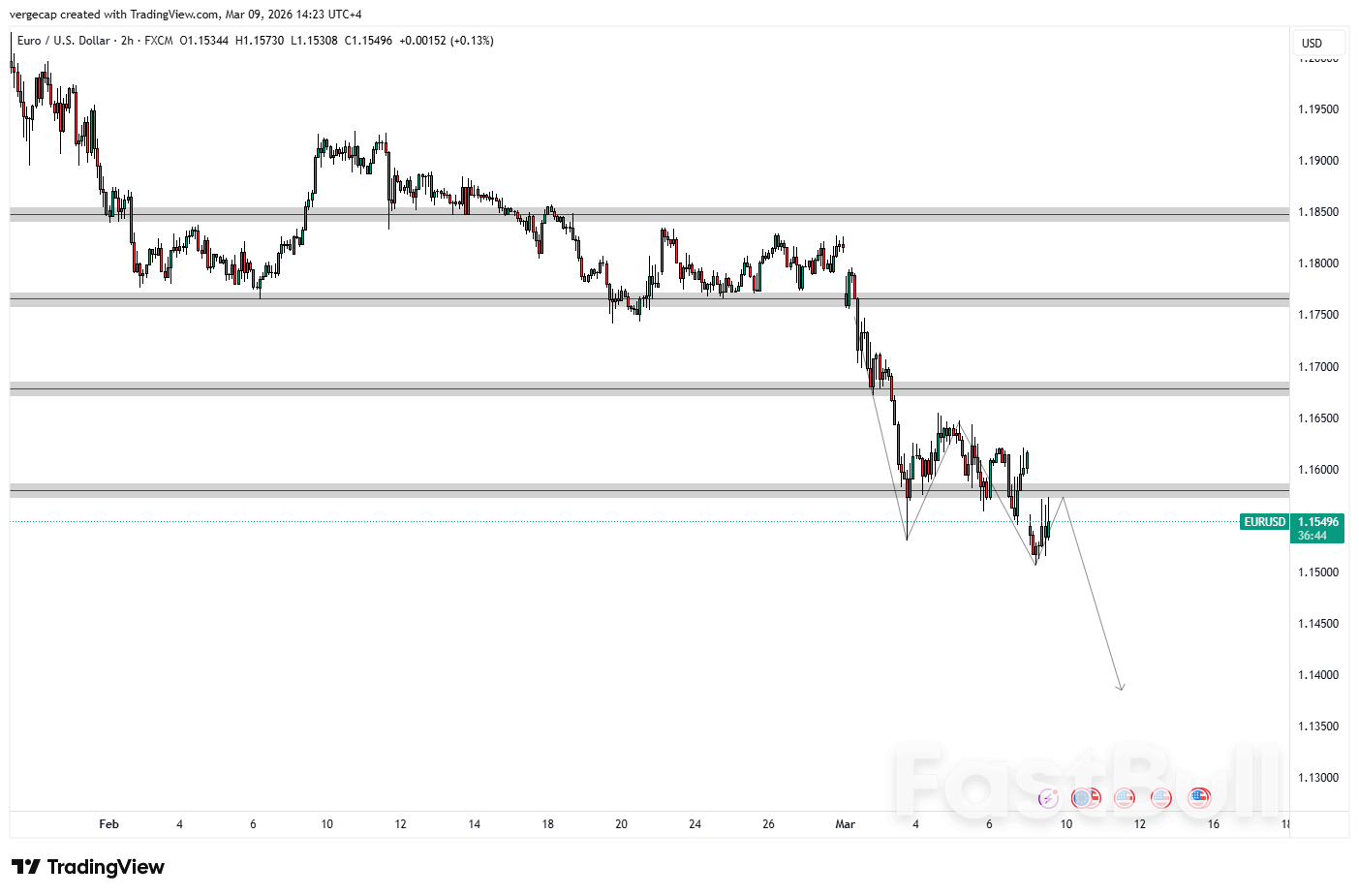
From a technical perspective, EUR/USD remains entrenched in a clearly defined bearish structure, with the 2-hour chart showing a persistent sequence of lower highs and lower lows that underscores sustained downside pressure. The broader trend has shifted decisively lower following a sharp breakdown from the 1.1780–1.1800 support region, which previously acted as a key consolidation floor throughout late February.
The decisive breach of this zone triggered an aggressive bearish impulse that drove prices rapidly toward the 1.1600 psychological level, confirming a deterioration in market structure and signaling that sellers remain firmly in control of the near-term direction. Since reaching this level, EUR/USD has attempted a modest rebound, but price action continues to struggle beneath a key resistance band around 1.1580–1.1600, which has now transitioned into a supply zone following the recent breakdown.
This area represents an important near-term ceiling, and repeated failures to reclaim it suggest that the recent bounce may simply represent a corrective retracement within the broader downtrend rather than the beginning of a sustained recovery. As long as price remains capped beneath this resistance region, bearish momentum is likely to remain intact.
If EUR/USD fails to maintain support above the 1.1500–1.1520 demand zone, which marks the most recent swing low on the chart, the pair could resume its downward trajectory. A decisive break below this support would likely accelerate selling pressure and expose the 1.1400 region, which represents the next major structural support and aligns with the projected downside path illustrated on the chart.
A sustained move beneath 1.1400 would reinforce the bearish trend and potentially open the door for a deeper extension toward the 1.1300 psychological level, signaling a more pronounced continuation of the broader corrective phase.
On the upside, bullish traders would need to reclaim the 1.1600 level in order to stabilize the current structure. A sustained move above this threshold could trigger a short-term recovery toward the 1.1680–1.1700 resistance zone, where the next significant supply region is located. However, only a decisive breakout above the 1.1780–1.1800 region would invalidate the prevailing bearish outlook and signal a broader trend reversal.
Momentum dynamics appear consistent with a corrective consolidation within a broader downtrend. The Relative Strength Index (RSI) is likely hovering near neutral territory after rebounding from oversold levels, indicating that downside momentum has temporarily cooled without shifting the broader bias. Meanwhile, the Moving Average Convergence Divergence (MACD) appears to be flattening below the zero line, suggesting that bearish momentum remains dominant but may pause briefly before the next directional move unfolds.
Overall, as long as EUR/USD remains below the 1.1580–1.1600 resistance zone, the technical outlook continues to favor further downside pressure, with sellers likely targeting lower support levels in the coming sessions.
TRADE RECOMMENDATION
SELL EUR/USD
ENTRY PRICE: 1.1580
STOP LOSS: 1.1620
TAKE PROFIT: 1.1400


