EUR/USD is trading modestly lower around the 1.1650 area on Monday, although the pair continues to preserve most of last week’s advance. Price action remains cautious at the start of the week as investors await details of a new US sanctions package against Iran, keeping geopolitical uncertainty elevated.
US Treasury Secretary Scott Bessent signaled over the weekend that Washington is preparing an aggressive economic campaign designed to cut Iran off from its remaining financial and commercial channels. The key question for markets is how far those measures extend, particularly if they target countries or institutions maintaining economic ties with Tehran.
Iran has responded with increasingly forceful rhetoric, threatening to disrupt Gulf oil exports and warning that cooperation with Washington’s sanctions campaign could be treated as an act of war. For now, however, energy markets are showing limited signs of panic, with Brent crude remaining below Friday’s highs. That has prevented geopolitical tensions from generating a significant safe-haven bid for the Dollar.
At the same time, concerns over US Dollar debasement remain an important underlying theme. OCBC argues that the Treasury’s decision to expand its long-dated bond buyback programme has revived concerns surrounding the Dollar, particularly as the move suggests policymakers are becoming uncomfortable with elevated long-term borrowing costs. The resulting decline in yields has encouraged investors to unwind some Dollar positions while supporting alternative stores of value such as Gold.
This leaves EUR/USD in an interesting position. Geopolitical uncertainty is providing some support to the Greenback, but the broader Dollar picture remains vulnerable following the Treasury’s intervention in the bond market. In my view, the current EUR/USD weakness looks more like consolidation after last week’s rally than a convincing bearish reversal, particularly while the pair continues to hold above the 1.1650 region.
The next major catalyst arrives with US PCE inflation on Wednesday, followed by Fed Chair Kevin Warsh’s Jackson Hole speech on Friday. Both events could determine whether the recent pressure on US yields and the Dollar has further room to run or whether markets begin rebuilding expectations for tighter Fed policy.
Technical Analysis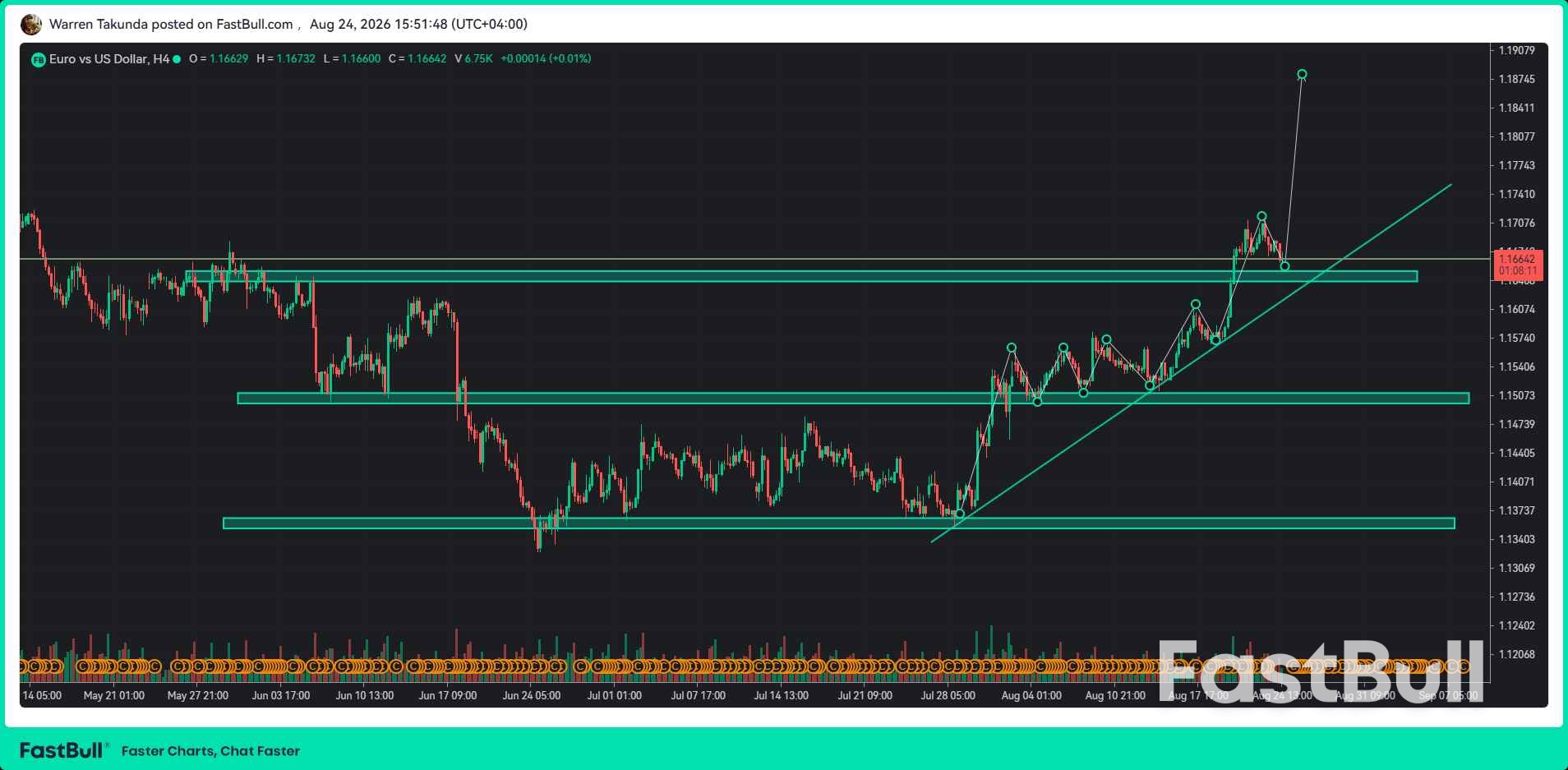
EUR/USD continues to maintain a constructive bullish structure on the 4-hour chart, with the advance from the late-July lows developing through a well-defined sequence of higher highs and higher lows. The rising trendline remains intact, while the latest pullback from the 1.1700–1.1710 region has brought price back toward an important former resistance zone rather than materially damaging the broader recovery.
The immediate focus is on the 1.1630–1.1650 area, which previously acted as a significant ceiling and is now being tested as support. This is an important technical retest following last week’s breakout. As long as buyers continue to defend this region, the current decline can be viewed as a corrective move within the broader bullish trend, with the market potentially building a base for another leg higher.
A recovery above 1.1700–1.1710 would confirm that buyers are regaining control and reinforce the continuation scenario. Beyond this level, relatively limited structural resistance is visible on the chart, leaving room for an extension toward 1.1750, followed by the 1.1800 region. If momentum strengthens further, the broader bullish projection points toward 1.1870–1.1900, which would represent a substantial continuation of the recovery from the July lows.
On the downside, a decisive break below 1.1630 would weaken the immediate setup and suggest that the breakout has failed to attract sufficient follow-through. In that scenario, EUR/USD could retreat toward the rising trendline before potentially testing the more significant 1.1490–1.1510 support zone. This area previously attracted strong buying interest and remains the key structural floor for the broader bullish setup. Only a sustained move below 1.1490 would seriously undermine the current higher-high, higher-low formation and expose the 1.1350 region.
Overall, the pullback toward 1.1650 looks more like a breakout retest than a reversal at this stage. The combination of the rising trendline, established higher lows and former resistance turning into support keeps the technical bias tilted higher. Holding above the 1.1630–1.1650 zone would favor another attempt at 1.1710, with a breakout potentially opening the path toward 1.1800 and eventually 1.1870–1.1900.
TRADE RECOMMENDATION
BUY EUR/USD
ENTRY PRICE: 1.1670
STOP LOSS: 1.1590
TAKE PROFIT: 1.1800


