The euro has regained a firmer footing against the US dollar, with EUR/USD turning positive on the daily chart on Wednesday as selling pressure in the greenback begins to ease. The pair found solid demand around the 1.1720 area during the European morning session before pushing back above 1.1750, where it was trading as markets headed into the US opening. While the rebound remains tentative, the price action suggests that downside momentum is losing traction, even as year-end conditions keep trading volumes subdued.
The immediate catalyst for the mild recovery appears to be a loss of steam in the recent US dollar bounce. With liquidity thinning sharply ahead of the New Year holiday, even modest shifts in expectations can generate outsized moves. Attention later in the session turns to US Initial Jobless Claims, one of the few remaining top-tier data points before markets effectively shut down for the year. While the release is unlikely to dramatically alter the macro narrative on its own, it could inject some short-lived volatility into what has otherwise been a sleepy trading environment.
Looking beyond the day-to-day fluctuations, the broader trend continues to favor the common currency. The euro is on course to post an annual gain of roughly 14% against the dollar, a striking performance that underscores the scale of the shift in global monetary policy expectations over the past year. At the heart of this move lies a clear divergence between the European Central Bank and the US Federal Reserve. While the ECB has signaled a willingness to keep policy restrictive for longer in its fight against inflation, the Fed has moved closer to the end of its tightening cycle and has already begun easing policy.
Political and structural factors in the United States have added to the dollar’s woes. President Donald Trump’s unpredictable approach to trade policy has injected a fresh layer of uncertainty into the outlook for US growth and global trade flows. At the same time, signs of a softening US economy have become harder to ignore, reinforcing the view that US interest rates are more likely to fall than rise in the months ahead. Together, these dynamics have steadily eroded the dollar’s yield advantage, a key pillar of its strength in previous years.
The minutes from the Federal Open Market Committee’s latest meeting, released on Tuesday, offered further insight into the shifting balance within the Fed. They revealed a wider-than-expected divergence among policymakers, with the decision to cut rates by 25 basis points passing by a narrower margin than markets had assumed. Importantly, the committee emphasized that any additional easing would depend on a sustained and convincing decline in inflation. This conditional stance has cast doubt over the timing and pace of future rate cuts, prompting a brief bout of dollar strength immediately after the minutes were published.
However, that reaction proved short-lived. Investors appear increasingly skeptical that the Fed will be able to maintain a restrictive stance for long if economic data continue to soften. As a result, rallies in the dollar are being viewed as opportunities to sell rather than the start of a more durable recovery, particularly against currencies such as the euro that are underpinned by a relatively more hawkish central bank outlook.
From a market structure perspective, conditions remain far from ideal for trend-following strategies. Most major financial centers will be closed on Thursday for New Year celebrations, while Japanese markets are shut for the remainder of the week. These closures are likely to keep liquidity thin and price action choppy, increasing the risk of false breakouts in either direction.
Technical analysis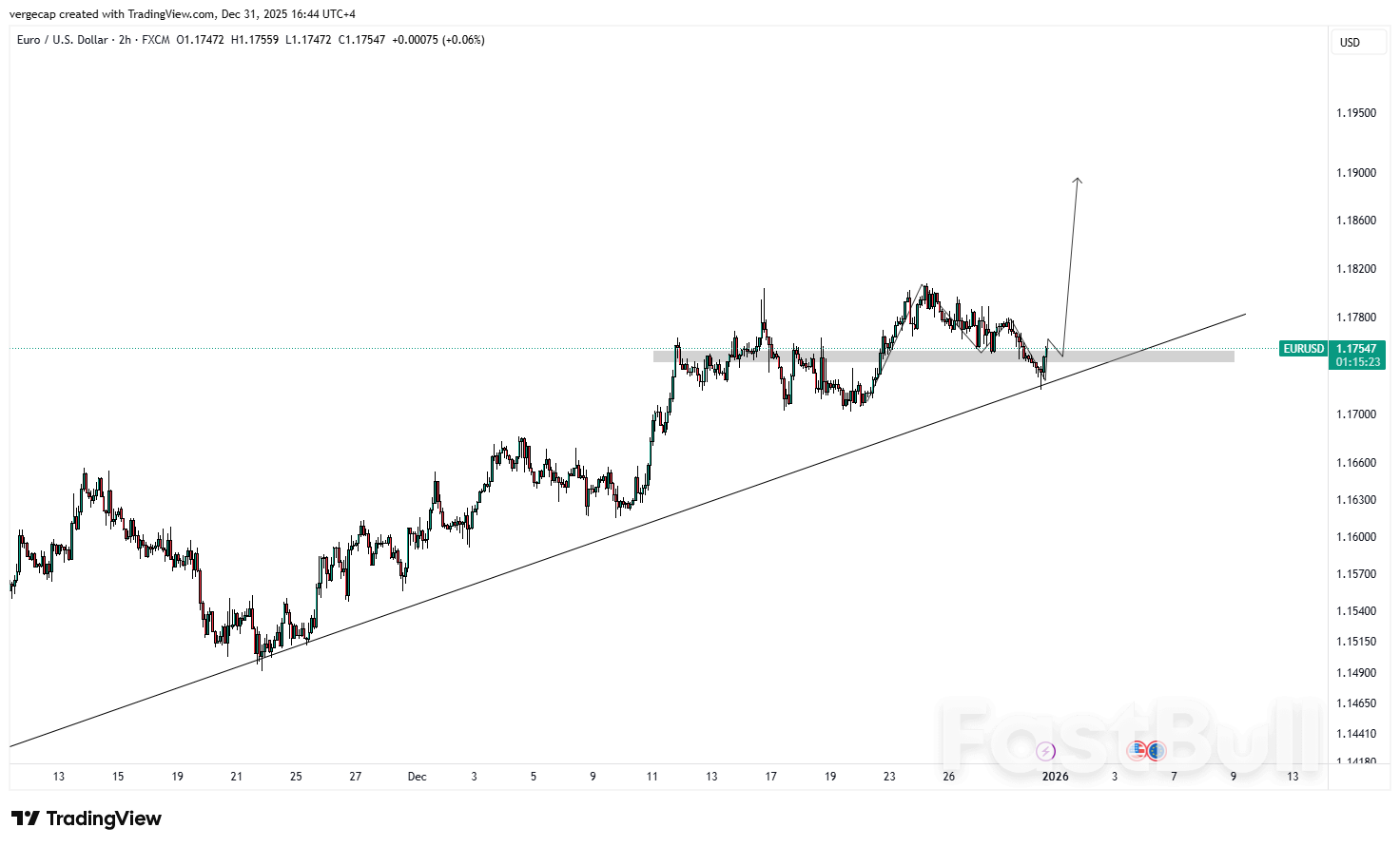
On the technical front, EUR/USD is showing early signs of stabilization, though the recovery is still fragile. On the four-hour chart, the Relative Strength Index has rebounded from levels close to oversold territory, indicating that bearish pressure is easing. Nevertheless, the RSI remains below the neutral 50 mark, suggesting that upside momentum has yet to fully reassert itself. The Moving Average Convergence Divergence indicator tells a similar story: bearish momentum is fading, but the MACD line is still below zero, pointing to lingering downside risks.
Key resistance levels remain clearly defined. A reverse trendline, currently around 1.1770, is likely to act as the first major obstacle to any sustained bullish reversal. A decisive break above this area would open the door toward the December 16 and December 24 highs near 1.1805. Beyond that, the September 23 and 24 peaks around 1.1820 come into focus, a zone that could prove challenging without a stronger fundamental catalyst.
TRADE RECOMMENDATION
BUY EURUSD
ENTRY PRICE: 1.17550
STOP LOSS: 1.17160
TAKE PROFIT: 1.1820


