The euro remained under pressure against the US dollar on Friday, extending its decline for a seventh consecutive trading session as investors digested a mixed set of US labor-market figures that ultimately favored the greenback. The EUR/USD pair was trading near 1.1638 at the time of writing, struggling to stabilize as the dollar retained broad-based support amid resilient US macro fundamentals and persistent policy divergence expectations.
Figures released by the US Bureau of Labor Statistics offered a nuanced snapshot of labor-market conditions. Nonfarm Payrolls increased by 50,000 in December, undershooting market expectations for a 60,000 rise and marking a slowdown from November’s 64,000 gain. While the headline job creation number pointed to a cooling pace of hiring, it stopped short of signaling any abrupt deterioration in employment conditions.
More supportive for the dollar was the unexpected improvement in the Unemployment Rate, which fell to 4.4% from 4.6%, beating forecasts that had penciled in a modest decline to 4.5%. The lower jobless rate suggests that labor demand remains firm enough to absorb slower hiring, reinforcing the view that the US economy is decelerating gradually rather than slipping into a pronounced downturn.
Wage data added another layer of complexity to the report. Average Hourly Earnings rose 0.3% month-on-month in December, in line with expectations and a notable pickup from November’s 0.1% increase. On an annual basis, wage growth accelerated to 3.8% from 3.6%, exceeding market forecasts. This acceleration in pay growth continues to underscore the stickiness of labor-related inflation pressures, an issue that remains central to the Federal Reserve’s policy calculus.
Taken as a whole, the employment report sent mixed but not alarming signals. Softer payroll growth contrasted with a tighter unemployment rate and firmer wage momentum, pointing to a labor market that is cooling at the margins while remaining fundamentally resilient. For currency markets, this balance has been sufficient to keep the dollar underpinned, particularly against a euro that lacks near-term supportive catalysts.
From a monetary policy perspective, the data reinforced expectations that the Federal Reserve will maintain a cautious stance. Markets remain confident that policymakers will leave interest rates unchanged at the January 27–28 FOMC meeting, while continuing to emphasize a data-dependent approach toward any rate cuts later in the year. Importantly, the combination of slower hiring and rising wages gives the Fed room to stay patient, avoiding premature easing that could reignite inflation pressures.
By contrast, the euro continues to be weighed down by uncertainty surrounding the Eurozone growth outlook and the European Central Bank’s likely policy trajectory. With inflation in the bloc easing more convincingly and growth indicators remaining fragile, investors increasingly expect the ECB to move toward rate cuts earlier than the Fed. This widening policy divergence has been a persistent headwind for the single currency and remains a key driver behind EUR/USD’s extended decline.
Attention now turns to the University of Michigan’s preliminary January Consumer Sentiment survey, which could provide fresh insight into US household confidence and inflation expectations. In addition, remarks from Richmond Fed President Thomas Barkin and Minneapolis Fed President Neel Kashkari will be closely watched for clues on how comfortable policymakers are with the current disinflation trend and whether wage growth is becoming a renewed concern. Any indication of lingering hawkishness could further reinforce the dollar’s advantage.
Technical Analysis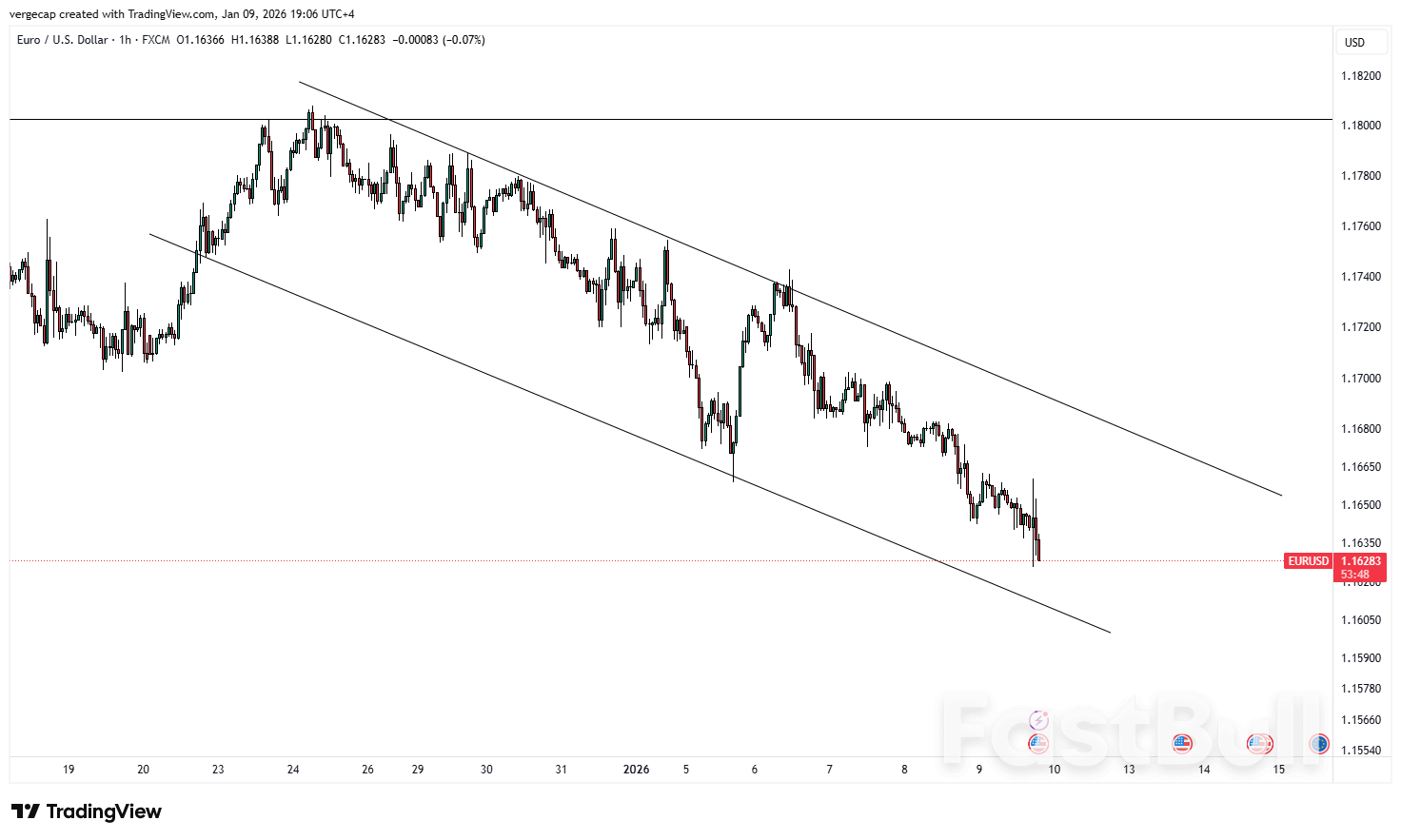
From a technical standpoint, the outlook for EUR/USD remains decisively bearish despite early signs of short-term exhaustion. The pair continues to trade below its 50-period exponential moving average, highlighting persistent negative momentum on an intraday basis. Price action remains confined within a downward-sloping channel, confirming that the broader move is corrective in nature but still firmly biased to the downside.
Momentum indicators, including relative strength measures, are stabilizing near oversold territory, suggesting that selling pressure may temporarily ease. However, such signals typically point to consolidation or shallow rebounds rather than a meaningful trend reversal. As long as the pair fails to reclaim the upper boundary of its descending channel, any recovery is likely to be corrective and vulnerable to renewed selling interest.
In practical terms, downside risks remain skewed toward a continued grind lower, with price action still gravitating toward lower liquidity zones within the prevailing structure. Bounces that lack follow-through and fail to attract sustained buying interest are likely to be viewed by market participants as opportunities to re-establish short positions rather than evidence of a shift in trend.
TRADE RECOMMENDATION
SELL EURUSD
ENTRY PRICE: 1.1625
STOP LOSS: 1.1670
TAKE PROFIT: 1.1540


