The Euro extended its decline against the US Dollar for a third consecutive session on Thursday, with EUR/USD slipping toward the 1.1670 region during North American trading as stronger-than-expected US economic data reinforced the view that the Federal Reserve will keep interest rates elevated for longer.
The pair traded near 1.1679 after briefly touching an intraday high around 1.1721, as renewed Dollar demand overshadowed softer inflation data from Spain and kept bearish pressure firmly on the common currency.
The latest US economic figures painted a picture of an economy that continues to show resilience despite elevated borrowing costs and persistent inflationary pressures. US Retail Sales rose 0.5% month-on-month in April, matching market expectations and highlighting the durability of consumer spending activity. On an annual basis, sales surged 4.9%, comfortably above forecasts of 3.3%, suggesting that household demand remains far stronger than many analysts had anticipated.
In my view, the strength in consumer spending continues to reinforce the Federal Reserve’s argument that inflation risks remain skewed to the upside. The combination of resilient demand, elevated energy costs, and a still-solid labor market significantly reduces the urgency for policymakers to begin easing monetary policy anytime soon.
Particularly notable was the sharp increase in gasoline-related spending. Receipts at gasoline stations climbed 2.8% in April after surging 13.7% in March, reflecting the sharp rebound in energy prices tied to ongoing geopolitical tensions in the Middle East. Data from the US Energy Information Administration showed gasoline prices jumped 12.3% last month, adding another layer of inflationary pressure to the broader economy.
Meanwhile, labor market conditions continue to show only modest signs of softening. Initial Jobless Claims rose to 211,000 for the week ending May 9, slightly above expectations of 205,000, but still remain historically low and consistent with a relatively tight employment environment.
The stronger economic backdrop has fueled additional gains in the US Dollar, with the US Dollar Index climbing 0.33% to near 98.77, its highest level in roughly ten days. The Greenback also found support after comments from Kansas City Federal Reserve President Jeffrey Schmid, who warned that inflation remains the “most pressing risk” facing the US economy.
Schmid emphasized that the US economy continues to display “remarkable resilience” while describing the labor market as “functioning effectively.” His remarks reinforced the growing market consensus that the Federal Reserve is unlikely to cut interest rates in the foreseeable future, especially after recent consumer and producer inflation reports confirmed that price pressures remain stubbornly above the Fed’s 2% target.
Interest rate markets are now increasingly reflecting expectations that the Fed may not deliver any rate cuts throughout 2026, a dramatic shift from earlier forecasts that anticipated aggressive easing this year.
Across the Eurozone, inflation data offered little support to the Euro. Spain’s Consumer Price Index slowed to 3.2% year-on-year in April from 3.4% previously, matching market expectations but doing little to alter the broader economic picture of slowing growth and weakening industrial momentum across the bloc.
Investors are now turning their attention toward upcoming inflation figures from Italy, while traders in the United States await the release of the New York Empire State Manufacturing Index and Industrial Production data for further clues on the strength of the US economy.
For now, the divergence between a resilient US economy and a sluggish Eurozone backdrop continues to favor the Dollar. Unless incoming US data begins to show clearer signs of economic deterioration, EUR/USD may remain vulnerable to further downside pressure in the near term.
Technical Analysis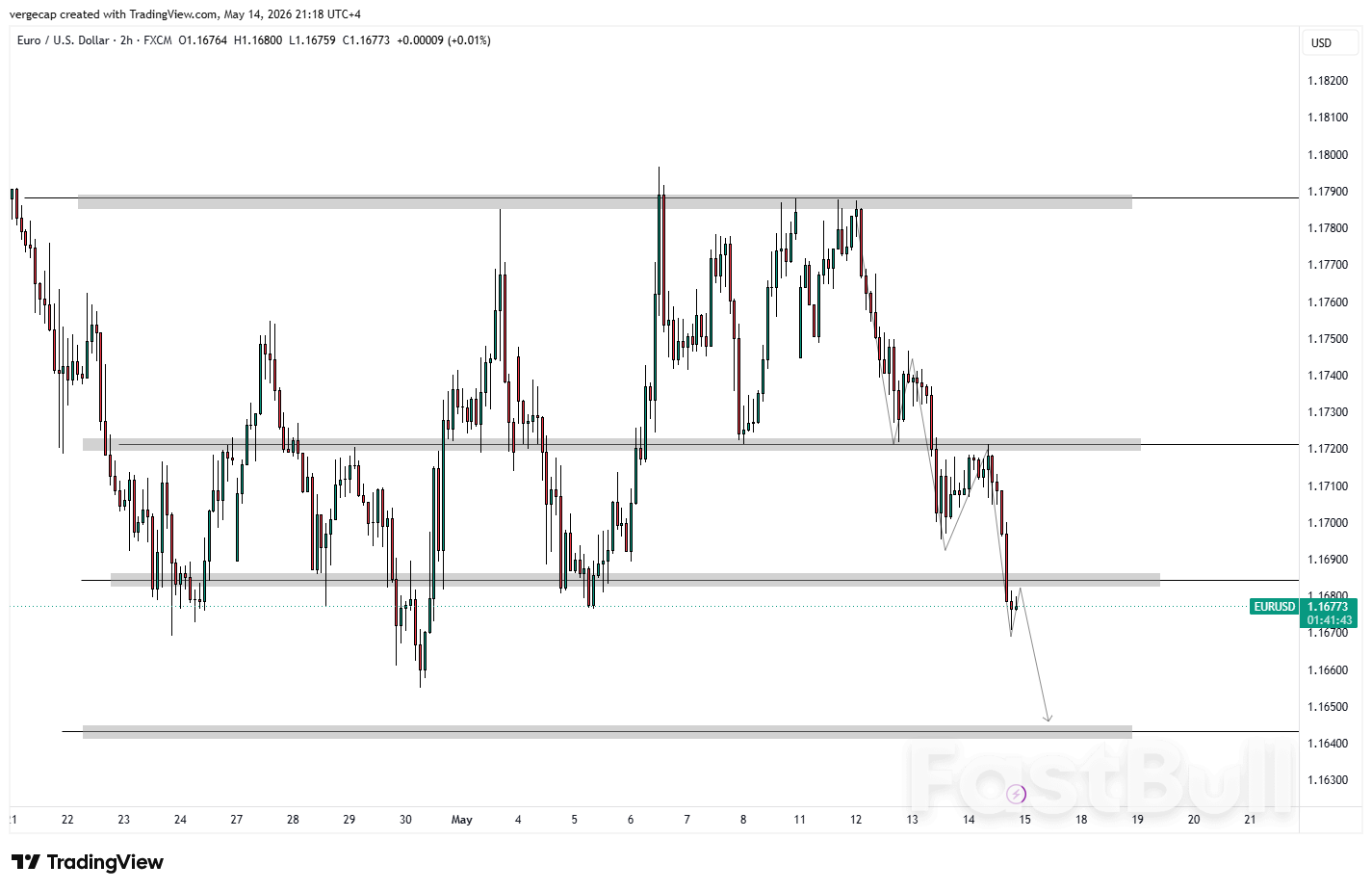
From a technical perspective, EUR/USD has shifted into a clearly bearish short-term structure after failing repeatedly to sustain momentum above the 1.1780–1.1790 resistance zone on the 2-hour chart. The pair has now broken below multiple layers of support and is trading near 1.1677, with bearish momentum accelerating following the decisive rejection from the upper resistance band earlier this week.
Price action shows the pair carving out a sequence of lower highs and lower lows after failing to maintain gains above the 1.1720 pivot region. The recent breakdown below the 1.1680 support area is particularly significant, as this zone had previously acted as a strong consolidation floor throughout late April and early May. The failure to hold above that level suggests sellers remain firmly in control in the near term.
The chart also reveals the formation of a short-term bearish continuation structure, with the latest rebound attempt near 1.1720 quickly rejected before another aggressive leg lower emerged. This reinforces the broader downside bias and increases the likelihood of further weakness toward the next major support zone around 1.1640–1.1650.
A sustained break beneath the 1.1640 region would confirm a broader bearish breakdown and could expose deeper downside targets toward 1.1600, a key psychological handle that may attract stronger buying interest. If bearish pressure intensifies further, the pair could even revisit the late-April lows near 1.1560.
On the upside, bulls need to reclaim the 1.1720 resistance area to stabilize short-term sentiment. A move back above this level would ease immediate downside pressure and potentially allow EUR/USD to retest the stronger resistance zone near 1.1780–1.1790. However, the repeated rejection from that area suggests bullish momentum remains weak unless buyers can secure a decisive breakout above 1.1800.
Momentum indicators continue to favor the downside. The Relative Strength Index (RSI) appears to be drifting below the neutral 50 mark, reflecting weakening bullish momentum and growing selling pressure. At the same time, the Moving Average Convergence Divergence (MACD) likely remains below its signal line and is edging deeper into negative territory, signaling strengthening bearish momentum rather than temporary consolidation.
Overall, the broader technical structure suggests EUR/USD remains vulnerable to additional downside pressure unless buyers can quickly reclaim lost support levels. The combination of repeated resistance failures, deteriorating momentum, and bearish price structure continues to favor sellers in the near term.
TRADE RECOMMENDATION
SELL EUR/USD
ENTRY PRICE: 1.1675
STOP LOSS: 1.1735
TAKE PROFIT: 1.1600


