The Euro is under significant pressure on Tuesday, with EUR/USD sliding to session lows just above 1.1750 after failing to extend Monday's modest gains beyond the 1.1790 ceiling. The catalyst is unambiguous — a ZEW Economic Sentiment Survey so catastrophically below expectations that it has forced markets to confront an uncomfortable reality: the US-Iran conflict is not merely a geopolitical headline. It is actively hollowing out European economic confidence in ways that are becoming increasingly difficult to dismiss.
German Economic Sentiment collapsed to -17.2 in April — its weakest reading since December 2022 and a staggering deterioration from March's already-subdued -0.5. Analysts had forecast -5.0. The miss of more than 12 points is not a disappointment. It is a repudiation of the optimistic scenario entirely.
The Current Situation index fell to -73.7 from -62.9, signalling that institutional investors believe Germany's economy is not merely heading toward weakness — it is already deeply mired in it. Eurozone-wide sentiment told the same story, dropping to -20.4 against a consensus expectation of -3.6 and its own weakest reading since December 2022. This is a continent-wide confidence crisis, and the US-Iran conflict's disruption to energy markets is at the heart of it.
For the ECB, the data arrives at the worst possible moment. Markets had been building toward near-consensus expectations of a June rate hike following March's inflation revision to 2.6%. Tuesday's ZEW collapse has not killed that narrative — but it has put it on life support. Raising rates into an economy where institutional confidence is freefall carries enormous downside risk, and the more dovish members of the Governing Council now have powerful ammunition to argue for delay. President Lagarde's language about remaining "completely agile" looks less like boilerplate and more like genuine optionality being deliberately preserved for exactly this scenario.
For EUR/USD specifically, the near-term implications are straightforwardly bearish. A currency deriving support from ECB rate hike expectations cannot sustain that support when the data is actively undermining the case for hiking.
The session's one constructive development came from the geopolitical front. The Wall Street Journal reported that Tehran had conveyed through regional mediators a willingness to send a delegation to Pakistan — a meaningful de-escalation from Monday's threats to abandon the peace process entirely following the US seizure of an Iranian cargo vessel in the Gulf of Oman. A Reuters-cited anonymous US source added simply that "things are moving forward," lending the diplomatic process a modest degree of credibility that had been badly lacking 24 hours earlier.
Markets have reacted to this with appropriate restraint. A peace process that nearly collapsed over a single naval seizure is not one that warrants confident optimism. The risk of a fresh headline derailing progress remains acute, and Tehran's engagement through back-channels rather than direct confirmation leaves the situation genuinely fragile.
The combination of a three-and-a-half-year low in ZEW sentiment, an ECB facing a genuinely difficult policy dilemma, and a geopolitical situation that remains unresolved keeps my near-term bias on EUR/USD firmly to the downside.
Technical Analysis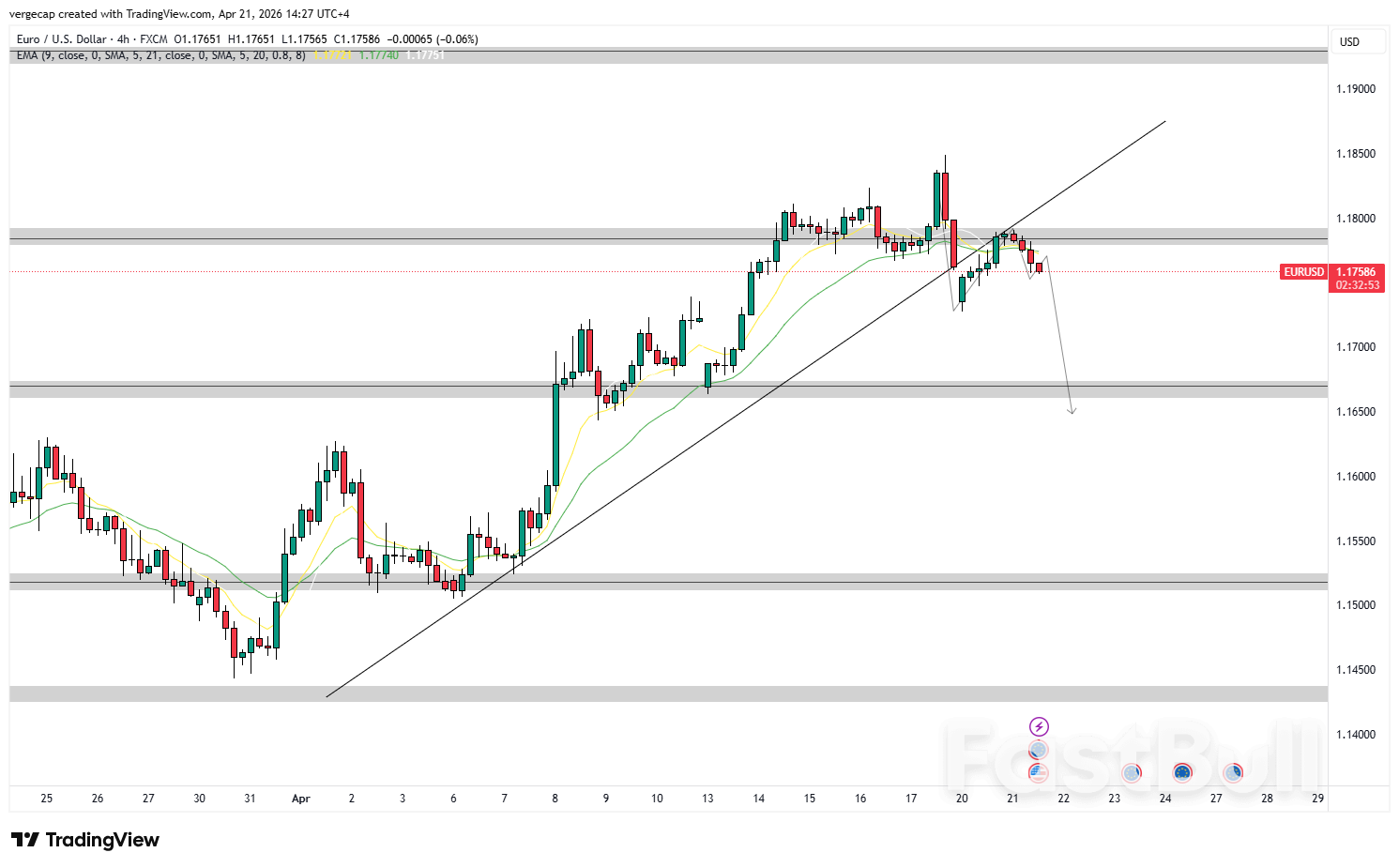
From a technical perspective, EUR/USD has undergone a significant and structurally important deterioration on the 4-hour chart, with price breaking decisively below the ascending trendline that had been the backbone of the pair's impressive rally from the 1.1450 lows of late March. That trendline — which guided price higher in a remarkably consistent and orderly fashion across three full weeks of bullish momentum — has now been violated with a conviction that shifts the near-term bias from cautiously bullish to clearly bearish. Price currently trades at 1.17586, and the breakdown is not ambiguous. It is confirmed, it is clean, and it carries meaningful downside implications.
The trendline break deserves particular attention because of how well-respected the structure was during the rally phase. From the April 2 acceleration point through the April 16–17 highs near 1.1850, price tracked the ascending trendline with impressive fidelity — touching it, bouncing from it, and using it as a dynamic launch pad on multiple occasions. That kind of repeated validation creates institutional memory around the trendline's significance, which means its eventual breach is not treated as routine noise by the market. When a well-validated trendline breaks, algorithmic systems and technical traders act on it simultaneously, and the resulting selling pressure tends to be self-reinforcing rather than easily absorbed. That dynamic is precisely what the current 4-hour candle structure is reflecting.
The 9-period EMA at approximately 1.1741 and the 21-period SMA at approximately 1.1740 have both flipped above current price following the breakdown — a configuration inversion that transforms what were previously dynamic support levels into near-term resistance. Price attempting to recover toward 1.1740–1.1750 and failing to sustain above those moving averages would be the technical confirmation that the trendline breakdown is genuine and that sellers are using the moving averages as a ceiling to reload short positions on any corrective bounce.
The 1.1780–1.1800 zone represents the critical overhead resistance band. This level capped the pair on multiple occasions during the mid-April consolidation phase and now carries the additional weight of the broken trendline and converging moving averages in its vicinity. A recovery attempt that reaches but fails to close above 1.1800 on the 4-hour timeframe should be treated as a selling opportunity rather than a reversal signal, consistent with the broader breakdown structure now in play.
On the downside, the projected path drawn on the chart points toward the 1.1650 horizontal support band as the primary near-term target — a level that aligns with a prominent gray support zone visible on the chart and represents the next meaningful area where prior price action would attract fresh buying interest. A sustained break below 1.1650 would extend the corrective move toward the 1.1550 major support band — one of the most structurally significant horizontal levels on the entire chart, having provided a strong floor during the mid-to-late March consolidation phase. Below 1.1550, the pair would be in genuinely dangerous technical territory, with limited reference points before the 1.1450 region.
The scale of the potential correction is consistent with the magnitude of the preceding advance. EUR/USD rallied approximately 400 pips from the 1.1450 lows to the 1.1850 highs — a move that, if subject to even a standard 50% retracement, would point toward the 1.1650 area as a natural resting point. That alignment between the Fibonacci retracement level and the horizontal support at 1.1650 creates a confluence zone of elevated technical significance and represents the most logical target for the current corrective sequence.
The only scenario that would invalidate the bearish near-term thesis is a swift and sustained recovery back above the broken trendline — currently intersecting near the 1.1780–1.1790 area — accompanied by a clean reclaim of both moving averages on a closing basis. Without that reclamation, the path of least resistance is lower.
TRADE RECOMMENDATION
SELL EUR/USD
ENTRY PRICE: 1.1758
STOP LOSS: 1.1820
TAKE PROFIT: 1.1650


