EUR/USD continues to struggle, trading near 1.1045 on Friday after extending its losses towards a 19-month low. The pair is on track for its third consecutive weekly decline as the US Dollar benefits from a sharp increase in Treasury yields and growing expectations of more aggressive Federal Reserve tightening in December.
Eurozone economic data offered a mixed picture, with preliminary third-quarter GDP showing that the economy expanded by 0.6%, while annual growth remained unchanged at 1.3%. Although the quarterly improvement provided some encouragement, weaker employment figures and disappointing trade data limited the Euro's recovery potential.
Employment increased by just 0.1% in the third quarter, missing expectations of a 0.2% improvement and matching the previous quarter's pace. Meanwhile, September's trade balance recorded a EUR 10.3 billion deficit, improving from August's EUR 16.6 billion shortfall but remaining considerably wider than the EUR 4.5 billion deficit anticipated by economists.
On the US side, the Dollar continues to attract demand as markets rapidly reassess the Federal Reserve's monetary policy outlook. ING analysts describe the latest advance as a powerful macro-driven rally, highlighting the significant repricing of short-term US interest rate expectations.
US short-dated Treasury yields have climbed nearly 40 basis points since Tuesday morning, following Fed Governor Christopher Waller's comments about the possibility of a 50-basis-point increase in December. Markets are increasingly considering consecutive rate increases in December and January, further strengthening the Dollar's yield advantage over the Euro.
Attention now turns to Friday's US Producer Price Index (PPI) release, which could provide additional evidence of persistent inflationary pressures. Headline producer inflation is expected to accelerate to 6.6% annually in October from 6.3% in September, while core PPI is forecast to remain at 5%. Stronger-than-expected readings could reinforce expectations of further Fed tightening and extend the Dollar's recent advance.
EUR/USD remains fundamentally vulnerable as the divergence between US and Eurozone economic conditions continues to favour the Greenback. Although stronger quarterly GDP provides some support for the Euro, weak employment growth and the wider-than-expected trade deficit highlight underlying economic challenges. Unless US inflation begins to moderate or Treasury yields reverse their recent advance, the pair could remain under pressure, with upcoming PPI data serving as an important catalyst.
Technical Analysis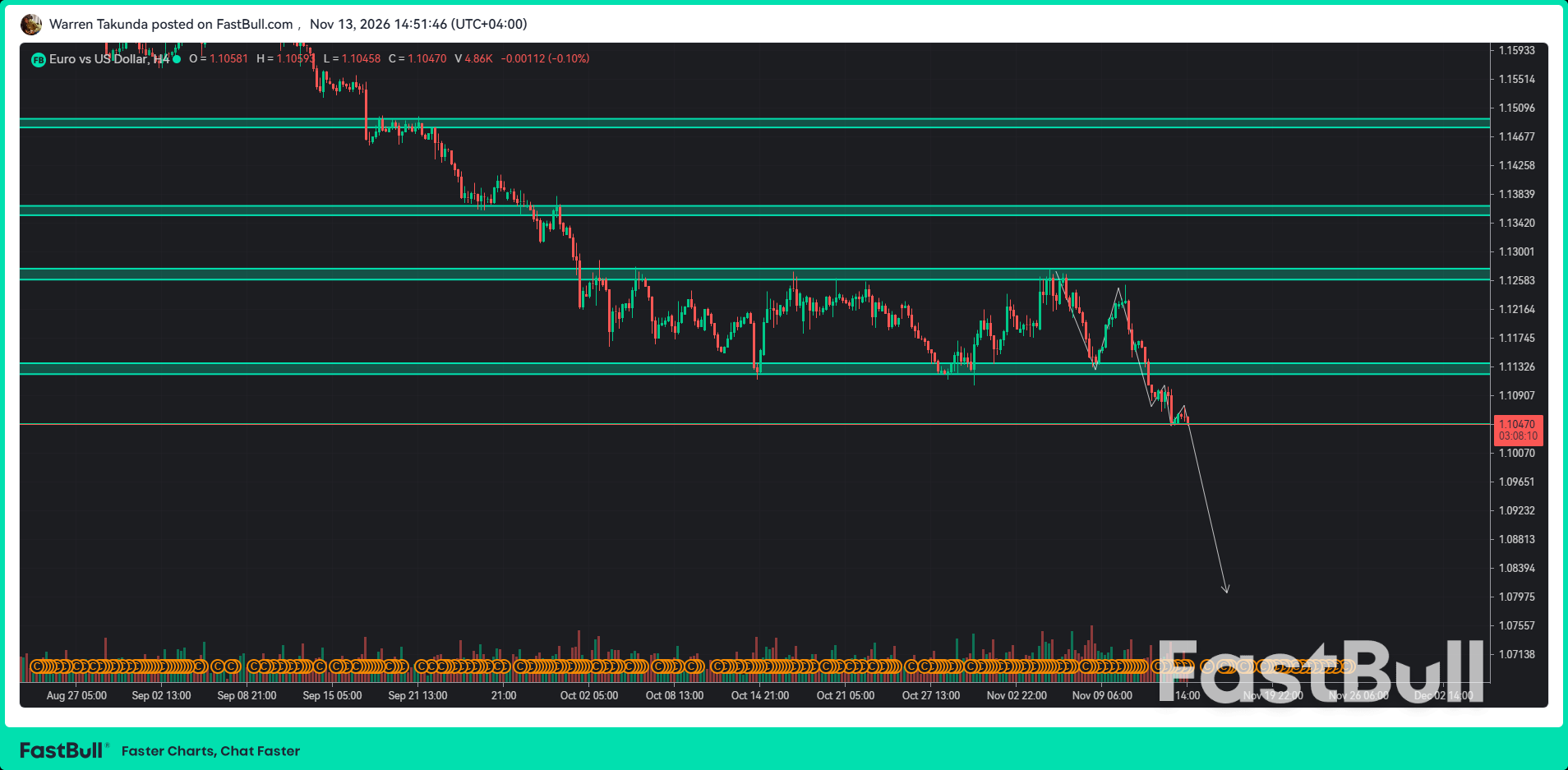
EUR/USD is trading near 1.1047 after breaking below the 1.1122-1.1139 range floor that held for six weeks, a fresh multi-month low. The pair is falling from the 1.1250 bounce high of November 10, which was a lower high beneath the 1.1275 range ceiling that had capped four earlier rallies. The range formed after a long decline from the 1.1650 area, so the breakdown reads as a continuation of the broader downtrend, with a clean sequence of lower highs and lower lows.
The immediate focus is on the 1.1045 low and the 1.1076-1.1105 resistance area, the first low of the breakdown and the lower high that followed. A decisive H4 close below 1.1045 could strengthen bearish momentum and open the door toward 1.1000, followed by 1.0960, the measured move of the roughly 160-pip range projected from the 1.1119 floor. If sellers maintain control, the pair could extend toward 1.0900 and then 1.0805, in line with your projected path.
However, the pair remains vulnerable to a squeeze if it reclaims the broken floor. A rebound above 1.1105 could target the 1.1122-1.1139 zone, now expected to act as supply. A close above 1.1110 would weaken the bearish scenario, and a close back above 1.1139 would turn the move into a failed breakdown and invalidate it.
Overall, EUR/USD has a cautiously bearish short-term outlook, with a sustained break below 1.1045 needed to confirm further downside toward 1.1000 and then 1.0960. Until that breakdown occurs, the pair could still stage a corrective bounce into broken support within the broader downtrend.
TRADE RECOMMENDATION
SELL EUR/USD
ENTRY PRICE: 1.1050
STOP LOSS: 1.1300
TAKE PROFIT: 1.0960


