The EUR/JPY cross edged modestly higher on Friday, hovering around the 186.70 level and posting a marginal 0.06% gain, as investors adopted a cautious stance ahead of a critical week dominated by monetary policy decisions from major central banks. While the move higher appears limited in scope, it reflects a broader market tone defined by hesitation rather than conviction, with traders reluctant to take aggressive positions in the face of competing macroeconomic forces.
The Euro continues to display underlying resilience, offering a degree of support to the cross despite growing signs of economic fragility within the Eurozone. Market participants are largely aligned in their expectations that the European Central Bank will leave interest rates unchanged at its upcoming meeting. However, the policy outlook remains far from straightforward. Rising energy prices—largely driven by ongoing disruptions in the Strait of Hormuz—are beginning to reintroduce inflationary pressures, complicating the ECB’s path forward.
This dynamic has fueled a subtle shift in rhetoric among policymakers. Governing Council member Gediminas Šimkus recently indicated that the possibility of an additional rate hike later this year cannot be dismissed, while firmly ruling out any immediate rate cuts. Such commentary has provided a floor under the Euro, reinforcing expectations that the ECB may be forced to maintain a restrictive stance for longer than previously anticipated. In my view, this evolving narrative is quietly reshaping market positioning, as traders begin to reassess the timing and scale of any future easing cycle.
That said, the Euro’s upside remains constrained by deteriorating economic fundamentals, particularly in Germany—the bloc’s largest economy. The latest IFO Business Climate Index fell to 84.4 in April, missing expectations and signaling a deeper-than-anticipated decline in business sentiment. This data point underscores the growing disconnect between inflation risks and economic momentum, creating a challenging backdrop for policymakers and limiting the Euro’s ability to stage a sustained rally.
On the Japanese side, the Yen continues to trade under the influence of mixed and often conflicting drivers. On one hand, persistent speculation around potential currency intervention, coupled with verbal warnings from Japan’s Finance Ministry, has helped stabilize the Yen and deter excessive weakness. These factors have introduced an element of caution for traders holding long EUR/JPY positions, particularly as the pair remains elevated near multi-year highs.
On the other hand, structural pressures continue to weigh on the Japanese currency. The surge in global energy prices—exacerbated by supply disruptions linked to geopolitical tensions in the Middle East—poses a significant challenge for Japan, a major energy importer. Higher import costs are not only straining the trade balance but also dampening broader economic confidence, limiting the Yen’s ability to mount a meaningful recovery.
The Bank of Japan is widely expected to keep its policy rate unchanged at 0.75% at its upcoming meeting, maintaining a cautious approach to normalization. While recent inflation data show gradual progress, with headline inflation at 1.5% year-on-year, core measures remain below the central bank’s 2% target. This suggests that policymakers are unlikely to accelerate tightening in the near term, even as global inflation risks resurface. In my assessment, this policy divergence—between a relatively hawkish ECB and a still-accommodative BoJ—continues to underpin EUR/JPY, albeit with diminishing momentum.
From a broader perspective, EUR/JPY is increasingly caught between two competing narratives: a Euro supported by inflation concerns and policy rigidity, and a Yen constrained by domestic economic vulnerabilities but intermittently supported by intervention risks. This tug-of-war is likely to keep the pair range-bound in the near term, with volatility potentially increasing as central bank decisions and forward guidance provide fresh directional cues.
Technical Analysis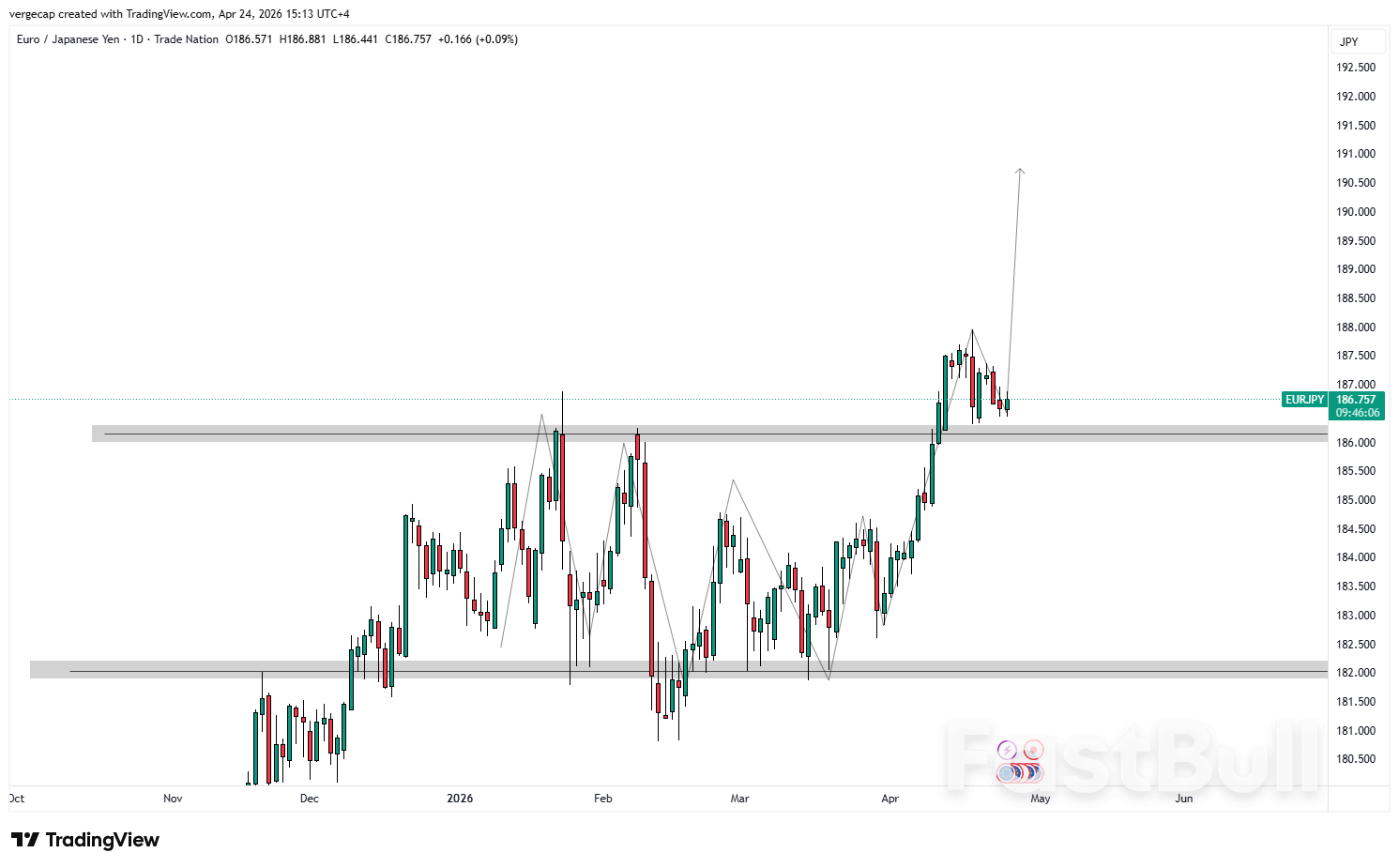
From a technical perspective, EUR/JPY remains entrenched in a broadly bullish structure, with price action on the daily chart signaling a continuation bias despite near-term consolidation. The pair has recently broken above a well-defined horizontal resistance zone around 186.00–186.20, which previously capped upside attempts for several months. This breakout marks a significant shift in market structure, effectively turning former resistance into a new layer of support.
Following the breakout, prices have entered a consolidation phase just above this zone, currently hovering near 186.70. This pause reflects a healthy digestion of recent gains rather than a reversal, as bulls appear to be maintaining control while awaiting fresh catalysts. The cluster of recent candles shows reduced volatility and smaller real bodies, indicative of indecision but not outright weakness.
The broader price structure reveals a sequence of higher highs and higher lows extending from the March bottom, reinforcing the prevailing uptrend. Additionally, the sharp impulsive move that propelled EUR/JPY above 186.00 suggests strong underlying momentum, often characteristic of breakout continuation patterns. The projected price path on the chart also hints at a potential continuation higher, with a measured move targeting the 190.00–191.00 region.
From a support perspective, the 186.00–186.20 zone now serves as immediate and critical support. A sustained break below this level would weaken the bullish structure and expose the next downside target near 182.00, which represents a broader consolidation floor seen in previous months. A deeper decline below 182.00 would signal a more meaningful trend reversal, potentially opening the door toward the 180.00 psychological level.
On the upside, the next key resistance is seen around 188.00, followed by the psychological 190.00 handle. A decisive break above these levels would likely trigger renewed bullish momentum, attracting trend-following flows and reinforcing the continuation of the broader uptrend. Such a move would validate the breakout and confirm that the consolidation phase was merely a pause before the next leg higher.
Momentum dynamics further support a constructive outlook. While specific indicators are not displayed, the price behavior suggests that momentum has moderated following the breakout, rather than reversed. This aligns with a typical bullish continuation pattern, where overextended conditions are worked off through sideways movement rather than sharp declines.
In my view, EUR/JPY is exhibiting classic post-breakout behavior. The ability to hold above the 186.00 support zone will be critical in determining the next directional move. As long as this level remains intact, the path of least resistance appears tilted to the upside, with dips likely to be viewed as buying opportunities rather than signals of a broader reversal.
TRADE RECOMMENDATION
BUY EUR/JPY
ENTRY PRICE: 186.780
STOP LOSS: 185.50
TAKE PROFIT: 190.50


