The Euro extended its decline against the US Dollar on Thursday, as a fresh batch of upbeat US economic data reinforced the narrative of American exceptionalism and further strengthened the Greenback. The EUR/USD pair remained under sustained pressure throughout the session, struggling to regain traction as investors reassessed the outlook for US monetary policy following signs of continued resilience in the labor market and regional manufacturing activity.
The latest figures from the US Department of Labor showed that Weekly Initial Jobless Claims fell sharply to 198,000 for the week ending January 10, well below market expectations of 215,000. The prior week’s reading was also revised lower to 207,000 from 208,000, underscoring a trend of persistently tight labor conditions. Adding to the upbeat tone, the four-week moving average of initial claims dropped to 205,000, down from a revised 211,500, suggesting that layoffs remain limited despite restrictive monetary policy.
Beyond the labor market, US regional manufacturing surveys delivered a notable upside surprise. The New York Fed’s Empire State Manufacturing Index surged into expansionary territory at 7.7, a dramatic improvement from December’s -3.7 reading. Similarly, the Philadelphia Fed Manufacturing Index jumped to 12.6 from -8.8, signaling improving business conditions across key industrial regions. Together, the data painted a picture of an economy that continues to defy expectations of a sharp slowdown.
Markets reacted swiftly. The US Dollar Index (DXY), which measures the Greenback against a basket of six major currencies, climbed to above 99.35, marking its strongest level in more than a month and its highest since early December. The Dollar’s advance reflected renewed confidence that the Federal Reserve will have little urgency to ease policy aggressively, particularly while economic momentum and labor-market strength remain intact.
Comments from Federal Reserve officials reinforced that view. Chicago Fed President Austan Goolsbee welcomed the strong data, saying he was “not surprised” by the low jobless claims reading and emphasizing that the US labor market continues to show underlying strength. Goolsbee described overall economic growth as “good” and noted that recent figures point to ongoing labor-market stability. While he reiterated his expectation that the Fed could cut interest rates later this year, he stressed that policymakers need sustained evidence—particularly on inflation—before committing to that path. Importantly, he cautioned that while rates “can still go down a fair amount,” the central bank’s overriding priority remains returning inflation to its 2% target.
In contrast, Atlanta Fed President Raphael Bostic adopted a more hawkish and cautious stance. Bostic warned that inflation remains uncomfortably high and argued that monetary policy must stay restrictive for longer. He projected that inflationary pressures could persist well into 2026, even as economic growth remains resilient. Bostic expects US GDP growth to stay above 2% through 2026, reinforcing the case for a slower and more measured approach to rate cuts than markets had previously anticipated.
For the Euro, the backdrop remains far less supportive. The single currency has struggled to attract buyers amid softer Eurozone growth prospects, fading disinflation momentum, and the growing divergence between the European Central Bank and the Federal Reserve. With US data consistently surprising to the upside and Fed officials pushing back against expectations of rapid easing, EUR/USD remains vulnerable to further downside.
Technical Analysis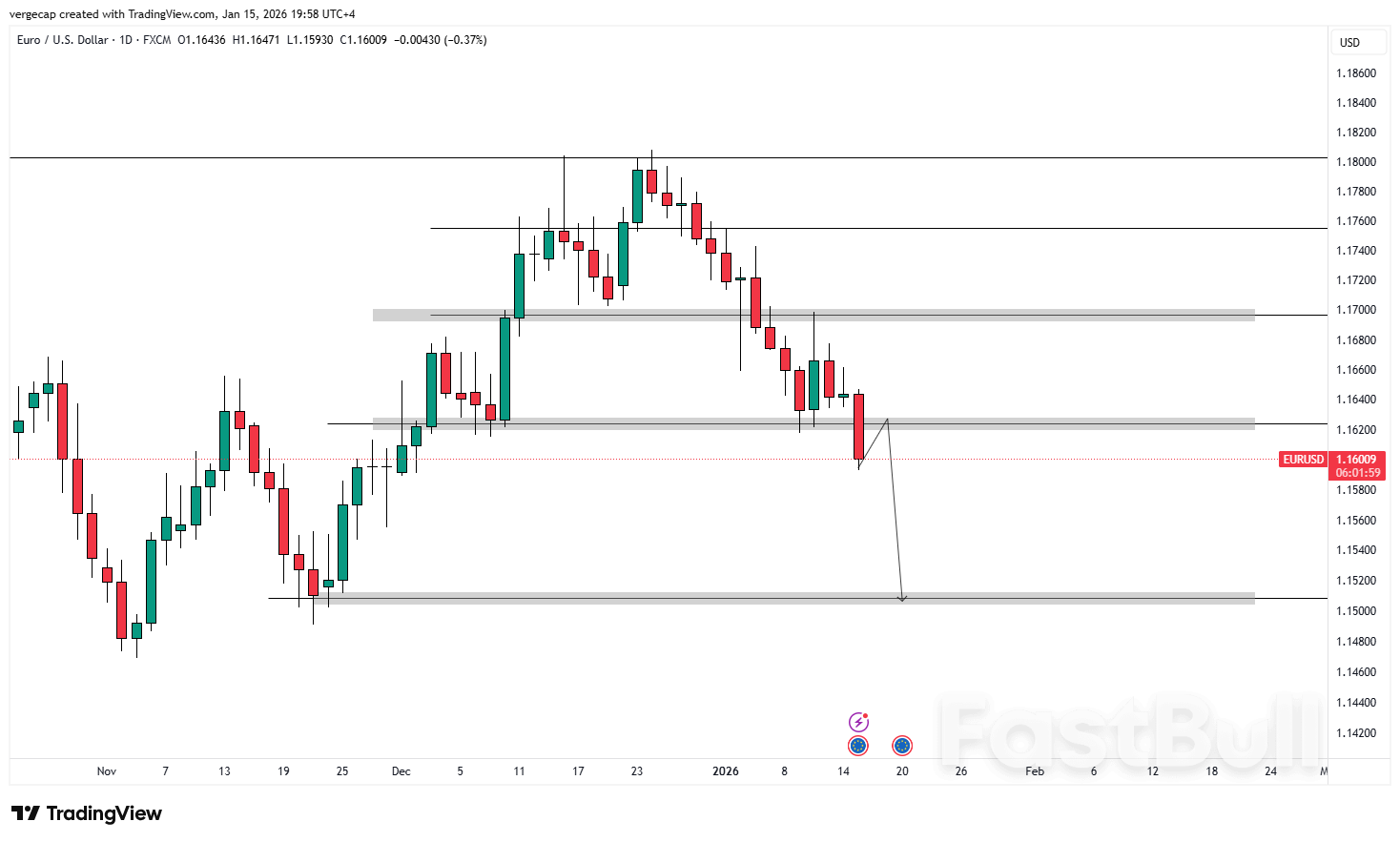
From a technical perspective, the pair has now reached a critical support zone between 1.16151 and 1.16364. This area has acted as a key demand region in recent sessions, but repeated tests have weakened its defensive strength. A decisive break and daily close below this support band would likely confirm a bearish continuation pattern, opening the door to deeper losses.
Bearish Scenario:If EUR/USD breaks and sustains trade below the 1.16151–1.16364 support zone, selling pressure could accelerate as stop-loss orders are triggered and momentum indicators turn decisively negative.Downside Target: 1.14830
TRADE RECOMMENDATION
SELL EURUSD
ENTRY PPRICE: 1.1610
STOP LOSS: 1.16800
TAKE PROFIT: 1.14830


