In the chess game of central banking, a single session’s price action can often obscure the broader strategic shift unfolding on the board. This is precisely the scene playing out in the Euro Sterling cross this Friday. While the EUR/GBP pair has surrendered ground, dipping to session lows near 0.8685 after failing to sustain a break above the psychologically significant 0.8700 barrier, market participants would be wise to look beyond the daily squall. The real story is found in the weekly candle, which is set to close in the green for the first time in eight weeks—a seemingly modest gain that belies a fundamental recalibration of interest rate expectations across the English Channel.
The fuel for this shift is pure, unadulterated policy divergence. This week’s twin central bank decisions from Frankfurt and London were not the synchronized holds that a cursory glance at headline rates might suggest. Instead, they revealed a deepening chasm in outlook, communication, and impending action. The European Central Bank, under President Christine Lagarde, executed a masterclass in hawkish inertia. Holding rates was a foregone conclusion, but Lagarde’s dismissal of inflation risks from a strong Euro and her repeated assertion that policy is in a “good place” sent a clear, steel-edged message: the Governing Council is in no rush to entertain the cutting cycle that money markets have been eagerly pricing. The subsequent near-0.7% rally in the Euro on Thursday was a direct testament to markets parsing this stubborn stance.
Conversely, across the North Sea, the Bank of England delivered what can only be interpreted as a dovish hold with a side of explicit guidance. While the decision to maintain the Bank Rate at 5.25% was unanimous, the critical revelation was buried in the details of the Monetary Policy Committee vote: a faction of four members, double the number anticipated by consensus forecasts, voted for an immediate 25-basis-point cut. This was not a mere dissenting whisper; it was a declaration that the debate within the MPC has decisively pivoted from if to when and how fast.
Governor Andrew Bailey then amplified this signal. His expression of confidence that inflation will return to the 2% target “sooner than expected” was a deliberate piece of forward guidance, effectively pre-announcing the Bank’s intention to ease policy more aggressively in the coming quarters. The market heard him loud and clear, bringing forward expectations for the first cut to June and pricing in a significantly steeper path for 2024. The Pound, accordingly, found itself on the back foot, supplying the thrust for the EUR/GBP’s weekly ascent.
Friday’s pullback, therefore, represents not a reversal of this theme, but a sobering pause—a reminder that the Eurozone’s economic foundation remains worryingly fragile. The catalyst was a dire industrial production report from Germany, the bloc’s economic engine. Data from Destatis revealed a shocking 1.9% monthly collapse in output for December, violently overshooting the already grim forecast of a 0.3% decline. To compound the misery, November’s figure was revised down to a paltry 0.2% growth from a previously reported 0.8%. This data paints a picture of an industrial sector mired in a profound slump, grappling with weak external demand, high energy costs, and persistent structural challenges. It’s a stark counterpoint to the ECB’s confident rhetoric and inevitably triggers questions about how long Frankfurt can maintain its restrictive stance in the face of such glaring economic weakness.
Technical Analysis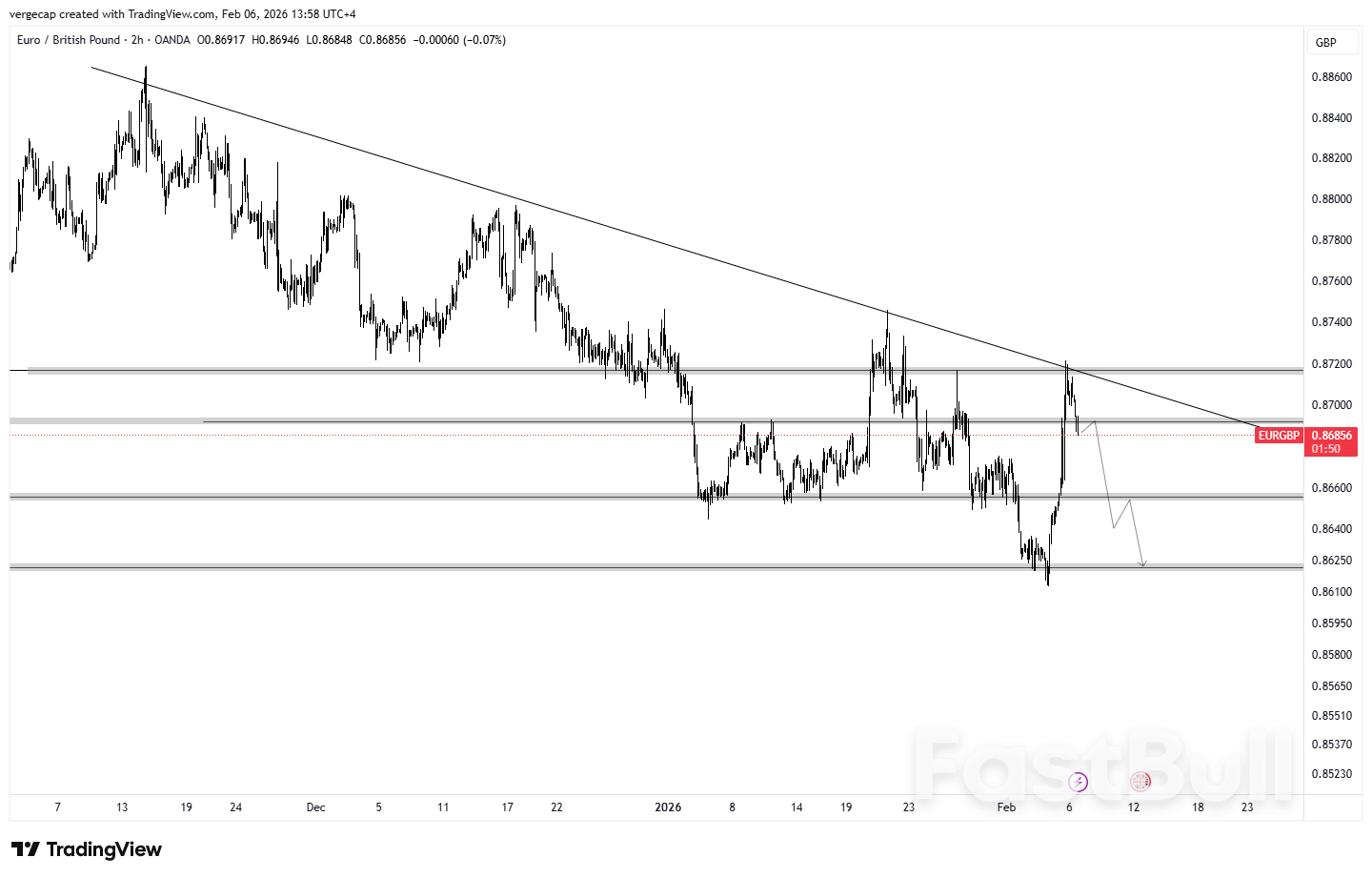
From a technical perspective, EUR/GBP remains entrenched in a broader bearish structure on the 2-hour chart, with price continuing to respect a long-term descending trendline that has capped rallies since late 2025. The recent rally into the 0.8700–0.8720 resistance zone resulted in a sharp rejection precisely at the confluence of horizontal resistance and descending trendline supply, reinforcing the dominance of sellers at higher levels.
Price action shows a clear sequence of lower highs, confirming that the prevailing trend remains to the downside despite intermittent corrective rallies. The pair recently rebounded from the 0.8620 support zone and staged a corrective push higher, but the inability to sustain momentum above 0.8700 suggests the move was corrective rather than the start of a bullish reversal.
The 0.8680–0.8700 region now acts as a near-term pivot, and the rejection from this zone indicates increasing downside pressure. As long as price remains below the descending trendline and the 0.8720 resistance band, the path of least resistance favors a continuation lower.
A sustained move below the 0.8650–0.8660 support zone would confirm bearish continuation and expose the 0.8620 region, which represents the next key support level and aligns with recent swing lows. A break beneath this area would open the door toward 0.8580–0.8600, marking a full downside rotation within the broader downtrend.
On the upside, bulls would need a decisive break and acceptance above 0.8720, followed by a move above the descending trendline, to invalidate the bearish structure and shift focus toward 0.8780–0.8800. Until such a breakout occurs, rallies are likely to be viewed as selling opportunities within the prevailing downtrend.
Momentum conditions suggest corrective consolidation within a bearish trend rather than trend exhaustion, supporting expectations for renewed downside pressure following the recent rejection.
TRADE RECOMMENDATION
SELL EUR/GBP
ENTRY PRICE: 0.8686
STOP LOSS: 0.8730
TAKE PROFIT: 0.8620


