A tepid attempt by the euro to claw back lost ground fizzled out ahead of the 1.1490 handle on Tuesday, with the common currency quickly succumbing to renewed selling pressure following a softer-than-expected reading of Eurozone inflation. The single currency now finds itself entrenched near two-week lows at 1.1465, on pace to close out March with a bruising decline of nearly 3%—a stark reminder of the dollar’s persistent strength as geopolitical uncertainty and monetary policy divergence keep traders on edge.
Preliminary data released Tuesday from Eurostat showed the Eurozone Harmonised Index of Consumer Prices (HICP) rose at a 2.5% annual pace in March, undershooting consensus forecasts that had pointed to a 2.7% print. While the headline figure marked a notable acceleration from February’s 1.9% reading, the modest miss was enough to snuff out the morning’s fragile recovery. On a month-on-month basis, consumer inflation jumped to 1.2%, double the 0.6% increase recorded in the prior month, underscoring the persistent upward pressure on prices across the bloc.
Perhaps more telling for the European Central Bank’s policy calculus, core HICP—which strips out volatile food and energy prices—unexpectedly eased to a 2.3% year-on-year rate in March. Economists had forecast a steady reading at 2.4%, and the slight downside surprise briefly raised eyebrows in a market that has grown accustomed to upside inflation shocks. Yet for all the chatter about softening underlying price pressures, the market’s reaction was remarkably contained.
Why the muted response? Because these numbers, while marginally softer than anticipated, do little to derail the prevailing narrative that the ECB is running out of patience. With headline inflation still sitting comfortably above the central bank’s 2% target—and energy prices continuing to spiral amid the ongoing conflict in the Middle East—the path to an April rate hike remains firmly intact. Consumer prices in the Eurozone are not only elevated but are widely expected to climb further as the war in Iran keeps oil markets on edge and supply chain disruptions threaten to feed through to broader costs.
ECB President Christine Lagarde effectively pre-committed to that outcome last week, signaling in no uncertain terms that the governing council stands ready to raise interest rates if the projected increase in inflation proves more than a temporary phenomenon. Having spent much of the past two years battling a narrative that it was behind the curve, the ECB now appears determined to act preemptively. For currency markets, that means the euro’s near-term fate will be dictated less by incremental data surprises and more by how aggressively the central bank ultimately moves—and whether the Federal Reserve’s own trajectory diverges in the months ahead.
But for now, the dollar continues to wield the upper hand, buoyed not only by the Federal Reserve’s comparatively hawkish stance but also by its perennial status as the ultimate safe haven. The war in Iran shows no signs of abating, and the conflict continues to cast a long shadow over global risk sentiment. The Strait of Hormuz, a chokepoint through which roughly one-fifth of global oil production flows, remains a flashpoint. Recent reporting from The Wall Street Journal suggested that the Trump administration may be quietly considering a path toward ending the conflict—even if the strait stays closed—though such deliberations remain shrouded in the kind of back-channel ambiguity that does little to soothe jittery markets.
Publicly, President Trump has struck a far more combative tone, reiterating threats to obliterate Iran’s energy infrastructure should Tehran refuse to reopen the critical waterway. Iranian officials, for their part, have dismissed U.S. peace overtures as “unrealistic,” leaving the region locked in a tense stalemate that shows few signs of resolution. Against this backdrop, the dollar’s appeal as a store of value remains difficult to challenge, and any euro recovery attempt is likely to face stiff resistance unless there is a decisive shift in either the geopolitical landscape or the relative monetary policy outlook.
Technical Analysis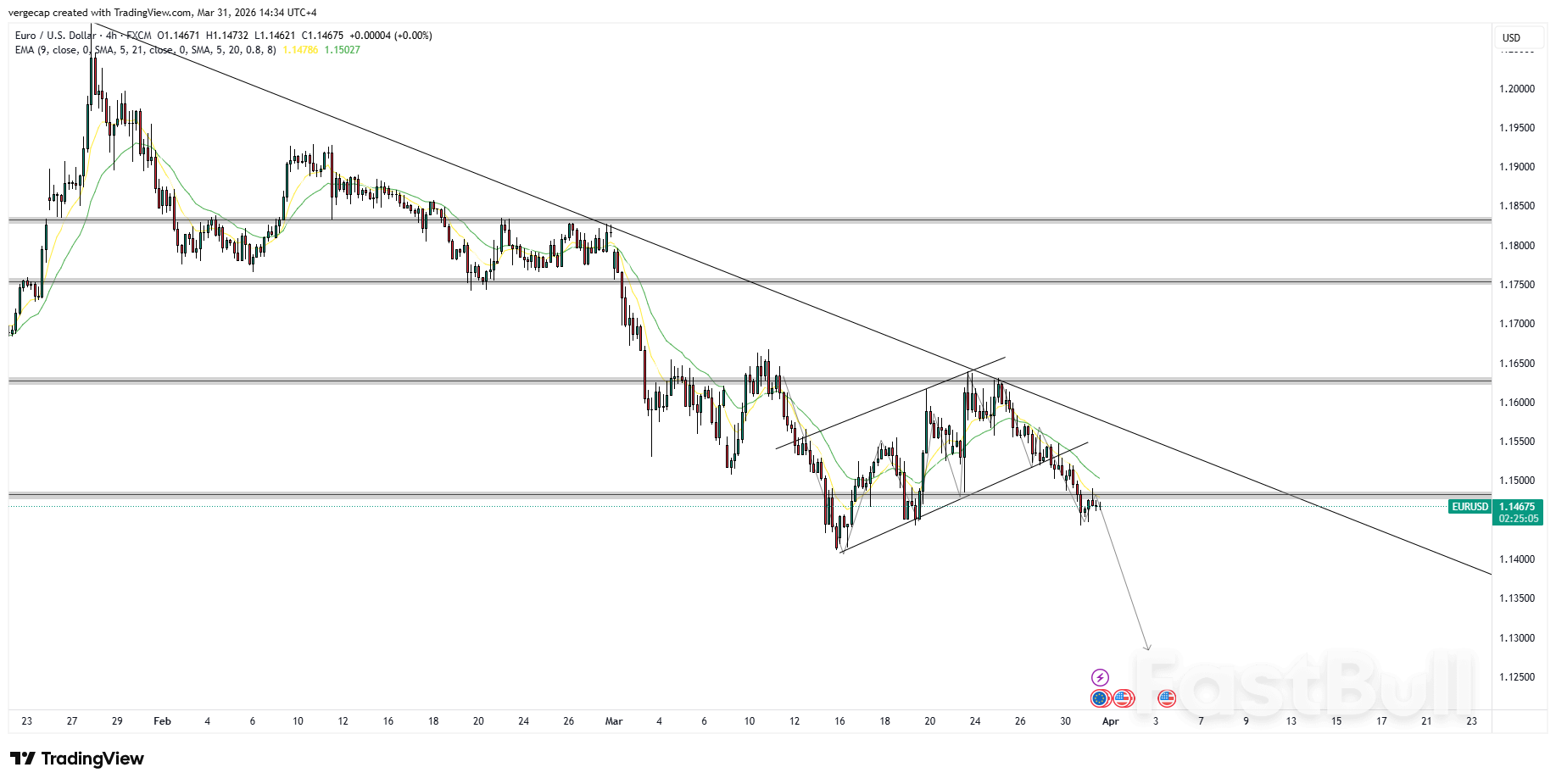
From a technical perspective, EUR/USD is firmly entrenched in a deteriorating bearish structure on the 4-hour chart, with price completing what appears to be a textbook symmetrical triangle breakdown that has now opened the door to a significantly deeper corrective move. After peaking near the 1.2000 psychological ceiling in late January 2026 — a level that proved an insurmountable wall for euro bulls — the pair has been locked in a relentless sequence of lower highs and lower lows that has progressively stripped away layer after layer of support, leaving the technical landscape decidedly and convincingly bearish heading into April.
The symmetrical triangle pattern that formed throughout March, bounded by a descending resistance trendline capping every recovery attempt and an ascending support trendline containing the downside, has now resolved in the direction of the dominant trend — lower. This is a critical development. Symmetrical triangles are continuation patterns by nature, and the fact that this one has broken to the downside — in alignment with the prevailing multi-month downtrend from the 1.2000 highs — carries significant technical weight. The breakdown was not a tentative or ambiguous affair; price has closed multiple 4-hour candles below the triangle's lower boundary near the 1.1500 area, confirming the pattern's resolution with conviction.
The 9-period EMA, currently sitting at 1.1479, and the 21-period SMA at 1.1503 have both rolled decisively lower and are now positioned above the current price of 1.1468, acting as dynamic resistance rather than support. This bearish inversion of the moving average stack — with price trading beneath both averages as they slope downward in tandem — is a clear and unambiguous signal that momentum belongs entirely to the sellers. Any attempted recovery that fails to reclaim and sustain above the 1.1500 level should be treated as a corrective bounce within the developing bearish sequence and a fresh opportunity for short positioning rather than a genuine reversal signal.
The 1.1450–1.1475 zone, which represents the current price action area and aligns with a prior support shelf established during the early March lows, is now the immediate battleground. A failure to hold this level on a closing basis would accelerate the move toward the first meaningful downside target at 1.1300–1.1350 — a zone that aligns with the measured move projection of the triangle breakdown drawn on the chart and represents the next significant horizontal support on the broader timeframe. The projected extension visible on the chart points toward an even deeper target around the 1.1250–1.1275 area, which would represent a nearly full retracement of the Euro's remarkable rally from the 1.0500 region that began in late 2025.
Below 1.1250, the technical picture becomes significantly more alarming for euro bulls, with the 1.1200 psychological threshold and ultimately the 1.1000 round number coming into view as medium-term downside objectives should the fundamental backdrop continue to deteriorate in favor of the US Dollar.
On the upside, the path back to bullish credibility for EUR/USD is steep and littered with obstacles. The broken triangle support — now resistance — sits near 1.1500, representing the first barrier any recovery must overcome. Above that, the 1.1500–1.1650 zone is densely populated with prior support-turned-resistance levels that would be expected to cap any corrective bounce aggressively. A full reclaim above 1.1650 would be needed to meaningfully challenge the bearish thesis, while only a sustained move back above 1.1800 would signal that the corrective structure from the 1.2000 highs has been genuinely repaired. Neither scenario appears remotely likely based on the current technical configuration.
The broader descending structure from 1.2000 — defined by the dominant falling trendline connecting the January peak to the series of lower highs throughout February and March — remains fully intact and continues to exert gravitational pressure on any recovery attempt. Until this trendline is convincingly breached to the upside, the bias must remain firmly bearish on every timeframe, with rallies treated as selling opportunities rather than reversal signals.
TRADE RECOMMENDATION
SELL EUR/USD
ENTRY PRICE: 1.1465
STOP LOSS: 1.1620
TAKE PROFIT: 1.1270


