The euro inched higher against the British pound during European trading hours on Thursday, a modest advance that did little to mask the deepening fissures within the Eurozone economy. The single currency’s fleeting strength was fueled almost entirely by verbal intervention from the European Central Bank’s most prominent hawk, yet the rally lacked conviction as dismal sentiment data out of Germany underscored the precarious tightrope the bloc now walks.
At its core, the EUR/GBP pair’s latest price action tells a story of a currency propped up by central bank rhetoric while being dragged down by a real economy showing clear signs of stagnation. The pair remains entrenched in a choppy, sideways trading cycle, reflecting a market that sees little reason to commit decisively in either direction.
The spark for Thursday’s cautious euro buying came from Bundesbank President Joachim Nagel, who delivered remarks that will likely sharpen the focus on the ECB’s April policy meeting. Speaking earlier in the day, Nagel made clear that another interest rate hike is very much on the table, specifically if geopolitical tensions—namely the war in the Middle East—begin to manifest in a fresh wave of inflationary pressure across the currency bloc.
"An interest rate hike in April will be an option," Nagel stated, framing the decision as a direct response to potential supply-side shocks. It was a characteristically direct intervention from Germany’s top central banker, one that serves as a pointed reminder that the ECB’s governing council remains deeply divided on the path forward, even as the market begins to price in rate cuts for the back half of the year.
Nagel’s hawkish salvo followed remarks from ECB President Christine Lagarde on Wednesday, who reiterated that the institution would be forced to act “in a forceful and persistent way” should consumer inflation show signs of settling well above the 2% target. Taken together, the messaging from the ECB’s two most influential voices is clear: the fight against inflation is not over, and the market may be getting ahead of itself in pricing in an imminent pivot.
Yet for all the hawkish bravado, investors are not buying the euro with any real conviction. The reason lies in the widening chasm between central bank policy signaling and the grim reality of the Eurozone’s economic engine.
Data released Thursday painted a particularly bleak picture of consumer sentiment in Germany. The GfK Consumer Confidence Index plunged to -28 heading into April, a sharp deterioration from the previous month’s -24.8 reading. The decline was steeper than even the most pessimistic forecasts, suggesting that the German consumer—traditionally the backbone of the Eurozone economy—is battening down the hatches in anticipation of a sustained period of economic pain.
This was not an isolated data point. Wednesday’s German IFO Business Climate index, while beating the lowest estimates, still showed a deterioration in sentiment, confirming that corporate Germany is growing increasingly pessimistic. More alarmingly, the latest Purchasing Managers’ Index (PMI) survey underscored the primary threat to any nascent recovery: energy prices. With energy costs remaining stubbornly elevated, the survey highlighted the risk that a rebound in economic activity could be choked off before it even truly begins.
The confluence of these data points presents a near-impossible dilemma for the ECB. The prospect of higher borrowing costs—potentially as soon as next month—comes at a moment when the region’s largest economy is flashing warning signs of a potential recession. This is the classic stagflationary setup that central bankers dread: persistent inflation coinciding with stagnating growth. It is precisely this dynamic that is keeping investors wary and weighing heavily on demand for the common currency. A rate hike in April may bolster the euro temporarily, but it also risks further crippling an already fragile economy.
Across the Channel, the British pound is faring little better, which explains why the EUR/GBP cross remains trapped in a narrow trading range. Sterling is grappling with its own version of the inflation-growth conundrum, albeit with a slightly different nuance.
Recent UK inflation data revealed that consumer prices remained at 3%, a level that is particularly noteworthy because it was recorded before the recent escalation in Middle East tensions and the resultant spike in energy markets. This pre-conflict stickiness in inflation has reset market expectations for the Bank of England. Traders are now increasingly convinced that the BoE will be forced to deliver more than one rate hike this year, a significant shift in sentiment from just weeks ago.
However, similar to the euro, the pound finds itself in a difficult position. While the prospect of a more aggressive BoE might ordinarily underpin the currency, the UK economy is hardly in a position to absorb higher borrowing costs. The market appears to be pricing in a central bank that will be forced to choose between taming inflation and avoiding a prolonged downturn, a choice that is unlikely to yield a clear, unidirectional path for sterling.
Technical Analysis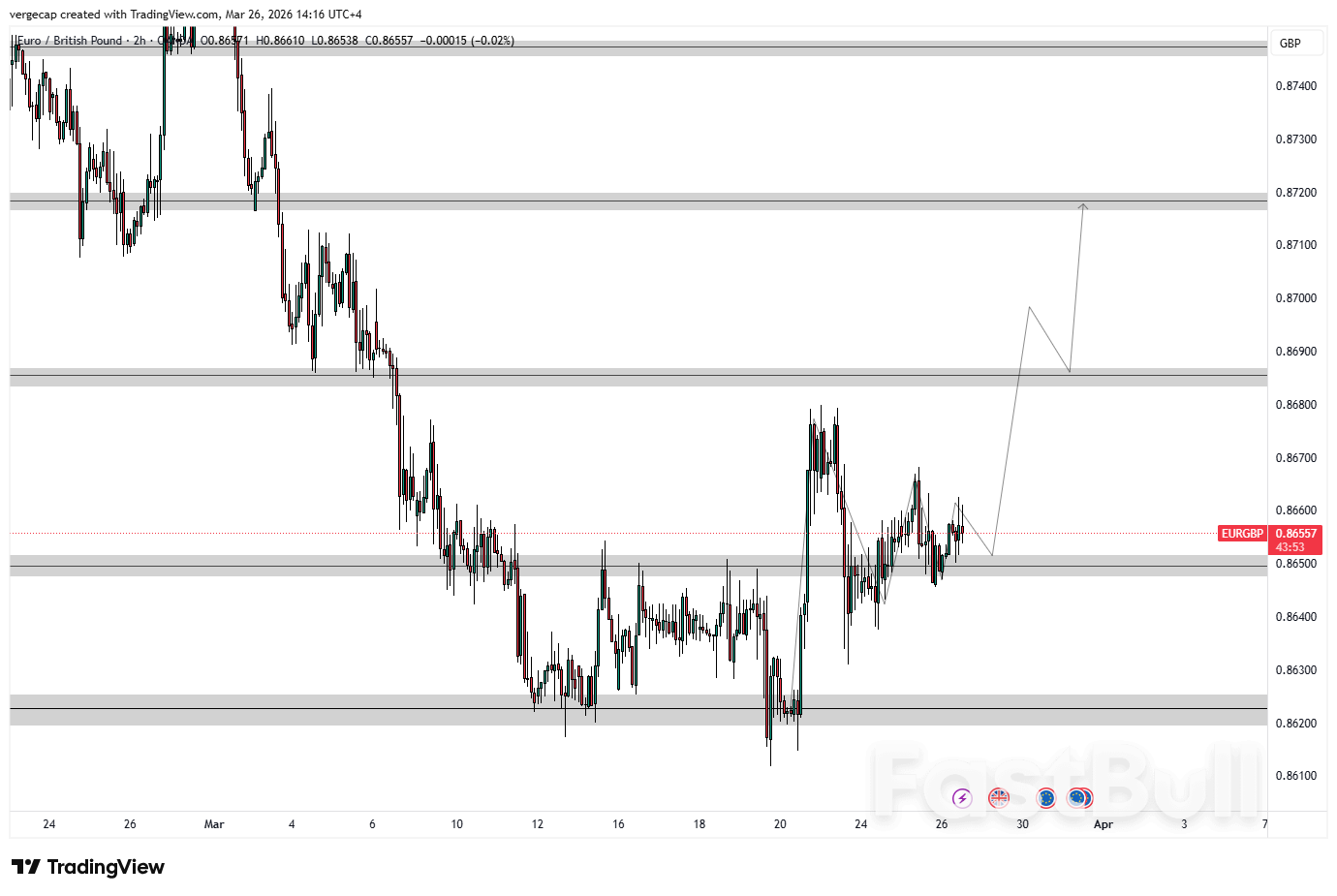
From a technical perspective, EUR/GBP appears to be transitioning out of a broader downtrend into a potential short-term recovery phase. On the 2-hour chart, price action has shifted from a clear bearish structure—characterized by lower highs and lower lows—into a consolidation base around the 0.8620–0.8650 region. This zone has repeatedly acted as a key support area, absorbing downside pressure and signaling the presence of demand.
Recent price action shows a gradual series of higher lows forming, suggesting early signs of accumulation. The pair is currently trading near 0.8655, just above a minor support band, with price attempting to stabilize after a sharp rejection from the 0.8680–0.8700 resistance zone. This indicates that while buyers are stepping in at lower levels, bullish momentum remains fragile and requires confirmation through a break of overhead resistance.
The broader structure highlights multiple supply zones above current price. The first significant resistance lies near 0.8680–0.8700, which previously acted as a rejection point following the recent impulsive rally. A sustained break above this region would likely trigger a continuation toward the 0.8720 level, followed by a more critical resistance band around 0.8750–0.8760. This upper zone represents a major supply area aligned with prior breakdown levels, making it a key target for bullish continuation.
On the downside, immediate support is located around 0.8640–0.8650, with stronger structural support at 0.8620. A decisive break below this lower boundary would invalidate the developing bullish structure and reintroduce bearish momentum, exposing downside targets toward 0.8600 and potentially the 0.8580 region, where previous consolidation occurred.
Momentum dynamics support the case for consolidation rather than a confirmed trend reversal. Price action lacks strong impulsive follow-through, instead forming a choppy, range-bound structure typical of accumulation phases. This suggests that the market is building liquidity before a more decisive directional move.
Overall, EUR/GBP is at a pivotal inflection point. A breakout above 0.8700 would confirm a short-term bullish reversal and open the path toward higher resistance zones, while a failure to hold above 0.8620 would likely reinforce the broader bearish trend.
TRADE RECOMMENDATION
BUY EUR/GBP
ENTRY PRICE: 0.8657
STOP LOSS: 0.8615
TAKE PROFIT: 0.8720


