A peculiar calm has settled over currency markets Thursday, with the Euro staging a modest, almost tentative, recovery against the US Dollar. Trading at 1.1880 as of New York open, the single currency has crawled higher from Wednesday’s weekly trough of 1.1833. Yet to characterize this movement as a genuine rebound would be premature. Rather, we are witnessing the market catch its breath—a pause for reflection following the seismic—and somewhat deceptive—jolt delivered by the January Nonfarm Payrolls report.
On the surface, the numbers were a triumph. The US economy added 130,000 net new jobs, nearly double the paltry 70,000 consensus forecast. The Unemployment Rate ticked down to a tidy 4.3%. For the Biden administration’s economic legacy, and for incoming Fed Chair Kevin Warsh, this was the validation they had been waiting for. But beneath the headline, the architecture of the report reveals hairline fractures that traders, notoriously eagle-eyed, have been quick to spot.
Let’s talk about quality versus quantity. Healthcare employment—a sector historically resilient but notoriously low-productivity in terms of GDP contribution—accounted for nearly two-thirds of total payroll creation. Furthermore, the Bureau of Labor Statistics’ annual benchmark revision lopped a significant chunk off previously celebrated 2025 figures. This isn’t the broad-based, industrial-strength labor market the hawks at the Federal Reserve want you to believe in. It is a market surviving on life support in specific verticals, while manufacturing and interest-rate-sensitive sectors continue to hold their breath.
That said, context is everything. The ADP and JOLTS data from last week painted a rather gothic picture of the American employment landscape, rife with slowing hiring and cooling demand. Against that backdrop, Wednesday’s NFP print, even with its imperfections, has successfully cauterized the worst of the recessionary fears. The patient is not dying; they are just not running marathons.
Perhaps the most significant realignment has occurred in the interest rate futures complex. The CME FedWatch Tool tells a story of aggressive repositioning. The probability of a rate cut in March—which, let us not forget, was once considered a lock by some overly optimistic fixed-income desks—has imploded to just 5%, down from 20% before the payrolls data hit terminals. Similarly, April has seen odds slashed to 20% from north of 40%.
This recalibration feels rational. With Kevin Warsh set to assume the Chairmanship at the Fed’s first monetary policy meeting under his tenure, the prevailing sentiment on the Street is that he will demand a full quarter of data—at minimum—before sanctioning any dovish pivot. As it stands, June remains the line in the sand, with futures pricing a 60% chance of liftoff. However, with headline CPI still sticky and consumer spending holding up, even that timeline feels vulnerable to further hawkish repricing.
For the Euro, this dynamic has relegated it to the role of a reactive currency. Without a dramatic widening in transatlantic rate differentials—and currently, the market is narrowing them—the upside for EUR/USD remains capped. The pair is clinging to 1.1880, but it lacks the conviction of genuine bullish momentum.
Today’s calendar offers little to shift the tectonic plates. We have a rotation of European Central Bank speakers taking the podium: Chief Economist Philip Lane, Board member Piero Cipollone, and Bundesbank’s Joachim Nagel. Expect the usual catechism—data-dependence, vigilance on inflation—but do not expect fireworks. The ECB is firmly in a holding pattern, waiting to see if US demand softens sufficiently to drag down global inflation dynamics.
Across the Atlantic, Initial Jobless Claims and Pending Home Sales offer potential volatility sparks, but they are ultimately sideshows. The main event is Friday’s Consumer Price Index. That release will be the true arbiter of the Fed’s summer schedule. A hot number here, and even June cuts will start looking shaky. A cool print, and the Euro may finally find the runway for a sustained push toward 1.1950.
Technical Analysis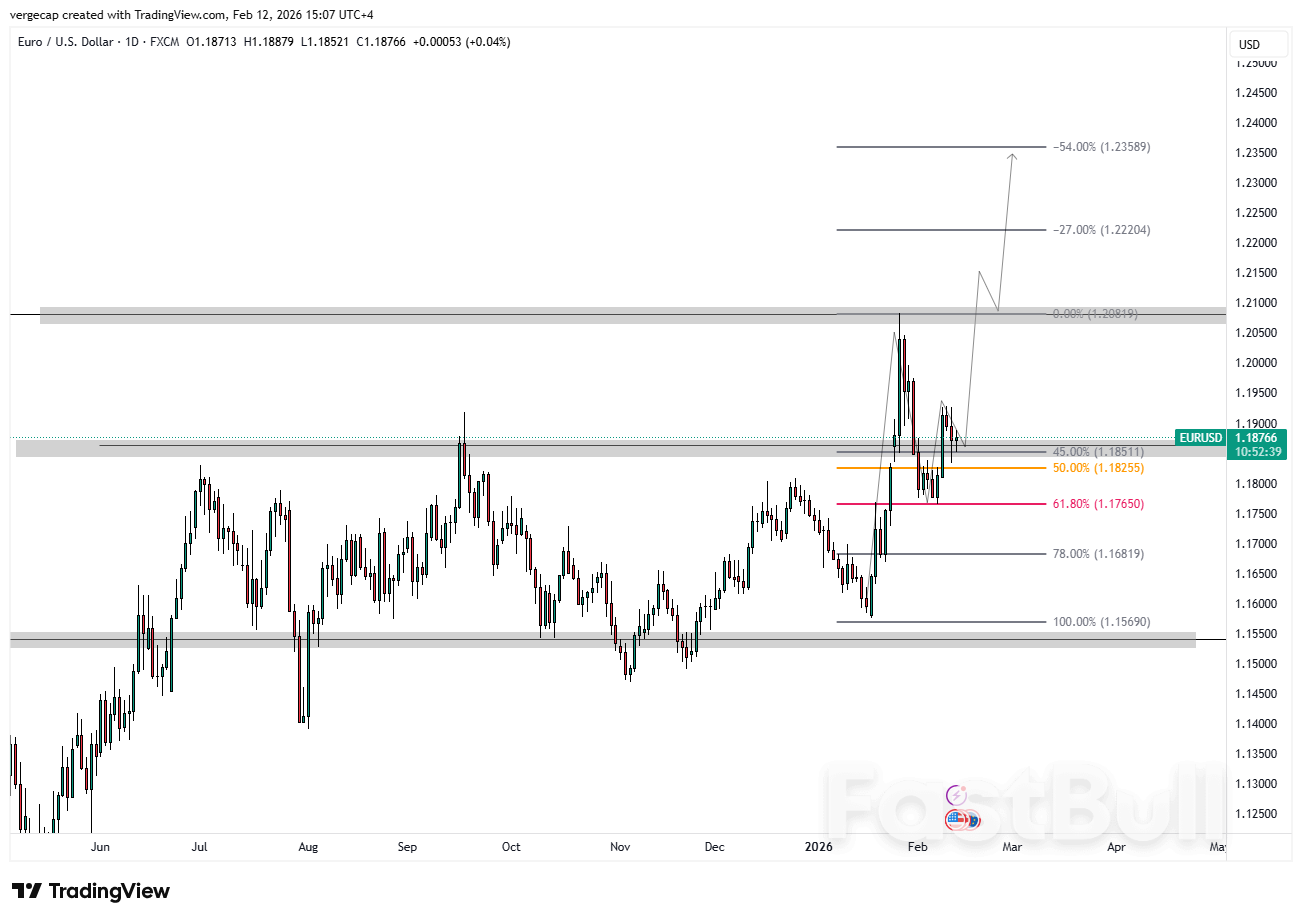
From a technical perspective, EUR/USD is transitioning into a broader bullish reversal structure on the daily chart, following a powerful impulsive rally from the 1.1560 base. Price has decisively broken out of its prior multi-month consolidation range and is now undergoing a measured pullback into key Fibonacci retracement levels, suggesting corrective behavior rather than trend failure.
The recent surge peaked just beneath the 1.2100 major resistance zone, which aligns with a long-standing horizontal supply area. This region has historically capped upside attempts and remains the primary barrier for bulls. After testing this zone, price retraced into the 45%–61.8% Fibonacci retracement band (1.1850–1.1765), where buyers appear to be stabilizing the market.
The 50% retracement level near 1.1825 is acting as an immediate pivot, with price currently hovering slightly above it. This level represents equilibrium within the recent impulse leg and is often a key decision point in trending markets. Below that, the 61.8% retracement at 1.1765 serves as stronger structural support. A sustained break beneath this level would suggest the pullback is deepening and could expose the 78.6% retracement near 1.1680, with the 1.1560 swing low remaining the ultimate invalidation point for the bullish reversal structure.
On the upside, bulls are focused on reclaiming and holding above 1.1900, which would confirm higher-low formation and reestablish upward momentum. A decisive breakout above 1.2100 would mark a significant structural shift, clearing multi-month resistance and opening the path toward the 1.2220 (−27% extension) and potentially the 1.2350–1.2360 region (−54% extension) as projected by the measured move on the chart.
The broader technical landscape reflects a classic impulse–correction sequence. The strong vertical rally indicates aggressive demand, while the current consolidation within Fibonacci support suggests controlled profit-taking rather than distribution. As long as price remains above 1.1765 on a sustained daily basis, the structure favors continuation higher.
A daily close below 1.1765 would weaken the bullish case and shift focus toward 1.1680. A breakdown below 1.1560 would invalidate the reversal thesis and signal a return to the prior range environment.
Overall, EUR/USD remains technically constructive, with the current pullback offering a potential re-entry zone within a developing bullish trend.
TRADE RECOMMENDATION
BUY EUR/USD
ENTRY PRICE: 1.1870
STOP LOSS: 1.1745
TAKE PROFIT: 1.2220


