The Euro strengthened against the US Dollar on Friday, pushing higher toward the top of its weekly range as a sudden bout of volatility in currency markets—triggered by suspected intervention from Japanese authorities—sent the Greenback broadly lower. At the time of writing, EUR/USD is trading near 1.1742, just shy of the 1.1755 level, as investors reassess short-term Dollar positioning amid shifting global dynamics.
The catalyst behind the latest move appears to stem from a sharp and abrupt decline in USD/JPY during the early European session. The pair plunged nearly 200 pips within seconds, a move widely interpreted by market participants as a second round of intervention by Tokyo in as many days. The timing—coinciding with thinner liquidity conditions due to Labour Day in several major markets—likely amplified the impact, allowing the move to ripple quickly across the broader foreign exchange complex.
This sudden drop in USD/JPY triggered a wave of Dollar selling, reversing earlier gains and providing a tailwind for major counterparts, including the Euro. EUR/USD, which had been trading under modest pressure earlier in the session, quickly regained upside momentum, extending its recovery from Thursday’s lows near 1.1655.
Beyond the immediate impact of intervention-driven flows, the Euro continues to draw support from shifting expectations around monetary policy in the Eurozone. On Thursday, the European Central Bank delivered what many analysts characterized as a “hawkish hold,” keeping interest rates unchanged while signaling that further tightening remains firmly on the table. The central bank’s communication suggested that inflation risks continue to dominate the policy outlook, even as growth concerns linger in the background.
That stance was reinforced by Joachim Nagel, President of the Bundesbank and a member of the ECB’s Governing Council, who indicated that a more restrictive monetary policy remains the baseline scenario. Notably, Nagel pointed to the possibility of a rate hike as early as June, underscoring the central bank’s willingness to act if inflationary pressures persist.
In my view, this evolving policy narrative is playing a crucial role in anchoring the Euro’s resilience. Despite signs of economic softening, including weaker-than-expected GDP data, markets appear increasingly focused on the inflation side of the equation. Recent price data from the Eurozone has come in hotter than anticipated, reinforcing expectations that the ECB may need to maintain a tighter stance for longer than previously assumed.
However, the broader macroeconomic backdrop remains far from supportive. The ongoing geopolitical tensions in the Middle East continue to cast a long shadow over global markets. The standoff between the United States and Iran shows little sign of de-escalation, with the strategically vital Strait of Hormuz now entering its third month of effective blockade. The lack of a credible resolution plan is sustaining elevated risk premiums across energy markets.
As a result, oil prices remain firmly elevated, with Brent Crude Oil hovering near $113.94 at the time of writing. For the Eurozone—heavily reliant on imported energy—this represents a significant economic headwind. Persistently high energy costs are likely to weigh on industrial activity, consumer spending, and overall growth prospects, potentially limiting the Euro’s upside over the medium term.
From a broader perspective, the current rally in EUR/USD appears to be driven more by Dollar weakness than by intrinsic Euro strength. The combination of intervention-driven volatility, shifting rate expectations, and geopolitical uncertainty is creating a highly fluid environment, where directional conviction remains fragile.
Technical Analysis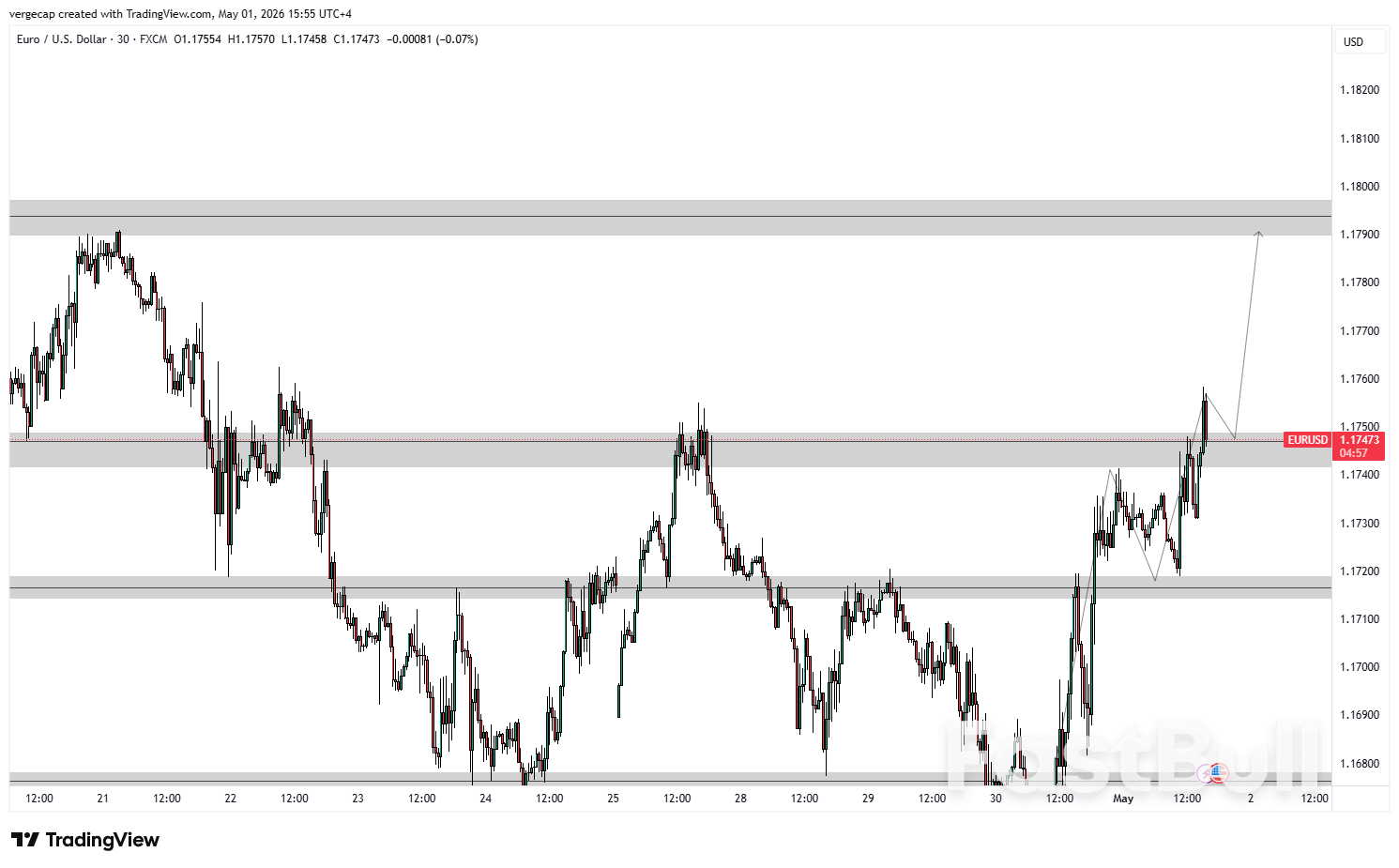
EUR/USD remains in the early stages of a bullish recovery following a broader corrective downtrend. On the 30-minute chart, price action has recently broken out of a short-term consolidation range and is now pushing into a well-defined supply zone around 1.1745–1.1755. This area has previously acted as resistance, and the current reaction suggests some hesitation as price tests this level. While this may temporarily cap upside momentum, it has not yet invalidated the developing bullish structure.
The recent sequence of higher lows from the 1.1680 base, combined with impulsive bullish candles, indicates strengthening buying pressure. A shallow pullback from current levels would be considered constructive, particularly if price holds above the 1.1720–1.1730 region, which now acts as near-term support. This zone aligns with prior consolidation and breakout structure, making it a key level to monitor for continuation signals.
Although moving averages are not explicitly shown, price behavior suggests short-term bullish alignment, with momentum favoring continuation as long as higher lows are maintained. A break back below 1.1720 would weaken the immediate bullish case and expose the 1.1700–1.1685 demand zone. A sustained move below this region would signal a broader structural failure and likely trigger a deeper retracement toward the 1.1650 area.
On the upside, a decisive break and close above 1.1755 would confirm a continuation of the bullish move and open the path toward the next resistance zone around 1.1790–1.1800, which is clearly marked as a higher-timeframe supply area. This aligns with the projected path on the chart, suggesting a potential impulsive move if resistance is cleared with strong momentum.
Momentum conditions appear supportive of continuation rather than exhaustion. The sharp bullish leg into resistance suggests strong participation, though the current pause implies some consolidation may occur before the next move. A period of sideways price action or a minor pullback would help reset momentum and provide a healthier base for continuation.
TRADE RECOMMENDATION
BUY EUR/USD
ENTRY PRICE: 1.1735
STOP LOSS: 1.1700
TAKE PROFIT: 1.1795


