The Euro staged a broad-based rally on Friday, climbing against its major counterparts as renewed optimism surrounding a potential peace agreement between Russia and Ukraine lifted global risk sentiment. The single currency’s gains were particularly pronounced against the Japanese Yen, with EUR/JPY extending its upward trajectory from mid-March lows near 182.00 to trade as high as 186.50, placing the year-to-date peak of 186.88 firmly within reach.
Market sentiment turned decisively in favor of risk assets following a report by Bloomberg, which cited comments from a senior aide to Ukrainian President Volodymyr Zelenskyy suggesting that Kyiv may be edging closer to a negotiated settlement with Russia. While details remain sparse, the mere prospect of de-escalation in a conflict that has weighed heavily on European economic prospects was sufficient to trigger renewed demand for the Euro.
Adding to the cautious optimism, Moscow ঘোষণাed a temporary 32-hour ceasefire to mark Orthodox Easter, a move interpreted by investors as a potential confidence-building measure. A senior Kremlin official further underscored the shifting tone, stating that peace could be achieved “today” if Kyiv were willing to engage, while emphasizing that Russia seeks a lasting resolution rather than a short-term truce. Although geopolitical risks remain elevated, markets appear increasingly willing to price in a scenario where hostilities gradually subside.
Prior to these developments, the Euro had struggled to establish clear direction, as lingering concerns over geopolitical instability—particularly surrounding tensions linked to Iran—kept risk appetite subdued. The evolving situation in the Middle East has introduced additional uncertainty into global markets, complicating the macroeconomic outlook and dampening investor confidence in recent sessions.
On the data front, Germany’s latest inflation figures provided an additional tailwind for the common currency. March Consumer Price Index data confirmed that price pressures remain persistent, with energy and supply-side disruptions—partly exacerbated by geopolitical conflicts—continuing to feed into broader inflation dynamics. The data reinforces expectations that the European Central Bank may need to maintain, or even accelerate, its policy tightening cycle in the near term, despite ongoing growth concerns.
In contrast, developments in Japan paint a different, albeit increasingly complex, monetary policy picture. Data released on Thursday showed that Japan’s Producer Price Index rose 2.6% year-on-year in March, accelerating from February’s 2.0% pace. On a monthly basis, producer prices surged 0.8%, a sharp increase from the prior 0.1% reading. The data underscores mounting inflationary pressures within the Japanese economy, driven in part by higher energy costs and global supply chain disruptions linked to geopolitical tensions.
These figures are likely to intensify pressure on the Bank of Japan to reconsider its ultra-loose monetary policy stance. While the central bank has long resisted tightening, citing the need for sustained wage growth and stable inflation, the latest data suggests that price dynamics may be shifting more decisively. This divergence in monetary policy outlook—between a potentially more hawkish ECB and a gradually constrained BoJ—has further fueled upside momentum in EUR/JPY.
Technical Analysis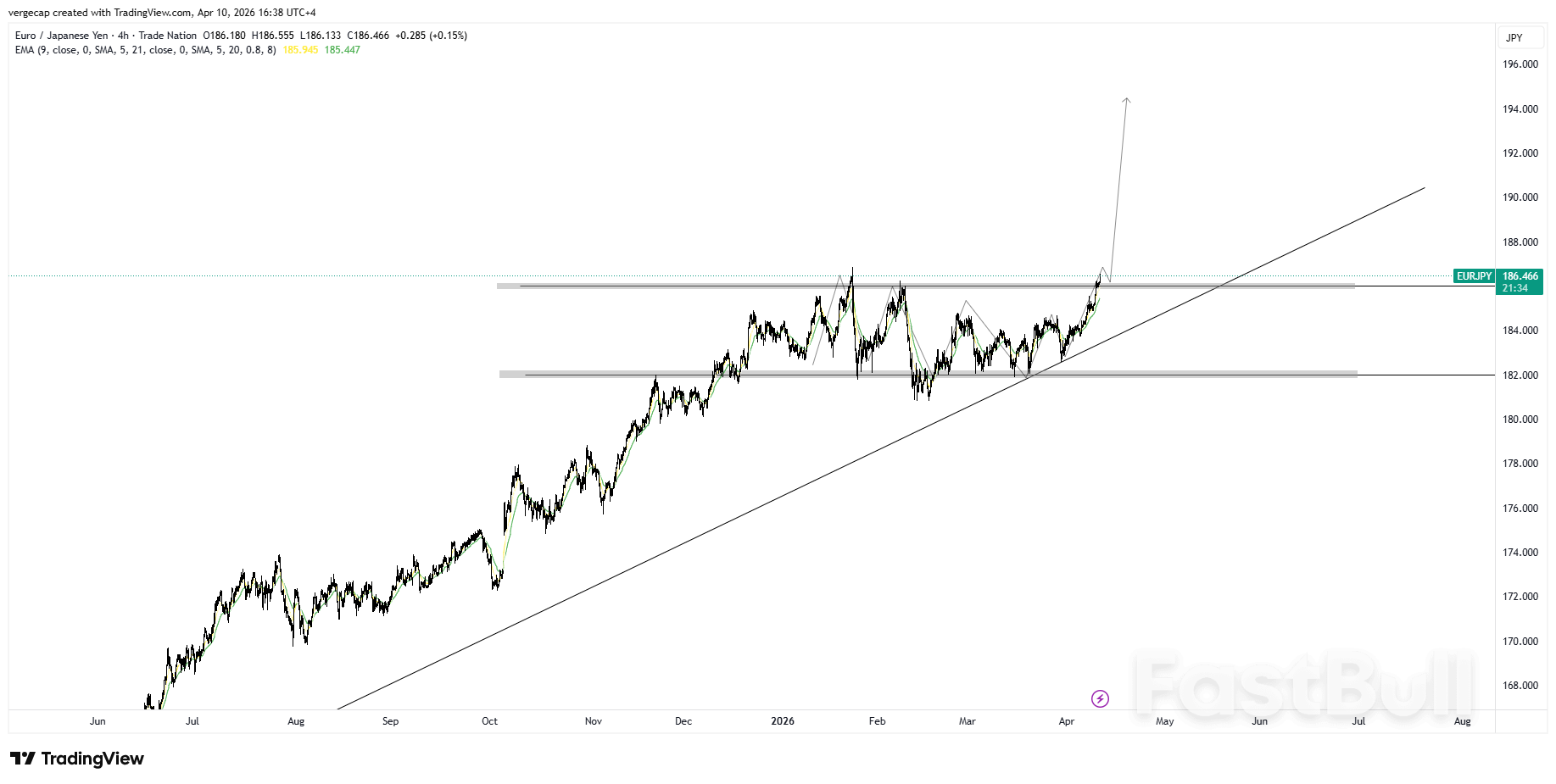
From a technical perspective, EUR/JPY remains firmly embedded within a well-established bullish structure, with price action continuing to respect a broader ascending trendline that has guided the move higher since mid-2025. On the 4-hour chart, the pair has recently broken above a key horizontal resistance zone around 185.80–186.00, a level that had repeatedly capped upside attempts throughout late March and early April. This breakout signals a potential shift from consolidation to trend continuation, with bullish momentum gradually building.
The pair is currently trading above both the 21-period and 50-period Simple Moving Averages (SMAs), which are positioned at approximately 185.95 and 185.45 respectively. Both moving averages are sloping upward, reinforcing the underlying bullish bias and suggesting that dips are likely to be viewed as buying opportunities rather than signs of weakness. The 21-period SMA is acting as immediate dynamic support, while the 50-period SMA represents a more critical structural support level.
The recent consolidation phase between roughly 182.00 and 186.00 appears to have formed a base within the broader uptrend. A successful breakout above this range opens the door for a continuation toward the year-to-date high near 186.88. A sustained move above this level would likely trigger momentum-driven buying and expose higher targets toward the 190.00 psychological level, which aligns with the projected continuation of the ascending trendline.
However, the breakout remains relatively fresh, and the risk of a false move cannot be entirely ruled out. A failure to hold above the 185.80–186.00 breakout zone would signal a lack of conviction among buyers and could lead to a retest of lower support levels. Initial downside support is seen at the 185.45 region (50-period SMA), followed by the lower bound of the previous range near 182.00. A decisive break below this level would represent a significant deterioration in structure and could shift the outlook toward a deeper correction, potentially targeting the 180.00 handle.
Price action also shows a series of higher lows leading into the breakout, indicating sustained buying pressure and accumulation. The presence of a projected bullish path on the chart suggests market participants are anticipating continuation, but such projections remain contingent on price holding above the breakout zone.
Momentum, while positive, appears to be stabilizing rather than accelerating, which is typical following a breakout from a consolidation phase. This suggests the market may enter a brief period of sideways movement or a shallow pullback before attempting another leg higher.
TRADE RECOMMENDATION
BUY EUR/JPY
ENTRY PRICE: 186.20
STOP LOSS: 184.80
TAKE PROFIT: 190.00


