The Japanese yen continues to struggle near the bottom of the major currency performance table, extending its underwhelming run during thin holiday trading on Wednesday. Against the euro, the yen remains firmly on the defensive, with EUR/JPY gravitating toward the 184.00 level by the European midday session. The pair rebounded from the 183.50 area on Tuesday, but the recovery has done little to alter the broader narrative of sustained yen weakness.
Viewed from a longer-term perspective, the cross remains uncomfortably close to its cycle highs. EUR/JPY is trading only a short distance below the long-term peak near 185.00 reached earlier this month and is on track to close the year with gains of more than 14%. Such a move is striking not only for its scale but also for its persistence, underscoring how deeply entrenched the negative sentiment toward the yen has become.
The primary driver of that sentiment continues to be the Bank of Japan’s hesitant approach to monetary normalisation. After years of ultra-loose policy, investors had hoped for a clearer and more decisive exit strategy. Instead, the BoJ has delivered cautious signals that tightening will continue, while offering little guidance on timing or pace. The latest Summary of Opinions from the central bank reaffirmed its commitment to further rate increases, yet stopped short of outlining a concrete path forward. This lack of clarity has reinforced the perception that any tightening will be slow, cautious and easily derailed by political considerations.
Those political considerations are increasingly important. Prime Minister Sanae Takaichi’s expansionary fiscal stance has revived concerns about Japan’s already stretched public finances, raising doubts about how aggressively monetary policy can tighten without destabilising growth. At the same time, lingering uncertainty over potential US trade tariffs under Donald Trump has added another layer of risk for Japan’s export-oriented economy. Together, these factors have created what many investors see as a perfect storm for the yen, helping to explain why it has emerged as the weakest major currency performer of 2025.
In this environment, upside attempts in the yen have consistently failed to gain traction. The government is widely expected to oppose anything more than a very gradual normalisation cycle, effectively limiting how far Japanese yields can rise relative to their global peers. As long as that remains the case, yield differentials are likely to continue favouring yen selling on rallies rather than encouraging a sustained recovery.
By contrast, the euro has found modest but meaningful support from shifting expectations around European Central Bank policy. In recent weeks, ECB communication has increasingly suggested that the easing cycle may be over. While officials remain cautious and data-dependent, markets are beginning to price the possibility that the next policy move could be a rate hike, potentially in the second half of next year. That change in tone has given the euro additional lift, particularly against low-yielding currencies such as the yen.
Technical Analysis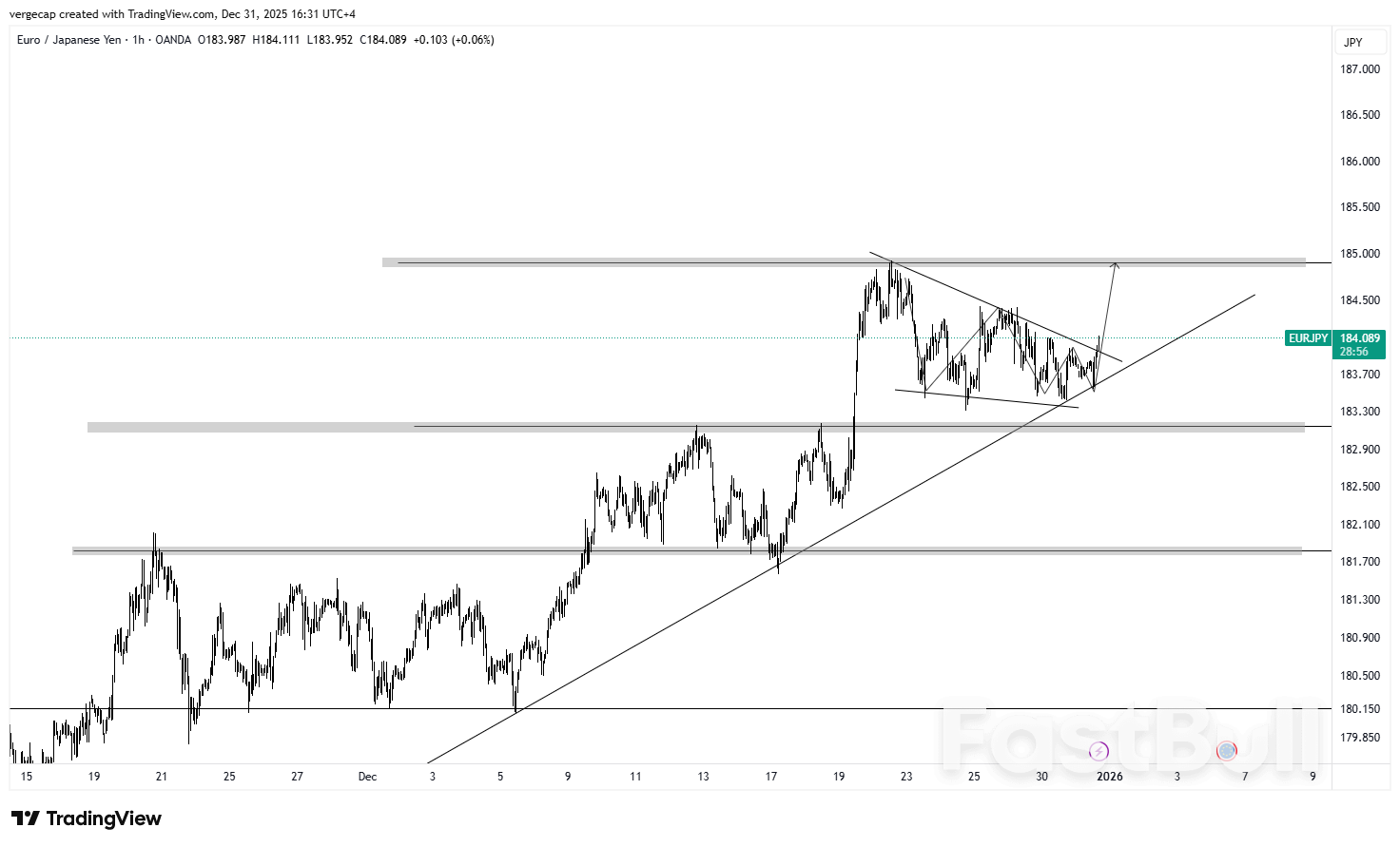
From an analytical standpoint, this divergence in central bank trajectories remains the dominant force shaping EUR/JPY. Even without a strong growth impulse from the euro zone, relative policy expectations have been enough to keep the cross elevated. Unless the BoJ surprises markets with a clearer and more assertive tightening signal, or global risk sentiment deteriorates sharply enough to trigger broad safe-haven demand, the balance of risks continues to tilt against the yen.
The technical picture reinforces that view. EUR/JPY continues to trade within a well-defined upward channel, confirming that the broader bullish structure remains intact. Recent price action shows the pair consolidating rather than reversing, forming a bullish triangle pattern that typically precedes trend continuation. The series of higher lows over recent sessions highlights the willingness of buyers to step in on dips, absorbing selling pressure without allowing a deeper correction to develop.
As price action compresses near the upper boundary of this consolidation, the probability of a directional break is increasing. A strong bullish candle closing above the upper trendline would confirm a breakout and likely attract momentum-driven flows, rather than trigger profit-taking. In that scenario, the next area of interest sits around 185.50, extending beyond this month’s highs and reinforcing the sense that the rally has not yet run its course.
TRADE RECOMMENDATION
BUY EURJPY
ENTRY PRICE: 184.10
STOP LOSS: 183.30
TAKE PROFIT: 185.50


