The EUR/JPY cross traded near 182.90 on Wednesday, extending its recent decline and slipping around 0.1% on the session, as renewed demand for the Japanese Yen continued to weigh on the pair. The move reflects a broader defensive shift across global markets, driven by rising geopolitical tensions in Asia and reinforced by increasingly firm signals from the Bank of Japan that its long-standing ultra-loose monetary stance is drawing to a close. Against this backdrop, the euro remains vulnerable, pressured by cooling inflation dynamics and signs of a deteriorating growth outlook across the Eurozone.
Latest figures from Eurostat showed that inflation across the single-currency bloc continued to ease in December, reinforcing the view that price pressures are gradually returning toward the European Central Bank’s target. The Harmonized Index of Consumer Prices rose by 2.0% on a year-on-year basis, in line with market expectations and slightly below the 2.1% reading recorded in November. On a monthly basis, prices increased by 0.2%, reversing a contraction seen in the prior month, though the broader disinflationary trend remains intact. More importantly for policymakers, core inflation slowed to 2.3% from 2.4%, confirming that underlying price pressures are losing momentum across the region.
While easing inflation offers some relief to households and businesses, it also highlights the fragility of the Eurozone economy. This is particularly evident in Germany, where recent data continue to underscore persistent weakness in domestic demand. Retail sales in Europe’s largest economy fell by 0.6% in November following a 0.3% decline in October, sharply contradicting expectations for a modest rebound. At the same time, German inflation slowed markedly in December, reinforcing concerns that subdued pricing power reflects weak consumption rather than improved productivity. Survey-based indicators paint a similarly cautious picture, with the Eurozone services Purchasing Managers’ Index revised lower for December, suggesting that momentum in the bloc’s most important growth engine is beginning to fade.
These developments leave the euro exposed, especially against currencies supported by either stronger growth prospects or defensive flows. In the case of the Japanese Yen, both factors are currently at play. Risk sentiment deteriorated sharply after tensions between China and Japan escalated earlier this week, following Beijing’s announcement of restrictions on exports of dual-use goods to Japan. The move was widely seen as retaliation for comments by Japanese Prime Minister Sanae Takaichi regarding Taiwan, reviving diplomatic strains between two of Asia’s most influential economies. Such developments have historically boosted demand for the yen, which continues to serve as a key safe-haven asset during periods of regional or global uncertainty.
Beyond geopolitics, monetary policy divergence remains a critical driver of EUR/JPY dynamics. Bank of Japan Governor Kazuho Ueda reiterated that the central bank remains committed to gradually tightening policy, reinforcing expectations that further interest rate increases are likely as Japan normalizes policy after decades of extraordinary accommodation. Although markets remain cautious about the precise timing of the next move, the BoJ’s increasingly hawkish tone provides structural support to the yen, particularly as investors contrast it with a European Central Bank that appears closer to easing than tightening. Nevertheless, lingering concerns over Japan’s fiscal position and elevated public debt levels may prevent an unchecked surge in the yen, potentially limiting the pace of further EUR/JPY declines.
Technical Analysis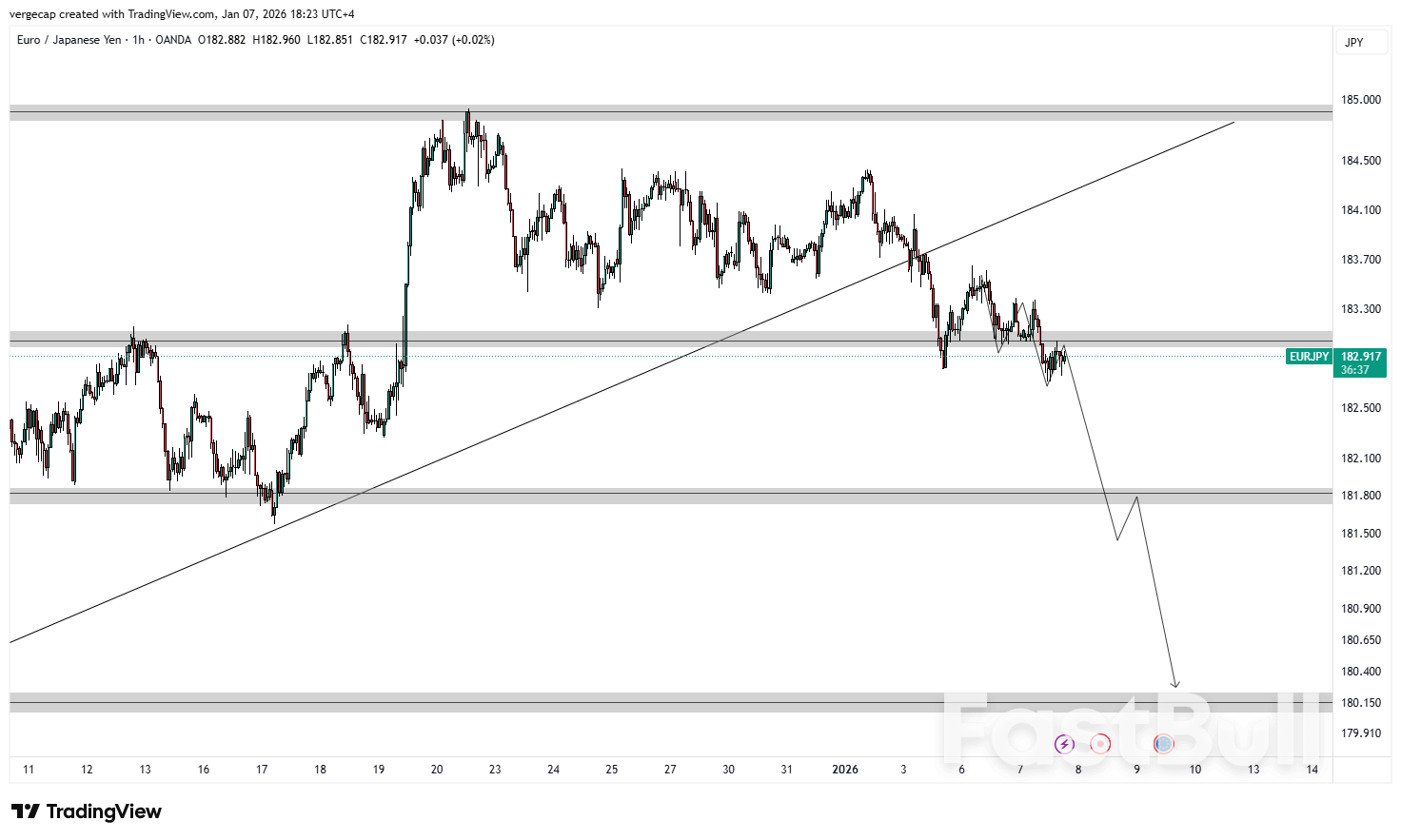
From a technical standpoint, the pair continues to trade below a key pivot level near 183.57, a development that keeps bearish momentum intact. Price action suggests that EUR/JPY is reacting negatively to this zone and remains vulnerable to a move toward overlapping support near 181.73. A sustained break below that area would likely reinforce downside pressure and confirm a broader corrective phase. On the upside, resistance around 184.38 remains a key barrier, and only a decisive move above that level would begin to ease near-term bearish risks. Given the current macro and geopolitical landscape, however, such a recovery appears unlikely without a material improvement in Eurozone growth prospects or a meaningful de-escalation of tensions in Asia.
TRADE RECOMMENDATION
SELL EURJPY
ENTRY PRICE: 182.90
STOP LOSS: 184.00
TAKE PROFIT: 180.50


