EUR/JPY regained upward momentum on Friday, recovering from early-session weakness as the Japanese Yen once again struggled to capitalize on mounting speculation of an upcoming Bank of Japan rate hike. The pair was last seen trading near 180.77 after dipping to an intraday low of 180.10, extending a familiar pattern of range-bound movement that has dominated trade since mid-November. Despite intraday swings, the underlying bias remains tilted toward the Euro, thanks in part to an improving economic backdrop across the Eurozone.
The Euro drew significant support from fresh GDP figures released by Eurostat, which painted a more resilient picture of the region’s economic landscape than previously anticipated. Third-quarter GDP expanded 0.3% on a quarterly basis, outperforming market forecasts of 0.2% and improving from the 0.2% growth recorded in the previous quarter. Year-on-year growth reached 1.4%, matching expectations and reinforcing the narrative that Europe’s recovery—although uneven—continues to slowly rebuild momentum.
The data highlighted broad improvement across key components of the Eurozone economy. Household spending edged higher, signaling modest improvement in consumer sentiment despite persistent price pressures. Government expenditure rose at a faster pace, offering fiscal support at a time when private sector confidence remains fragile. Investment activity also strengthened, rising nearly 1% and underscoring renewed confidence in long-term capital commitments. External trade contributed positively as both exports and imports increased, pointing to a gradual normalization of global supply and demand conditions.
Labour market trends were similarly encouraging. Employment in the Eurozone increased 0.2% during the quarter, surpassing analyst estimates and strengthening from the previous reading. On an annual basis, employment rose 0.6%, reinforcing the notion that the labour market remains tight and continues to provide a buffer against cyclical pressures. For currency markets, this relative macroeconomic stability has been sufficient to keep the Euro buoyant and limit aggressive Yen-driven pullbacks.
On the Japanese side, however, the dynamics remain far more complicated. Despite a growing chorus of speculation suggesting that the Bank of Japan may finally lift interest rates at its December 18–19 meeting, the Yen has been unable to sustain meaningful gains. Earlier in the week, BoJ Governor Kazuo Ueda signaled a willingness to consider policy adjustments, triggering renewed expectations of an imminent exit from the central bank’s long-standing ultra-loose stance.
That sentiment was reinforced by a Bloomberg report suggesting that BoJ officials are prepared to raise rates at the upcoming meeting, provided no major economic or financial shock emerges in the near term. The report also indicated policymakers may communicate readiness to pursue further rate increases if inflation trends and economic conditions continue to develop as projected. Still, the same insiders cautioned that the BoJ remains unsure about how far interest rates should ultimately rise, reflecting a characteristically cautious approach to tightening.
The Yen’s inability to strengthen in response to these developments highlights ongoing skepticism among traders. Many remain wary given the BoJ’s history of signaling shifts only to pull back at the last moment. Others believe that even if a hike occurs, it may be more symbolic than structural, offering limited long-term support for the currency. With global risk sentiment relatively stable, the Yen has also been unable to attract its usual safe-haven flows.
Market attention now shifts to Monday’s incoming Japanese data batch, which includes labor earnings, current account figures, and the final Q3 GDP revision. These figures will play a critical role in shaping expectations heading into the December meeting. Stronger growth and earnings could bolster confidence in a rate hike, while weaker numbers may reintroduce doubts and weaken the Yen further.
Technical Analysis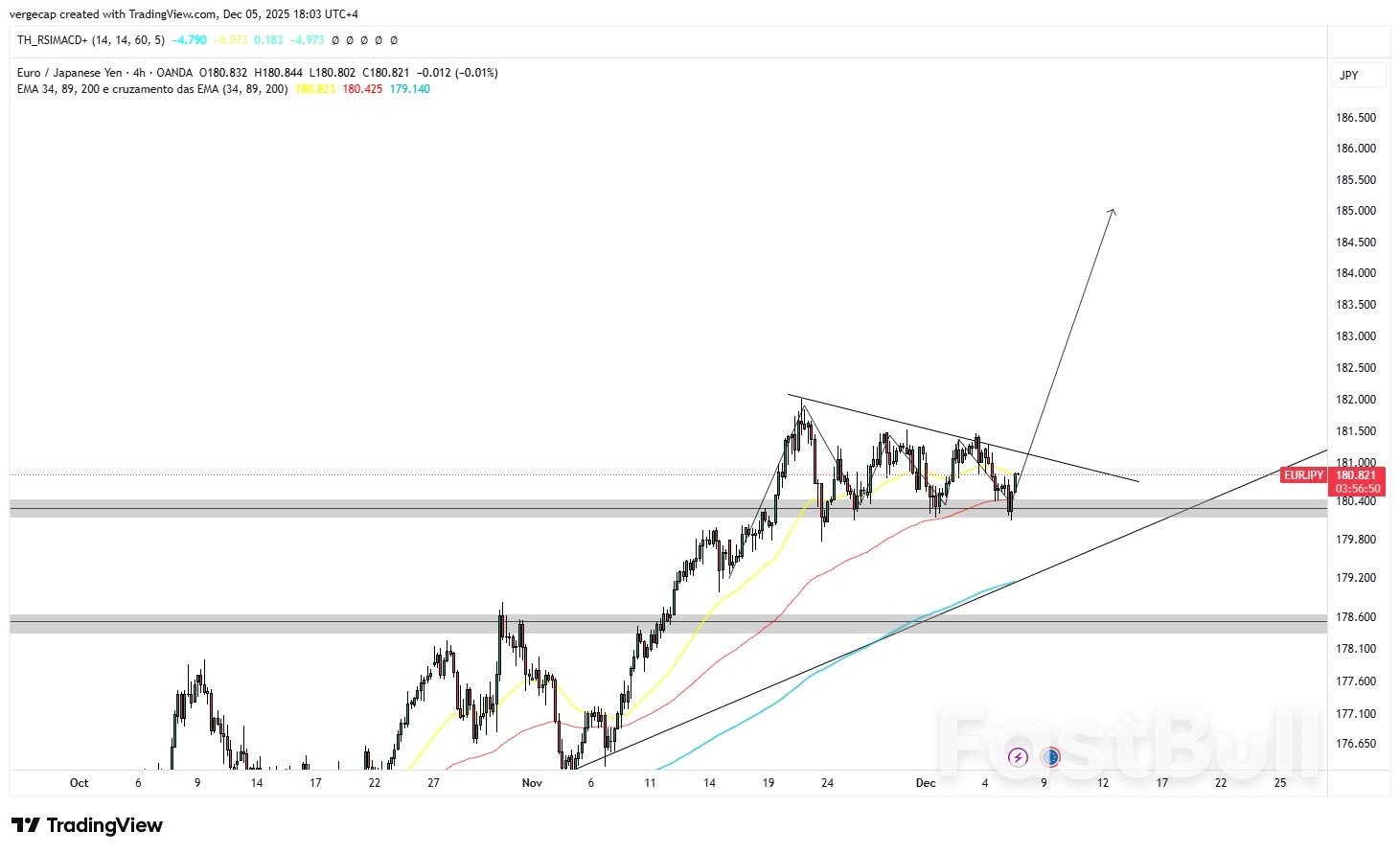
From a technical standpoint, EUR/JPY’s structure remains broadly constructive despite the latest corrective dip. The pair closed below the 181.70 ceiling, signaling a short-term pause in bullish momentum, while stochastic indicators continue to reveal lingering negative pressure. Nonetheless, the decline remains shallow and does not threaten the broader upward trajectory as long as the pair maintains support near the 179.40 zone. The market’s repeated refusals to break below this key level reinforce its importance as the base of the current bullish structure.
The correction toward 180.10 appears to be part of a healthier consolidation pattern rather than the early stages of a reversal. Traders are expected to look for renewed bullish momentum in the coming sessions, especially if Eurozone macro conditions continue to firm or if Japanese data fail to significantly strengthen the case for a BoJ hike. A decisive break above 181.70 would reopen bullish pathways and potentially extend the recent uptrend.
For now, EUR/JPY is expected to oscillate between 179.65 and 181.70, with the overarching trend still favoring the upside as long as key support levels hold.
TRADE RECOMMENDATION
BUY EURJPY
ENTRY PRICE: 180.830
STOP LOSS: 180.00
TAKE PROFIT: 186.00


