The Japanese Yen’s brief reign as the market’s primary safe-haven bulwark was cut short on Monday, as geopolitical tensions took a sharp turn toward de-escalation following unexpected diplomatic overtures from the White House. The EUR/JPY cross, which had plunged in early European trading as investors scrambled for cover, staged a modest but notable recovery, though it remained entrenched in negative territory as the North American session got underway.
Trading near 183.65 at the time of writing, the cross was down 0.30% on the day. The price action tells a story of a market whipsawed by headlines, flipping from a classic risk-off impulse to a more nuanced recalibration of sovereign risk. The pair’s rebound from its session lows highlights the fragility of the current macro environment, where a single comment from a world leader is proving sufficient to unwind a significant portion of the day’s safe-haven flows.
The initial leg lower for the pair was textbook. With tensions simmering in the Middle East, investors abandoned risk-sensitive currencies like the Euro in favor of the Japanese Yen, the quintessential haven in times of turmoil. The pressure on EUR/JPY was palpable, reflecting fears of a broader regional confrontation that could disrupt energy markets and global trade.
However, the narrative shifted dramatically following a Reuters report detailing remarks from US President Donald Trump. The President struck a surprisingly conciliatory tone regarding the ongoing standoff with Iran, revealing that the United States and Iran had engaged in “very good and productive conversations” over the past 48 hours regarding a potential resolution. In a move that further signaled a de-escalation of military posturing, Trump stated he had instructed the Department of War to postpone any planned military strikes on Iranian energy infrastructure for a five-day period, contingent on the progress of ongoing diplomatic discussions.
The market’s reaction was immediate. The Yen began to give back its earlier gains as the geopolitical premium priced into the currency started to erode. For traders, this is a stark reminder that in the current climate, headline risk is the primary driver. The sudden pivot allowed EUR/JPY to pare its losses, as the Euro, which had been sold off in a knee-jerk reaction, found a bid on the shifting sentiment.
Yet, to call this a return to complacency would be premature. The atmosphere remains one of heightened caution. The five-day window offered by the White House is just that—a window. The geopolitical situation remains exceptionally fluid, and any breakdown in negotiations could trigger a violent reversal of today’s flows, with the Yen likely to be the immediate beneficiary of a renewed dash for safety.
Beyond the headlines, the underlying technical and fundamental landscape for the EUR/JPY cross remains one of divergent central bank expectations, a theme that continues to provide underlying support for the pair.
On the Japanese side, authorities are maintaining a vigilant stance against excessive currency weakness. Japan’s top foreign exchange official, Atsushi Mimura, reiterated the government’s readiness to intervene in the market to combat disorderly moves. This verbal intervention serves as a persistent backstop, limiting the upside potential for the pair from current levels. Simultaneously, the Bank of Japan (BoJ) is charting a course toward normalization. Governor Kazuo Ueda continues to signal a hawkish tilt, maintaining that further interest rate hikes are firmly on the table should the domestic economy evolve in line with the bank’s forecasts. This structural support for the Yen is the primary reason the cross has struggled to sustain rallies above recent highs.
Conversely, the Euro is drawing strength from a different set of pressures. Surging energy prices in the Eurozone are complicating the European Central Bank’s (ECB) path toward rate cuts. While the market had priced in a series of reductions for this year, the recent spike in input costs is reinforcing the ECB’s hawkish bias. In its latest communications, the ECB highlighted that rising geopolitical tensions have rendered the outlook “significantly more uncertain,” citing clear upside risks to inflation alongside downside risks to growth. This stagflationary undercurrent is a double-edged sword, but for now, it is the inflation component that is supporting the Euro.
Technical Analysis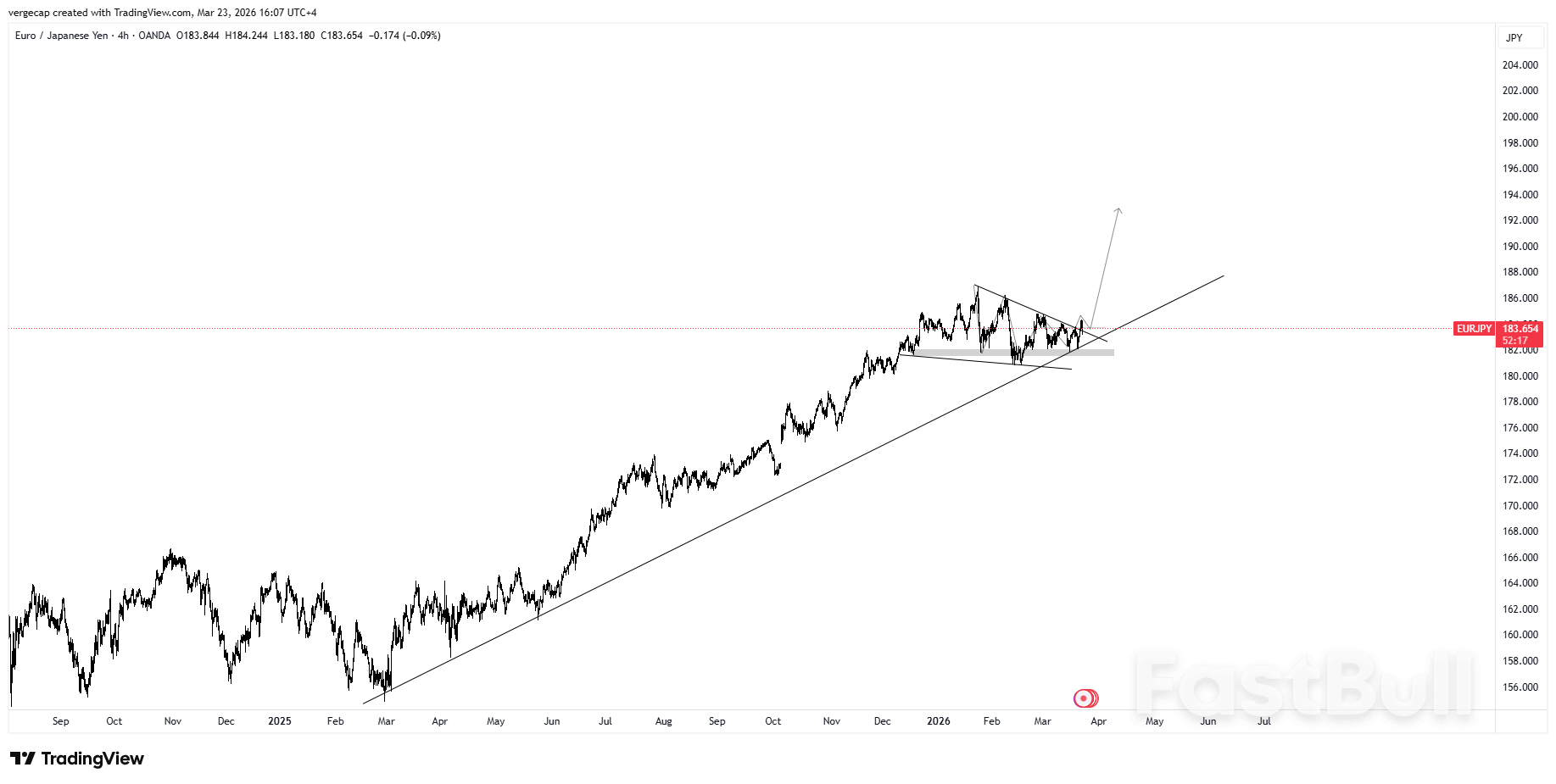
From a technical perspective, EUR/JPY remains embedded in a broader bullish structure, supported by a well-defined ascending trendline that has guided price action higher over the medium term. On the 4-hour chart, however, the pair is currently consolidating within a tightening symmetrical triangle formation, reflecting a period of indecision following the recent impulsive move higher. Price is now hovering near the apex of this structure, suggesting that a breakout is imminent.
The underlying trend remains constructive, as higher lows continue to form along the ascending trendline, reinforcing bullish control. The recent pullbacks have been shallow and well-supported, indicating that buyers remain active on dips. However, the series of lower highs within the triangle signals a temporary compression in momentum, with sellers defending the upper boundary near the 184.50–185.00 region.
On the downside, immediate support is located around the 182.00–182.50 zone, which aligns with both the lower boundary of the triangle and a previously established demand area. A decisive break below this region would weaken the bullish structure and expose the 180.00 psychological level. A sustained move beneath 180.00 would mark a deeper correction, potentially targeting the 176.00–178.00 zone where prior consolidation occurred.
On the upside, a confirmed breakout above the triangle resistance near 184.50 would signal a continuation of the broader uptrend. Such a move would likely attract momentum buying, opening the door toward 188.00 initially, followed by a more extended move toward the 192.00–194.00 region, as projected by the measured move and highlighted resistance zones on the chart.
Momentum dynamics point toward consolidation rather than reversal. The compression of price action within the triangle suggests energy is building for the next directional move, with the prevailing uptrend slightly favoring an upside breakout scenario. This aligns with a continuation pattern rather than distribution.
TRADE RECOMMENDATION
BUY EUR/JPY
ENTRY PRICE: 184.50
STOP LOSS: 181.80
TAKE PROFIT: 192.00


