The EUR/JPY cross has retreated from historic highs, snapping a multi-session rally as renewed verbal intervention from Japanese authorities triggered a rebound in the Yen and encouraged traders to lock in profits. At the time of writing on Tuesday, the pair was trading near 183.90, down roughly 0.30% on the day, after briefly touching an all-time peak close to 184.92 earlier in the week.
The pullback underscores the fragile balance driving the cross: a structurally weak Japanese Yen facing intermittent policy jawboning, set against a relatively stable Euro underpinned by the European Central Bank’s increasingly patient stance.
The Japanese Yen found modest support following comments from Japan’s Finance Minister Satsuki Katayama, who reiterated that authorities retain full flexibility to respond to “excessive” moves in the foreign exchange market. While no concrete action was announced, the reminder alone was sufficient to cool speculative enthusiasm and prompt a wave of short-covering in the Yen.
Historically, such rhetoric has often had only a fleeting impact unless backed by direct intervention or a material shift in monetary policy. Still, with EUR/JPY trading at record levels, the market appeared vulnerable to even mild policy pushback. The sharp ascent in recent sessions had left positioning stretched, making the pair susceptible to corrective moves on any hint of official discomfort.
That said, many investors remain skeptical about the durability of Yen strength without deeper structural support. Japan’s trade dynamics, yield differentials, and persistent capital outflows continue to weigh heavily on the currency, limiting the long-term effectiveness of verbal warnings alone.
At the heart of the Yen’s broader weakness lies the Bank of Japan’s cautious approach to policy normalization. Although the BoJ recently lifted its policy rate by 25 basis points to 0.75%, the central bank has been careful to avoid signaling a clear path toward further tightening.
Former BoJ board member Makoto Sakurai suggested that the next rate hike may not materialize until the middle of next year, while cautioning that subsequent increases could become increasingly difficult as economic momentum slows. This reinforces the perception that Japan’s policy normalization will remain gradual and limited, leaving the Yen exposed during periods of global risk stability and yield-seeking behavior.
As long as Japanese yields lag well behind those of Europe and the United States, rallies in the Yen are likely to remain corrective rather than trend-defining.
On the other side of the equation, the Euro continues to trade with relative stability. Investors are still assessing the European Central Bank’s policy trajectory into 2026, but recent communication has reduced uncertainty around near-term easing.
ECB officials have repeatedly emphasized that inflation is expected to remain close to the 2% target over the medium term, diminishing the urgency for additional rate cuts. At its latest meeting, the ECB left rates unchanged, with President Christine Lagarde stating that monetary policy is “in a good place” and that current settings may be maintained for an extended period.
Markets have increasingly interpreted this as a signal that the ECB’s rate-cut cycle is approaching its conclusion. If confirmed, this would provide a supportive backdrop for the Euro, particularly against low-yielding counterparts such as the Yen.
Incoming data from the Eurozone has done little to challenge this narrative. Germany’s Import Price Index rose 0.5% month-on-month in November, exceeding expectations and hinting at mild upstream price pressures. However, on an annual basis, import prices were still down 1.9%, reinforcing the view that inflation remains contained.
For policymakers, this combination of subdued inflation and improving stability supports a “wait-and-see” approach—one that contrasts sharply with the BoJ’s ongoing struggle to decisively exit ultra-loose policy.
Technical Analysis 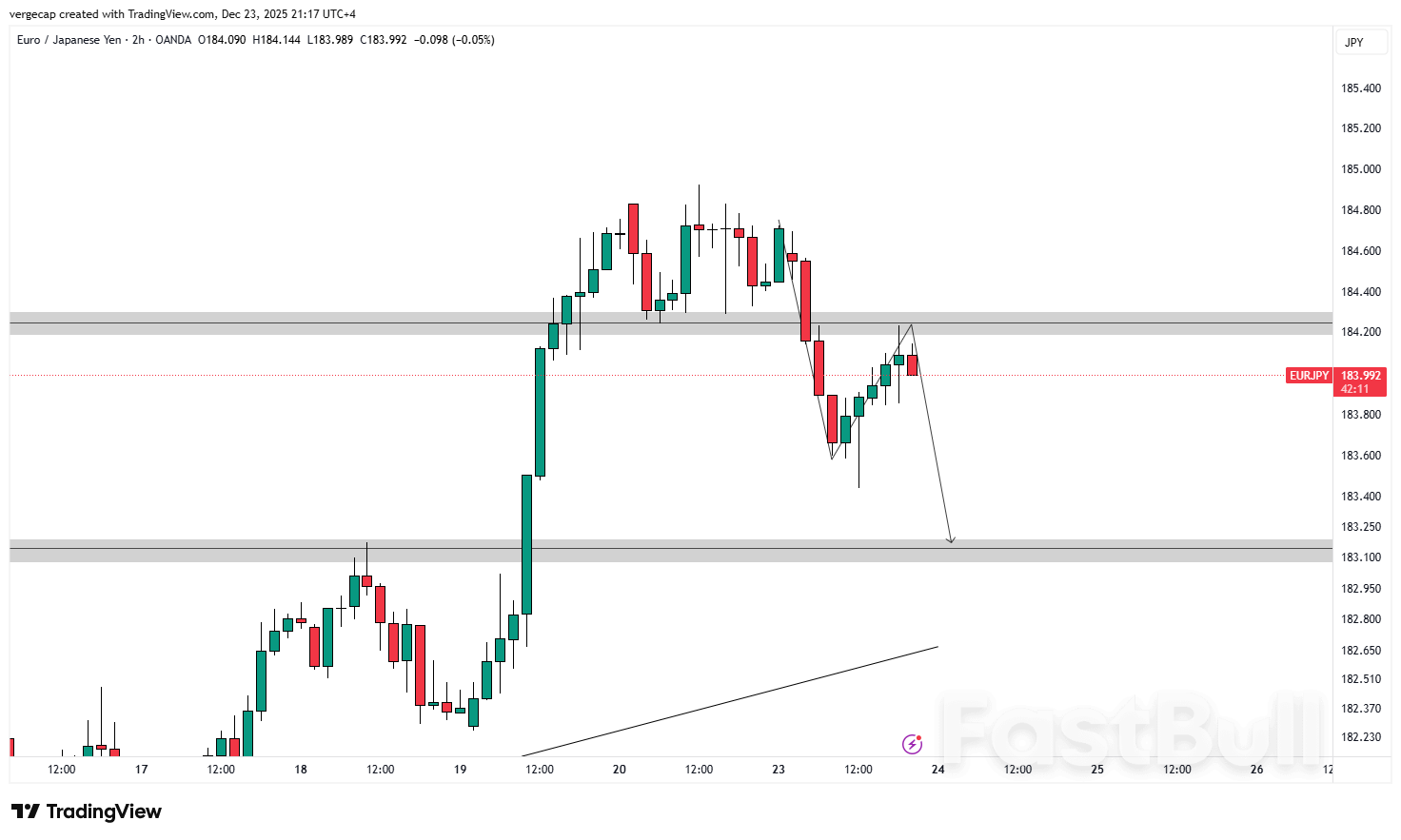
From a technical perspective, EUR/JPY appears to be entering a corrective phase after failing to sustain momentum above the 184.90 resistance zone, which has now emerged as a formidable barrier. The rejection from record highs has pushed the pair back toward 183.75–183.90, signaling the early stages of a bearish corrective wave.
Momentum indicators are beginning to align with this view. The Stochastic oscillator is drifting toward the 20 level, increasing negative pressure and favoring further downside in the near term. A continuation of corrective trading could see the pair test 183.30, with a deeper move potentially exposing key support near 182.80.
TRADE RECOMMENDATION
SELL EURJPY
ENTRY PRICE: 184.00
STOP LOSS: 185.00
TAKE PROFIT: 182.80


