EUR/JPY tumbled for a third consecutive session on Wednesday, breaching the critical 183.00 threshold as traders rushed to cover short Yen positions with an urgency not seen since the BoJ’s stealth interventions last year. The cross was last seen changing hands at 182.70, a 0.50% daily decline that masks the deeper structural recalibration now underway in Tokyo.
Make no mistake: this is no mere position squaring. This is a political earthquake.
Prime Minister Sanae Takaichi’s historic landslide victory for the Liberal Democratic Party has fundamentally altered the incentive structure for Japanese policymakers. For years, the playbook was simple—weak leadership, fractured coalitions, and deflationary entrenchment. That playbook is now obsolete. A supermajority of this magnitude isn’t just a win; it’s a blank check. Investors are pricing precisely that: the political capital to finally, credibly, exit the world’s last negative rate regime.
The Yen’s 1.2% rally against the Euro this week tells the story. Markets are no longer asking “if” but “when.” The BoJ’s gradualist rhetoric remains intact for now, but the market’s forward curve is already sniffing out a terminal rate higher than previously conceivable. Add to that the perennial specter of direct intervention—unspoken, unauthorized, but palpably present just below 185.00—and the technical setup for EUR/JPY turns decisively bearish.
Yet the Euro refuses to roll over entirely, and for good reason. The ECB remains the hawkish outlier among G10 central banks, having slammed the door shut on the easing cycle last year. Christine Lagarde continues to project serene confidence that inflation will settle at target, dismissing the recent soft CPI prints as statistical noise rather than a disinflationary trend. That steady hand matters.
Moreover, Brussels quietly delivered a strategic coup this week. The finalized EU-India trade agreement, eliminating tariffs on over 90% of goods within seven years, is a long-term structural positive often overlooked in the daily scrum. Danske Bank’s assessment is spot-on: India’s growth trajectory, while currently representing a modest share of Eurozone exports, offers precisely the kind of diversification the bloc needs to insulate itself from Sino-centric supply chain risks. This isn’t a 2024 catalyst—it’s a 2030 hedge. But sophisticated accounts are already positioning accordingly.
Still, the immediate horizon belongs to Tokyo. EUR/JPY’s technicals are flashing amber. Having cleared 183.00, the next significant support rests at 181.50, the 50-day moving average, with a clean break there opening a path toward 179.00. The onus is now on Eurozone data to arrest the slide. Wednesday’s Eurozone services PMIs will need to surprise materially to the upside to stall the Yen’s momentum.
For now, the message from the cross is unambiguous: the Yen is no longer the world’s preferred funding currency. Takaichi’s mandate has changed that. And in currency markets, regime shifts always demand respect.
Technical Analysis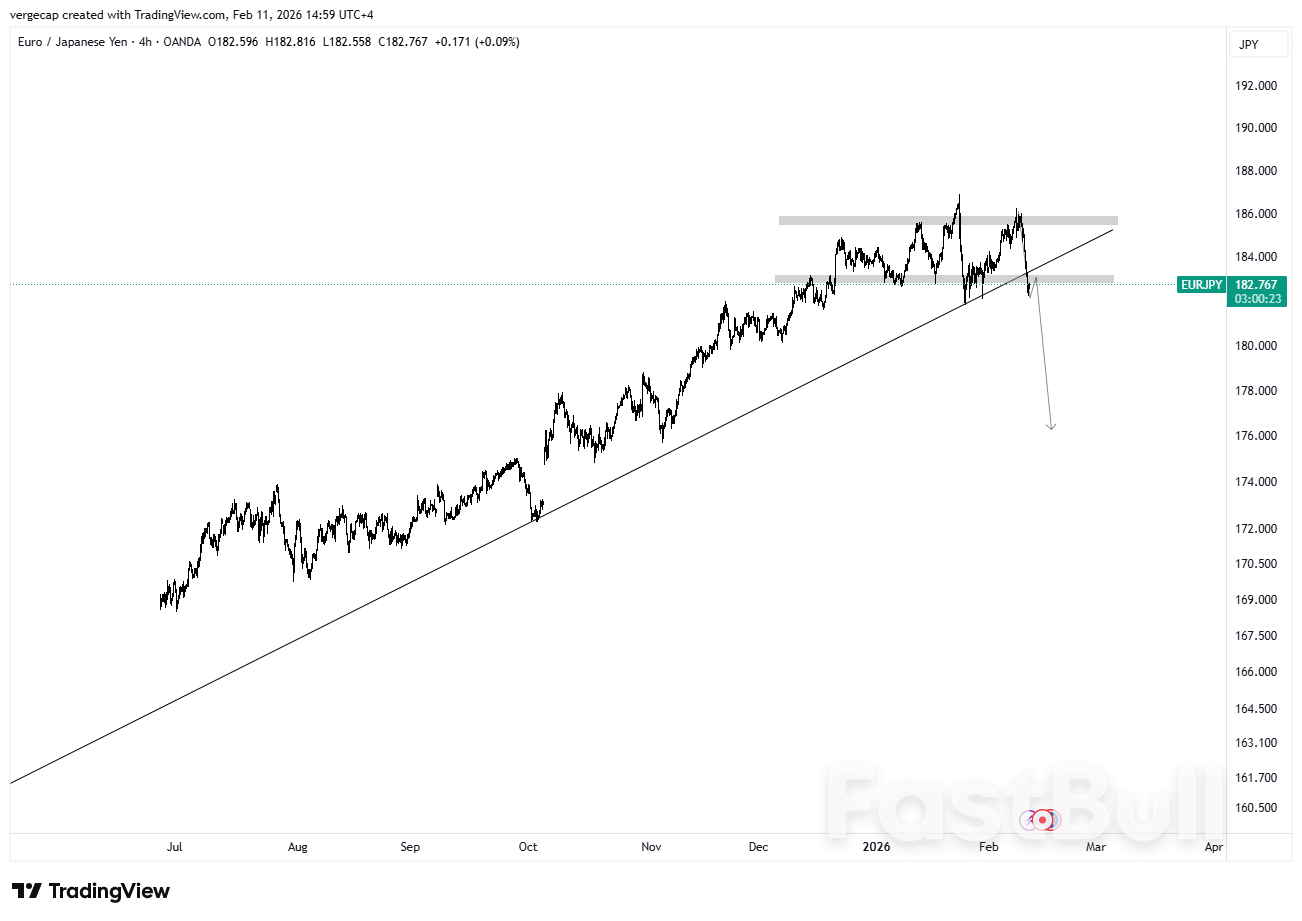
From a technical perspective, EUR/JPY is transitioning from a broader bullish structure into a vulnerable corrective phase. On the 4-hour chart, price action had been respecting a well-defined ascending trendline that guided the move higher from the December lows. However, the latest impulsive decline has driven the pair sharply back into a key horizontal support zone around 182.50–183.00, an area that previously acted as resistance and later flipped into support. The market is now testing this confluence region where horizontal structure meets the rising trendline.
The upper resistance zone near 185.50–186.00 remains a significant supply area. Multiple rejections from this region confirm the presence of strong sellers, and the latest failure to sustain gains above 186.00 formed a lower high relative to the prior peak. This rejection triggered a decisive bearish leg lower, suggesting distribution rather than healthy consolidation.
The ascending trendline drawn from the December swing low is now under direct pressure. A sustained break and 4-hour close below this trendline—particularly beneath the 182.50 support band—would mark a structural shift from higher highs and higher lows to a potential sequence of lower highs and lower lows. Such a breakdown would likely accelerate downside momentum.
If price decisively clears 182.50 to the downside, the next meaningful support does not emerge until the 179.50–180.00 region, followed by the 176.00–177.00 zone, which aligns with prior consolidation and projected measured-move targets from the recent breakdown. A move into that area would represent a deeper corrective retracement of the broader uptrend rather than a minor pullback.
On the upside, bulls would need to quickly reclaim the 183.50–184.00 region and, more importantly, regain acceptance above 185.50. A sustained break back above 186.00 would invalidate the immediate bearish structure, reestablish bullish control, and open the door for a renewed push toward 187.50 and potentially 188.00.
Overall price behavior suggests momentum has shifted in favor of sellers in the near term. The sharp impulsive nature of the latest decline, combined with failure at major resistance and pressure on trendline support, tilts the bias to the downside unless buyers can produce a strong reclaim of broken structure.
TRADE RECOMMENDATION
SELL EUR/JPY
ENTRY PRICE: 182.70
STOP LOSS: 184.20
TAKE PROFIT: 176.50


