The euro demonstrated renewed vigor against a listless Japanese yen on Friday, climbing to the 182.75 handle as a fresh batch of economic indicators painted diverging pictures of recovery on either side of the globe. The currency pair’s 0.13% gain on the day underscores a market recalibrating its expectations for central bank policy, with the Eurozone flashing green while Japan’s price pressures visibly cool.
The primary catalyst for the euro’s resilience came from the preliminary HCOB Purchasing Managers’ Index (PMI) data, which exceeded consensus forecasts and suggested the currency bloc’s downturn may be firmly in the rearview mirror. The headline Eurozone Composite PMI jumped to 51.9 in February, up from 51.3 and comfortably above the 51.5 anticipated by economists. Crucially, this marks a faster pace of expansion, driven by a broad-based improvement across sectors.
In a particularly welcome sign for policymakers, the region’s beleaguered manufacturing sector finally clawed its way back into expansionary territory. The Manufacturing PMI surged to 50.8 from January’s 49.5, signaling an end to a protracted contraction. The services sector, the backbone of the Eurozone economy, continued its solid run, posting a reading of 51.8. While this fell marginally short of the 52.0 forecast, it remains firmly in growth mode. Taken together, the data reinforces a growing narrative that the Eurozone’s economic engine is gaining traction as the first quarter progresses, potentially easing some of the urgency for aggressive monetary easing from the European Central Bank.
Adding a layer of stability to the euro’s foundation, ECB President Christine Lagarde offered clarity on her tenure. In an interview with the Wall Street Journal, Lagarde stated unequivocally that she expects to remain at the helm of the central bank until her term expires in October 2027. Dismissing speculation regarding an early resignation, her comments serve to eliminate a potential variable of political uncertainty at a time when investors are laser-focused on the ECB’s future rate path relative to the Federal Reserve.
Across the Pacific, the fundamental backdrop for the yen turned decidedly softer following the release of Japan’s latest national inflation figures. The data revealed a pronounced deceleration in price pressures, potentially complicating the Bank of Japan’s journey toward policy normalization. The headline National Consumer Price Index (CPI) rose just 1.5% year-on-year in January, a significant slowdown from the 2.1% clip recorded in December and the softest reading since March 2022.
More importantly for BoJ policymakers, the core measures of inflation also lost momentum. The core CPI, which strips out volatile fresh food prices, increased 2.0% annually, easing from 2.4% and landing exactly in line with market predictions. Even the bank’s favored “core-core” measure, which excludes both fresh food and energy, moderated to 2.6% from the previous 2.9%. Analysts at Danske Bank were quick to highlight the implications. “This moderation in underlying inflation, now at its lowest level in two years, could influence the Bank of Japan’s normalization timeline,” the research team noted. They pointed out that despite robust domestic demand suggested by recent PMI data, the relatively soft inflation print makes a compelling case for the BoJ to adopt a patient stance, complicating the decision to raise rates again in the near term.
While Prime Minister Sanae Takaichi’s commitment to steadily reducing Japan’s debt-to-GDP ratio offers a glimmer of hope for long-term fiscal sustainability, it does little to counteract the immediate headwinds facing the yen. The combination of cooling inflation and the resulting uncertainty over the pace of BoJ tightening is sapping the currency of its yield appeal and safe-haven demand, allowing the euro to maintain its modest bullish bias against the yen in the current session.
Technical Analsysis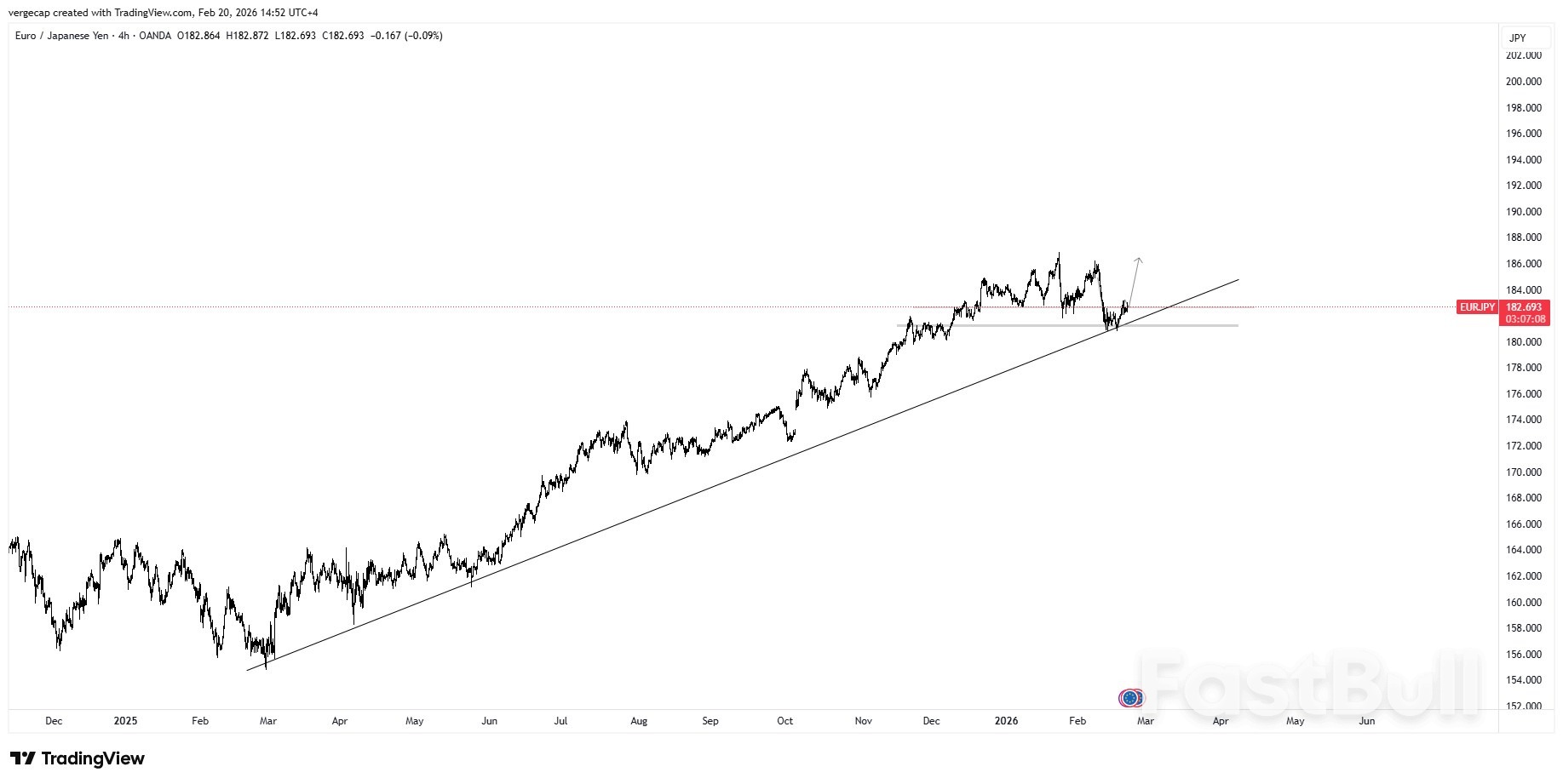
From a technical perspective, EUR/JPY remains entrenched in a well-defined bullish structure. On the 4-hour chart, price action continues to respect a rising trendline that has guided the broader advance since the March 2025 lows. The pair recently pulled back toward this ascending trendline and a horizontal support zone around 181.50–182.00, where buyers stepped in, reinforcing the integrity of the prevailing uptrend. While the latest consolidation phase has capped immediate upside momentum near the 185.50–186.00 resistance region, it has not meaningfully damaged the broader bullish structure.
The horizontal support near 181.50 represents a key structural pivot. This level aligns closely with the rising trendline and marks the neckline of the recent consolidation base. A decisive break below this confluence zone—particularly on a sustained 4-hour close—would signal short-term structural deterioration and expose deeper downside levels. In such a scenario, the next support is seen around 179.50–180.00, followed by the 177.50–178.00 area, where prior breakout momentum accelerated. A sustained move below 177.00 would suggest a broader corrective phase rather than a routine pullback within the uptrend.
On the upside, bulls remain focused on a clean break above the 185.50–186.00 resistance band, which has capped recent rallies. A sustained push through this barrier would confirm continuation of the higher-high sequence and likely open the door toward the 188.00 level initially, with scope for an extension toward 190.00 if momentum accelerates. Such a breakout would reaffirm trend strength and likely attract renewed momentum-based buying interest.
Price structure remains constructive overall, with higher highs and higher lows intact on the 4-hour timeframe. The recent pullback appears corrective rather than impulsive, and the swift rebound from trendline support suggests underlying demand remains firm. As long as price holds above the 181.50 support confluence, the technical bias favors further upside development following consolidation.
TRADE RECOMMENDATION
BUY EUR/JPY
ENTRY PRICE: 182.70
STOP LOSS: 180.80
TAKE PROFIT: 188.00


