EUR/JPY came under heavy selling pressure on Monday, falling around 1.11% to 179.45 as a sharp appreciation in the Japanese Yen overshadowed improving economic signals from parts of the Eurozone.
The Yen's advance is being driven primarily by expectations that the Bank of Japan is preparing to tighten monetary policy further. Markets now appear to have fully priced a 25-basis-point rate increase at the September 17-18 meeting, while speculation that policymakers could opt for an even stronger response has added momentum to the Japanese currency.
Concerns over persistent inflation and rising Japanese long-term bond yields are strengthening the argument for tighter policy. At the same time, renewed speculation that Japanese authorities could intervene in the foreign exchange market is making traders increasingly cautious about maintaining bearish Yen positions. Together, these factors have created significant downward pressure on EUR/JPY.
The Euro, meanwhile, received a mixed set of economic signals. German Industrial Production contracted 1.1% in July, missing expectations for 0.3% growth. June's reading was also revised down to show stagnation rather than the previously reported 0.2% increase. Compared with a year earlier, production fell 1.6%, highlighting continued weakness across Germany's industrial sector.
Broader Eurozone figures were considerably stronger. The Sentix Investor Confidence Index climbed to 5.1 in September from 0.9, indicating a notable improvement in sentiment. Second-quarter GDP was also revised upward, showing the economy expanded 0.6% quarter-on-quarter, compared with the previous 0.4% estimate and marking the strongest quarterly expansion since Q2 2022. Annual growth was upgraded to 1.2% from 1.0%.
Nevertheless, those positive developments have done little to reverse Monday's EUR/JPY decline. For now, the widening expectations for Japanese monetary tightening and the possibility of currency intervention are proving more influential than improving Eurozone growth, leaving the cross vulnerable to further pressure.
Technical Analysis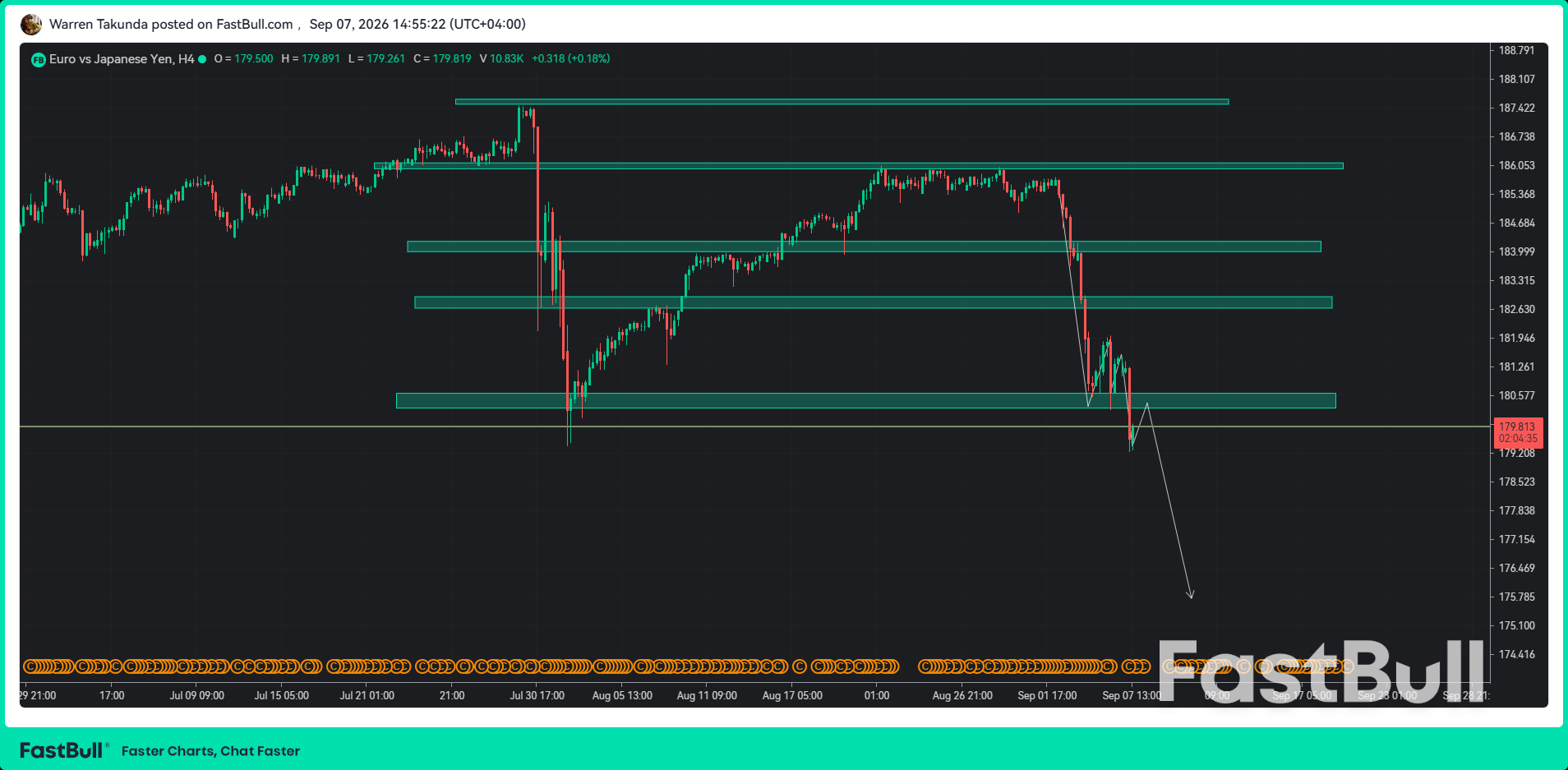
EUR/JPY has shifted into a decisively bearish structure on the 4-hour chart, with the latest decline extending the breakdown that began after repeated failures around the 185.50–186.00 resistance area. Selling pressure has accelerated significantly, taking the cross toward 179.80 and through several previously important support levels.
The most significant development is the break beneath the 180.30–180.70 support zone. This area previously attracted buyers and generated a meaningful rebound, but the latest move has pushed price below it. That breakdown suggests the zone could now become resistance if EUR/JPY attempts a short-term recovery.
The broader price structure reinforces the bearish outlook. EUR/JPY has already broken through support around 183.90–184.20 and 182.60–182.90, while successive rebounds have failed to recover previous highs. This sequence of lower highs and lower lows indicates that sellers remain firmly in control.
In the near term, a corrective rebound toward 180.30–180.70 remains possible following the speed of the latest decline. However, rejection from this region would strengthen the bearish continuation scenario. A sustained move beneath 179.00 would expose 177.80–178.00, before opening the way toward the larger projected downside target around 175.70–176.00.
For the bearish outlook to weaken, EUR/JPY would need to recover above 180.70 and subsequently reclaim the 182.60–182.90 region. Until that happens, rebounds are likely to remain corrective within the broader downward structure.
The chart therefore continues to favour selling into temporary recoveries, with the breakdown beneath 180.50 providing room for another extension toward the mid-175.00 region.
TRADE RECOMMENDATION
SELL EUR/JPY
ENTRY PRICE: 179.80
STOP LOSS: 183.00
TAKE PROFIT: 175.80
Risk Warnings and Investment Disclaimers
You understand and acknowledge that there is a high degree of risk involved in trading with strategies. Following any strategies or investment methodologies is the potential for loss. The content on the site is being provided by our contributors and analysts for information purposes only. You alone are solely responsible for determining whether any trading assets, or securities, or strategy, or any other product is suitable for you based on your investment objectives and financial situation.


