EUR/JPY is trading around 187.20 during Monday's Asian session, consolidating the modest gains registered in the prior day's trading as two separate and equally uncomfortable economic narratives compete for dominance over the cross. On one side sits a Japanese Yen weighed down by a Bank of Japan that is, for all practical purposes, unable to move. On the other sits a Euro that is holding its ground not because the Eurozone economy is thriving — it manifestly is not — but because the Yen's weakness is simply deeper, more structural, and more immediately pressing than the Euro's own considerable challenges. In currency markets, relative deterioration is often more powerful than absolute strength, and EUR/JPY is a textbook illustration of that principle playing out in real time.
The data that defined Tuesday's European session was unambiguous in its message and deeply unsettling in its implications. The German ZEW Survey — one of the most closely watched forward-looking indicators of economic sentiment in the Eurozone's largest economy — collapsed in April with a severity that caught even the most cautious forecasters off guard. The Economic Sentiment component plunged to -17.2, a reading that represents not merely a miss but a wholesale repudiation of the consensus forecast of -5.0 and a dramatic deterioration from March's already-subdued reading of -0.5.
To put that number in context: a ZEW Economic Sentiment reading of -17.2 signals that a significant majority of the surveyed financial and institutional analysts who responded to the survey expect German economic conditions to worsen over the coming six months. That is not a marginal downgrade in expectations. It is a broad-based collapse in confidence that reflects the accumulated weight of multiple simultaneous headwinds — elevated energy costs driven by the Middle East conflict, weakening export demand, the ongoing drag from tight monetary policy, and a global trade environment that remains deeply uncertain.
The Current Situation index was equally grim. It deteriorated sharply to -73.7, missing the already pessimistic consensus estimate of -70.0 and falling precipitously from -62.9 in the prior reading. A reading of -73.7 on the Current Situation index is not merely negative — it is deeply, structurally negative, reflecting an assessment that the German economy is in a materially worse position right now than it was even a month ago. For an economy that has been struggling with stagnation for the better part of two years, this is not the kind of data that inspires confidence in a near-term cyclical recovery.
The weakness was not confined to Germany. The Eurozone-wide ZEW Economic Sentiment index also deteriorated markedly, falling to -20.4 against expectations of -3.6 — a miss of nearly 17 full points that underscores the breadth of the confidence deterioration across the currency bloc. This is not a German-specific problem. It is a Eurozone-wide crisis of economic confidence, and the ZEW data has laid it bare with clinical precision.
For the Euro, the immediate market reaction was a studied lack of reaction — which is itself revealing. EUR/JPY barely flinched following the release, holding near 187.20 rather than selling off aggressively as one might expect in response to data of this quality. The explanation for that resilience lies entirely in the Yen's own weakness rather than any fundamental strength in the single currency. The Euro is being carried higher in this cross not by optimism about Frankfurt or Berlin but by pessimism about Tokyo — and that is a fragile foundation upon which to build a rally.
Adding a further layer of complexity to the European picture, ECB Vice President Luis de Guindos used a Tuesday address to flag private credit as a key source of risk to financial stability, alongside elevated market valuations and what he described as loose fiscal policy in certain Eurozone member states. The remarks, reported by Reuters, were carefully calibrated — de Guindos was not sounding an alarm so much as cataloguing the accumulation of vulnerabilities that the ECB's financial stability framework is currently monitoring with heightened attention.
But the timing of those comments, arriving in the same session as the catastrophic ZEW data, creates a narrative of an institution that is simultaneously worried about both too much risk-taking in financial markets and too little economic momentum in the real economy. That tension — between financial stability concerns that argue for caution and growth concerns that argue for accommodation — is one that the ECB will need to navigate with exceptional care in the months ahead, particularly as market pricing continues to build in rate hike expectations for June following March's hotter-than-expected inflation revision to 2.6%.
From my perspective, the ZEW data materially complicates the ECB's path. The central bank cannot easily justify hiking rates into an economy where business and investor confidence is collapsing at the pace reflected in today's survey. The counterargument — that energy-driven inflation is real, persistent, and threatening to de-anchor expectations — remains valid. But the case for a June hike just became more contested this morning, and I expect that debate to intensify considerably in the weeks ahead as incoming data continues to reflect the tension between inflationary pressures and deteriorating growth momentum.
If the Euro's situation is complicated, the Japanese Yen's is arguably more so — and more immediately damaging to the currency. The BoJ's April 28 monetary policy meeting, once anticipated as a potential inflection point for Japanese rate policy, is now almost universally expected to produce no change whatsoever. The Bank is forecast to leave its policy rate unchanged at 0.75%, a decision that has been effectively pre-ordained by the combination of geopolitical shocks, energy price surges, and — most recently and most dramatically — the magnitude 7.3 earthquake that struck off the coast of Honshu on Monday, triggering tsunami warnings and compounding an already dire economic assessment.
According to a report from Nikkei — Japan's most authoritative financial publication — the BoJ is expected to revise its inflation forecasts higher at the April 28 meeting while simultaneously lowering its growth projections. That combination — rising inflation and falling growth — is the definition of stagflation, and it places the Bank of Japan in precisely the same impossible position that has paralysed the Bank of England: unable to cut rates because inflation is too high, unable to raise them because growth is too weak, and left with no good options in either direction.
The energy dimension of this story is particularly acute for Japan. As one of the world's largest importers of crude oil and liquefied natural gas, Japan's economy is acutely sensitive to sustained elevations in global energy prices. The Middle East conflict — and particularly the ongoing disruption to shipping routes through the Strait of Hormuz — has delivered an energy cost shock to Japan that flows directly into corporate input costs, household utility bills, and ultimately into the inflation figures that the BoJ is now scrambling to incorporate into its revised forecasts.
What makes the BoJ's situation especially complex is the signal it may choose to send alongside its unchanged rate decision. Other reports suggest the central bank is actively assessing the economic impact of the Middle East conflict, and — critically — that it may signal a resumption of policy normalization as early as June if conditions allow. That potential June signal, however tentative and conditional it may be, is the one piece of information that Yen bulls are desperately clinging to right now. A credible BoJ commitment to June normalization — even if not fully binding — would at minimum provide the Yen with a narrative floor and reduce the pace of its depreciation against major peers including the Euro.
Whether the BoJ can credibly deliver such a signal in the current environment is, frankly, an open question. A central bank dealing with an energy shock, a natural disaster, and deteriorating growth projections simultaneously does not have the luxury of forward guidance clarity that markets typically demand. Any June signal will almost certainly be heavily conditioned on incoming data — which means it will provide limited comfort to Yen bulls who need something more concrete to push back against the structural selling pressure the currency is currently absorbing.
Stepping back from the individual data points and assessing the full picture, my view on EUR/JPY remains cautiously bullish in the near term — but with important caveats that I would not want readers to overlook. The pair is holding above 187.00 on the basis of Yen weakness rather than Euro strength, and that distinction matters enormously for assessing the durability of the current level.
The Euro is heading into a period of genuine uncertainty. ZEW data of the quality released today, combined with ECB financial stability concerns and an inflation-growth dilemma that has no clean resolution, creates the conditions for meaningful Euro volatility in the weeks ahead. If incoming Eurozone data continues to deteriorate and the June ECB hike narrative weakens, the Euro's ability to remain supported against even a weak Yen will be genuinely tested.
For now, however, the Yen's structural vulnerabilities — a frozen BoJ, an energy shock, earthquake damage, and zero near-term catalyst for meaningful yield support — continue to provide EUR/JPY with sufficient fundamental tailwind to hold current levels and potentially extend modestly toward the 187.80–188.00 area. The year-to-date high at 186.88 has already been surpassed, and the next meaningful technical resistance does not emerge until the 188.50–189.00 region.
The path of least resistance for EUR/JPY remains higher — but traders should watch the ZEW deterioration closely. An economy losing confidence this quickly has a habit of producing unpleasant surprises, and the Euro is not immune to the turbulence ahead.
Technical Analysis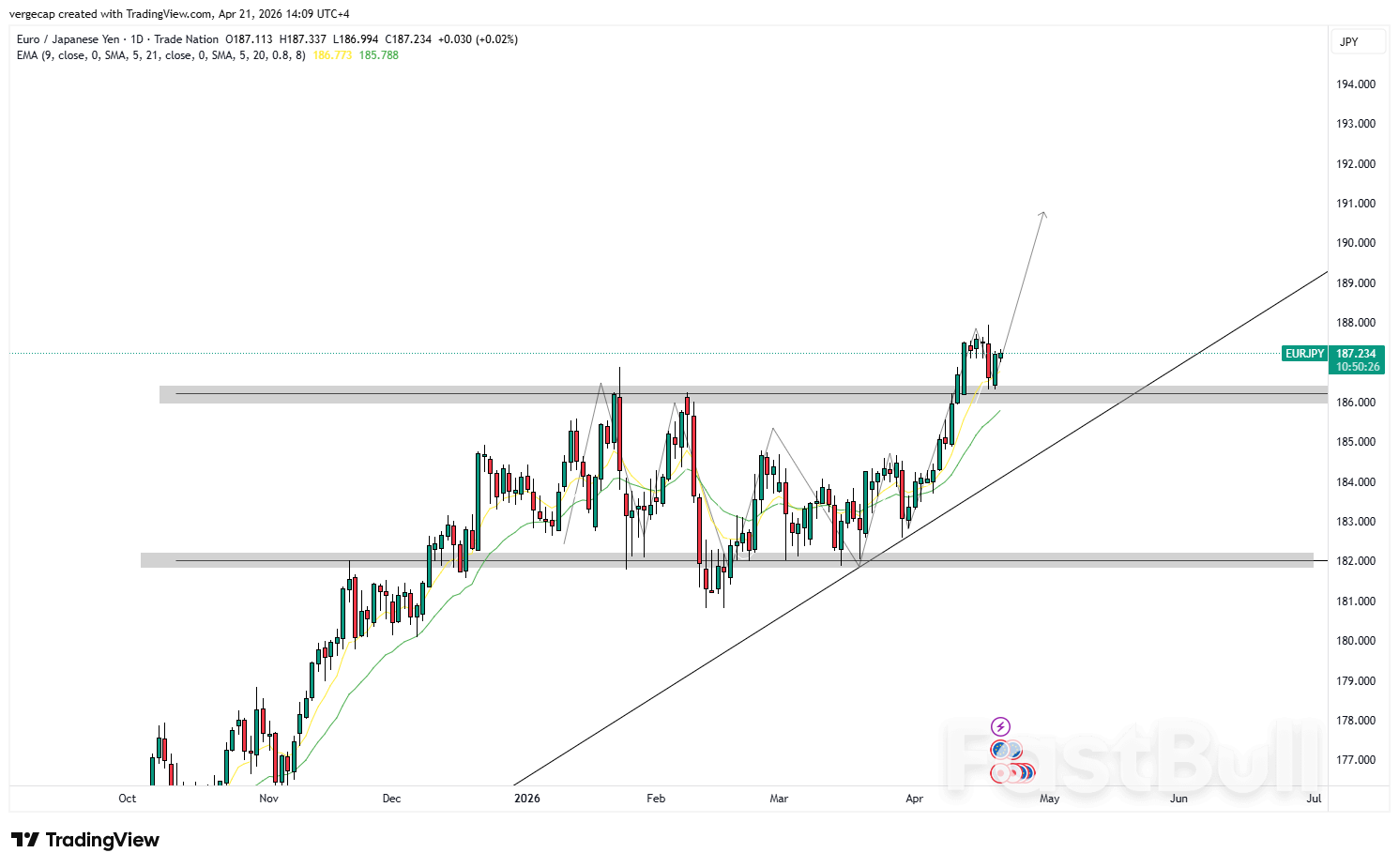
, EUR/JPY remains firmly entrenched within one of the most constructive and well-structured bullish formations visible across the major currency crosses on the daily chart. Price currently trades at 187.234, consolidating just above the critical 186.00 resistance-turned-support zone following a powerful breakout that has fundamentally altered the pair's medium-term technical landscape. The broader structure — defined by a rising trendline drawn from the October 2025 lows near 177.00 — has been intact for over six months and continues to slope upward with impressive consistency, underpinning every dip and validating every recovery with a reliability that demands respect from both trend-followers and counter-trend traders alike.
The most significant technical development on this chart is the decisive breakout above the 186.00 major horizontal resistance level — a zone that acted as a formidable ceiling throughout January and February 2026 and was tested repeatedly before finally yielding. The manner in which price broke through 186.00 in mid-to-late April was characteristically impulsive — a sequence of strong bullish daily candles that closed convincingly above the level and established it as a new support foundation. That structural conversion from resistance to support is one of the most powerful signals available on a daily chart, and the fact that price has since pulled back to test 186.00 from above and held — touching an intraday low of 186.994 on the current session before recovering — adds significant technical credibility to the breakout.
The 9-period EMA at 186.773 and the 21-period SMA at 185.788 are both positioned below current price and trending higher in a bullish stack formation that has been in place since the accelerating advance of April. This alignment — price above both averages, both averages sloping upward and separating from each other — is the textbook configuration of a trending market in a healthy impulsive phase rather than a topping or distribution process. The 21-period SMA near 185.80 represents the more critical dynamic support layer and continues to slope upward convincingly, reinforcing the medium-term bullish bias. A daily close below 185.80 would represent a meaningful deterioration in the moving average structure and would warrant a reassessment of near-term directional bias.
The 186.00 horizontal support band — now reinforced by its proximity to the rising trendline — constitutes the definitive line in the sand for the current bullish structure. A sustained daily close below 186.00, particularly if accompanied by a break of the ascending trendline that is now converging in the same area, would mark a genuine structural deterioration and could trigger a corrective move back toward the 184.00–184.50 zone, where prior consolidation activity from late March and early April would provide the next meaningful floor. Below that, the 182.00 major horizontal support band — one of the most prominent levels on the entire chart, having arrested the sharp February selloff with precision — represents the ultimate downside reference and the level whose breach would signal a far more serious trend interruption.
On the upside, the projected path drawn on the chart is unambiguously bullish, pointing toward an extension into the 190.00–191.00 area as the primary medium-term target. The 188.00 level — a minor resistance visible at the recent swing highs — represents the first hurdle that bulls must overcome cleanly before that broader projection comes into play. A sustained daily close above 188.00 would confirm that the consolidation phase near current levels has resolved in favor of the uptrend and would likely attract fresh trend-following momentum that accelerates the move toward 190.00. That level carries enormous psychological significance as a round number and a multi-year high reference, and its breach would represent a landmark technical development for the pair.
The rising trendline itself, now approaching the 186.00–186.50 area from below, provides an additional and increasingly proximate layer of dynamic support. Each successive test of this trendline across the chart's history — in November, December, February, and March — has produced a meaningful bullish reaction, and the current consolidation near 187.00 appears consistent with another routine trendline retest before the next leg higher rather than a trend-ending reversal.
TRADE RECOMMENDATION
BUY EUR/JPY
ENTRY PRICE: 187.00
STOP LOSS: 185.50
TAKE PROFIT: 190.50


