EUR/JPY is trading around 187.25 on Wednesday, up a marginal 0.05% on the day — a price action that perfectly encapsulates the fundamental stalemate currently gripping this cross. Neither the Euro nor the Japanese Yen has a compelling near-term catalyst to move aggressively in either direction, and the result is a pair that is treading water at elevated levels while two of the world's most important central banks sit on their hands and a Middle East ceasefire holds together by the thinnest of threads.
To understand EUR/JPY's current stasis, you have to understand that the forces acting on both sides of this cross are remarkably symmetrical in their uncertainty. The Euro is not strong — it is merely less weak than the Yen. And the Yen is not collapsing — it is simply unable to find the policy-driven catalyst that would give it genuine upside momentum. In a cross where both currencies are fundamentally constrained, the result is exactly what the chart is showing: consolidation at elevated levels with no conviction in either direction.
ECB President Christine Lagarde set the tone for Wednesday's European session with comments that were careful in their phrasing but stark in their substance. The Eurozone economic outlook, she warned, remains highly uncertain due to what she described as a significant energy supply shock linked to tensions in the Middle East and the ongoing blockade of the Strait of Hormuz. Crucially, she added that while energy prices have not yet reached their worst-case scenario levels, the outlook remains fragile — a word choice that carries considerably more weight coming from a central bank president than it might in ordinary circumstances.
That phrase — "fragile" — is doing a great deal of policy work in Wednesday's market narrative. It is Lagarde's way of communicating that the ECB's base case has not yet deteriorated to the point of demanding immediate policy action, but that the distance between the current situation and a materially worse one is uncomfortably short. It is the language of an institution that is watching the energy price dashboard with intense anxiety and knows that a single significant escalation in the Strait of Hormuz could push the Eurozone's economic trajectory in a direction that would force an uncomfortable policy choice.
ECB Governing Council member Martins Kazaks reinforced that message with his own characteristically direct assessment: the central bank is "not in a rush" to move on interest rates. Kazaks acknowledged that uncertainty linked to the Middle East war remains very high and that its impact on the real economy is only gradually being felt — a timeline observation that provides the ECB with intellectual cover for inaction while data continues to accumulate. The message from Frankfurt, delivered through multiple voices on Wednesday, is unified and consistent: we are watching, we are concerned, and we are not moving until we have better visibility.
Markets had been building toward a near-consensus expectation of a June ECB rate hike following March's inflation revision to 2.6% — the highest reading since July 2024. Tuesday's catastrophic ZEW Economic Sentiment data, which crashed to its weakest level since December 2022, had already introduced meaningful doubt about that timeline. Wednesday's cautious commentary from Lagarde and Kazaks has added another layer of uncertainty, and the balance of probability for a June hike — while still the market's base case — is now being actively contested rather than serenely assumed.
For EUR/JPY specifically, the ECB's paralysis removes one of the cross's key near-term upside drivers. A hawkish ECB surprise — rate hike signals, aggressive forward guidance — would provide the Euro with the interest rate differential tailwind needed to push the cross meaningfully higher. A cautious, data-dependent ECB that is "not in a rush" provides no such tailwind, leaving the Euro dependent on Yen weakness rather than its own fundamental strength to hold current levels.
The Japanese side of this equation is, if anything, more constrained than the European side. The Bank of Japan is widely expected to leave interest rates unchanged at 0.75% at its April 28 meeting — a decision that has been effectively pre-ordained by the combination of energy-driven inflationary pressure, a deteriorating growth outlook, and the seismic shock of Monday's magnitude 7.3 earthquake off the Honshu coast. According to Reuters sources, however, the BoJ is preparing to revise its inflation forecasts higher while simultaneously lowering its growth projections — a stagflationary update that will make the central bank's communication challenge at the April meeting extraordinarily difficult to navigate.
The one potential near-term catalyst for Yen strength is the signal that Reuters sources suggest the BoJ may deliver: a hint at policy normalization resuming as early as June, contingent on the geopolitical situation stabilising and incoming data supporting the case for a gradual tightening. That conditional June signal — if credibly delivered — would be the most significant piece of BoJ communication since the current conflict began, and it would provide the Yen with a genuine fundamental floor that has been conspicuously absent in recent weeks.
The critical word in that sentence is "conditional." A BoJ June signal that is buried under layers of qualifications about Middle East uncertainty and earthquake recovery will not move the Yen with the force that a clean, confident forward guidance statement would. Markets have become highly attuned to the difference between genuine BoJ hawkishness and performative hawkishness designed to manage Yen depreciation expectations without actually committing to action. If April 28's communication falls into the latter category — which remains entirely possible given the scale of the uncertainty the BoJ is navigating — the Yen will remain structurally weak and EUR/JPY will retain its elevated position.
Japan's energy vulnerability compounds the central bank's dilemma in ways that are worth spelling out clearly. The country imports the vast majority of its crude oil from Middle Eastern producers, and the Strait of Hormuz blockade has therefore delivered an energy cost shock that flows directly into every corner of the Japanese economy — from industrial input costs to household utility bills to the trade balance that has historically been one of the Yen's fundamental supports. A Japan paying significantly more for energy imports is a Japan with a wider current account deficit, weaker corporate margins, and a consumer whose purchasing power is being eroded in real time. None of those factors support the kind of confident BoJ tightening that would give the Yen a durable recovery.
Wednesday's geopolitical update brought a development that was simultaneously reassuring and deeply insufficient. President Trump announced that he would extend the ceasefire with Iran at Pakistan's request — a diplomatic gesture that confirmed the Pakistani mediation channel is functioning and that Washington retains at least some interest in pursuing a negotiated resolution. Markets received the news with cautious relief, noting that the ceasefire extension, however conditional and however reluctant, reduces the immediate probability of a catastrophic military escalation before a framework agreement can be reached.
What the ceasefire extension does not change, however, is the US naval blockade of Iranian ports — which Trump has explicitly stated will remain in place until a deal is signed. Tehran continues to characterise the blockade as an act of war and a violation of the ceasefire terms, and the IRGC's recent threats of "crushing blows" against American assets suggest that the military wing of the Iranian establishment has not been brought along by whatever diplomatic progress the political establishment is making in Islamabad. The gap between diplomatic signals and military posture on the Iranian side remains one of the most destabilising features of the current situation.
For EUR/JPY, any genuine escalation that breaks the ceasefire — a military incident in the Strait, an IRGC strike on US assets, or a formal Iranian rejection of the peace framework — would immediately revive safe-haven demand for the Japanese Yen, creating a sharp and potentially violent correction lower in the cross. That tail risk is the primary headwind preventing EUR/JPY bulls from pushing the pair aggressively toward the 188.50–189.00 targets that the technical picture otherwise supports.
Technical Analysis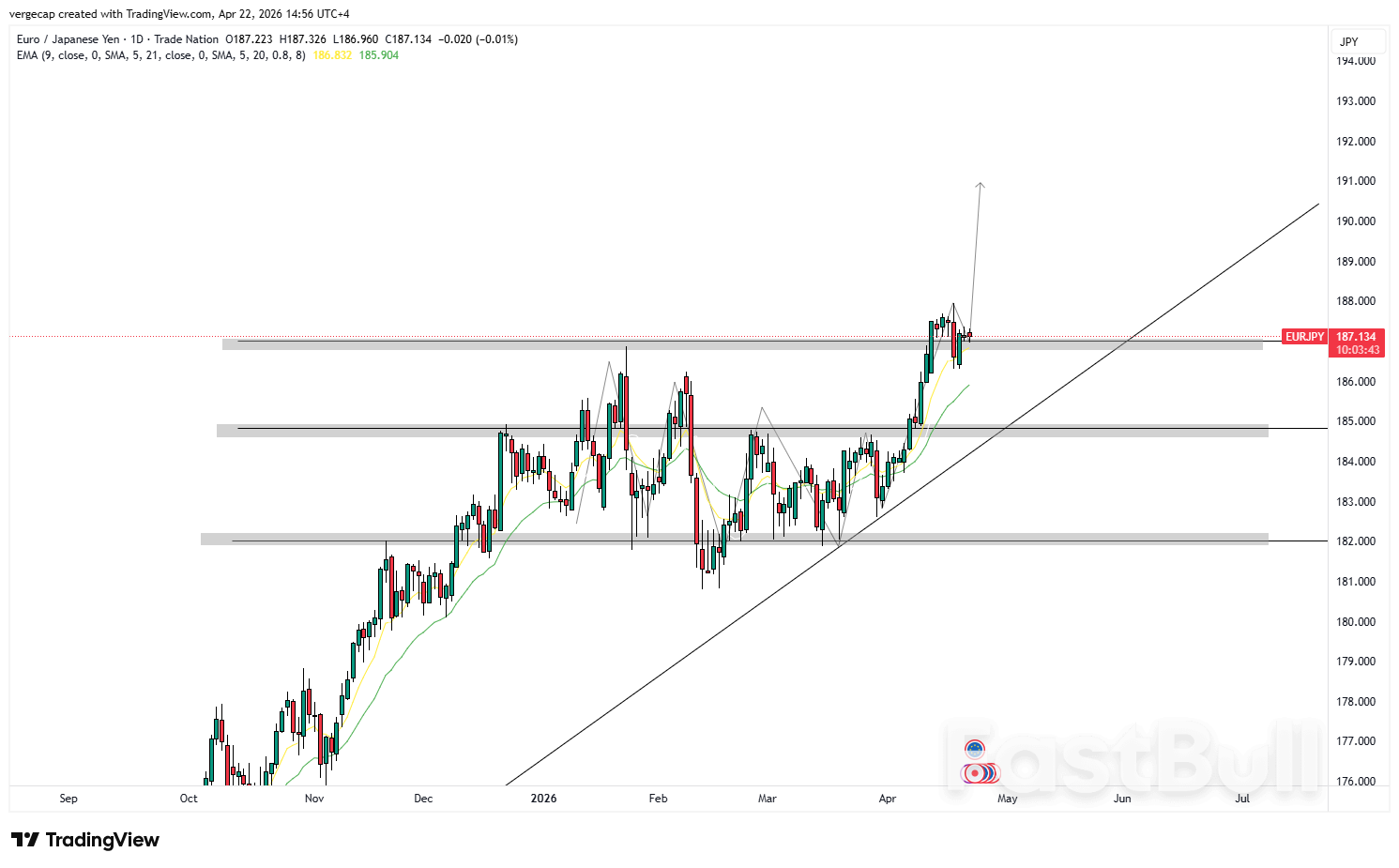
From a technical perspective, EUR/JPY remains firmly entrenched within one of the most structurally sound and long-running bullish formations visible across the major currency crosses on the daily chart. Price currently trades at 187.134, consolidating just above the critical 186.80–187.00 breakout zone following a decisive push through multi-month resistance — a development that has fundamentally altered the pair's medium-term technical landscape and placed the bulls squarely in control of the narrative heading into May.
The defining structural element on this chart is the ascending trendline drawn from the September 2025 lows near 176.00 — a trendline that has been intact for over seven months and has been validated on multiple occasions with a consistency that commands genuine technical respect. Each successive test of this trendline across the chart's history has produced a meaningful bullish reaction, and the April acceleration — where price broke through the 185.00–186.00 resistance band and extended toward fresh multi-month highs — represents the most powerful trendline-driven move yet recorded on this chart. The trendline is currently converging near the 186.00–186.50 area, providing a dynamic support floor that aligns precisely with the horizontal resistance-turned-support zone at 186.80 to create one of the most significant technical confluence regions on the entire chart.
The 9-period EMA at 186.832 and the 21-period SMA at 185.904 are both positioned below current price and trending higher in a clean bullish stack formation — the textbook configuration of a trending market in an impulsive phase rather than a distribution or topping process. The 21-period SMA near 185.90 represents the more critical dynamic support layer and continues to slope upward convincingly, reinforcing the broader bullish bias. A daily close below 185.90 would represent a meaningful deterioration in the moving average structure and would warrant a reassessment of the near-term directional bias, though it would not in isolation negate the broader bullish trend.
The 185.00 horizontal support band — one of the most prominent levels on the chart, having capped price on multiple occasions throughout December and January before being breached in the April advance — now represents the first major structural support below the moving averages. A sustained daily close below 185.00 would be a technically significant development and would shift the near-term bias from bullish to neutral, potentially opening a corrective move back toward the 182.00–182.50 major horizontal support band — the level that arrested the sharp February selloff with precision and represents the ultimate downside reference for any meaningful corrective sequence. Below 182.00, the broader bullish structure built since September 2025 would require fundamental reassessment.
On the upside, price is currently consolidating just beneath the 187.50–188.00 minor resistance zone — the recent swing highs from April 20–21. A clean daily close above 188.00 would confirm that the current consolidation has resolved in favor of the uptrend and would accelerate the projected extension toward the 190.00–191.00 area visible on the chart's projected path. The 190.00 level carries enormous psychological significance as both a round number and a multi-year high reference, and its eventual breach would represent a landmark technical achievement for the pair — one that would attract fresh trend-following institutional positioning and potentially trigger a broader momentum-driven extension toward 192.00–193.00 over the medium term.
The overall structure — a seven-month ascending trendline, a clean breakout above multi-month resistance, bullish moving average alignment, and a projected path pointing toward 191.00 — presents one of the most compelling technically bullish setups currently visible on daily timeframe charts across the major crosses.
TRADE RECOMMENDATION
BUY EUR/JPY
ENTRY PRICE: 186.80
STOP LOSS: 185.20
TAKE PROFIT: 190.50


