EUR/GBP traded firmly in negative territory around the 0.8725 handle on Wednesday, extending a run of losses that began earlier in the week and underscoring a shift in short-term sentiment in favour of the Pound Sterling. The cross has struggled to attract meaningful bids as investors digest a subtle but important divergence between the policy outlooks of the Bank of England and the European Central Bank, even as both institutions signal caution rather than urgency.
The immediate catalyst behind Sterling’s resilience has been the Bank of England’s latest policy decision. As widely anticipated, the BoE lowered its benchmark interest rate by 25 basis points to 3.75%, marking its first cut since last summer. While a rate reduction would normally weigh on a currency, the accompanying communication delivered a notably hawkish undertone. Governor Andrew Bailey stressed that the path of rates is likely to be “gradual” and warned that future cuts would become increasingly finely balanced, given that inflationary pressures have not been fully extinguished.
This messaging reinforced the perception that the BoE is not embarking on an aggressive easing cycle. Instead, policymakers appear intent on maintaining restrictive conditions for longer than many had assumed, particularly as wage growth and services inflation remain elevated. In currency markets, that nuance has mattered more than the cut itself, allowing Sterling to outperform both the euro and the US dollar in the near term.
Market pricing broadly reflects this cautious outlook. According to Reuters-based estimates, investors expect at least one additional BoE rate cut in the first half of next year, but see only around a 50% probability of a second move before year-end. That relatively shallow easing profile continues to underpin GBP, acting as a structural headwind for EUR/GBP and limiting the scope for any sustained rebound in the cross.
On the other side of the equation, the euro has found some support from the view that the European Central Bank may be close to the end of its own easing cycle. The ECB left its three key policy rates unchanged at its most recent meeting, the fourth consecutive hold, as officials opted for a wait-and-see approach amid mixed economic signals across the bloc. President Christine Lagarde reiterated that the ECB is in a “good position” and emphasised that policy decisions will remain data-dependent.
Money markets have taken this guidance at face value. Current pricing assigns less than a 10% probability of an ECB rate cut as early as February 2026, suggesting that investors believe most of the easing has already been delivered. In theory, this should help the euro stabilise. In practice, however, it has not been enough to offset the relative appeal of Sterling, particularly as UK data have shown tentative signs of resilience compared with a still-fragile Eurozone growth outlook.
The resulting dynamic has kept EUR/GBP on the defensive, though not in free fall. With liquidity thinning as the year-end holiday period approaches, price action has remained relatively contained. Unless there is a material shift in monetary policy expectations or a significant surprise in macro data, the cross is likely to remain guided by these relative central bank narratives in the near term.
Technical analysis 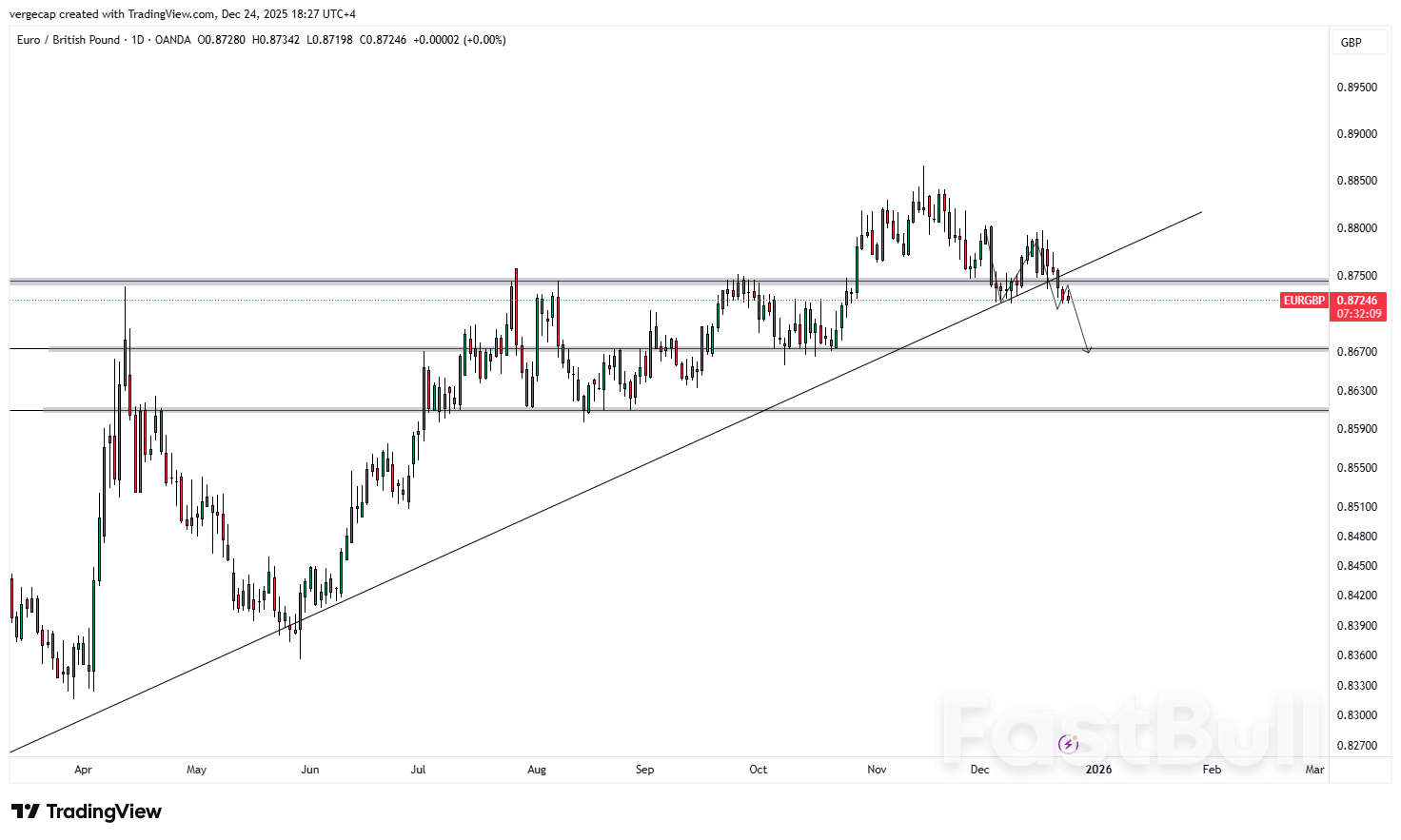
From a technical perspective, the daily EUR/GBP chart signals a meaningful change in market structure. For several months, the pair traded within a well-defined uptrend, supported by a strong ascending trendline that was repeatedly validated by multiple price rejections. These rebounds, previously viewed as confirmations of a solid demand zone, underpinned a broadly bullish bias.
That structure has now been challenged. Toward the end of December 2025, EUR/GBP broke decisively below the ascending trendline, a development that marked a shift in momentum. The breakout point, where selling pressure began to dominate, has become a key area of focus. Price action is currently testing whether this break will hold.
If the pair fails to reclaim the former trendline, the prior bullish structure would be considered invalidated, opening the door for a deeper corrective move. Under this primary bearish scenario, the immediate downside target sits around 0.86741, a previous horizontal support level that could attract buyers on the first test.
That said, traders should remain alert to the risk of a false breakout, particularly in thinner holiday markets. A sustained move back above the 0.87959 region would negate the bearish signal and suggest that the broader uptrend may yet resume.
TRADE RECOMMENDATION
SELL EURGBP
ENTRY PRICE: 0.8725
STOP LOSS: 0.8800
TAKE PROFIT: 0.8600


