The euro is struggling to find a foothold against a resilient British pound, with the EUR/GBP cross drifting lower on Wednesday as markets increasingly price in a near-term policy divergence between the Bank of England and the European Central Bank. Trading at 0.8725 at the time of writing, the pair is down 0.10% on the session, caught in a familiar tug-of-war between solid Eurozone data and the gravitational pull of hawkish BoE expectations.
On the surface, the Eurozone should be celebrating. The final HCOB Manufacturing Purchasing Managers’ Index (PMI) for March came in at 51.6, a notable upward revision from the flash estimate of 51.4 and a significant jump from February’s 50.8. This marks the highest reading for the bloc’s manufacturing sector in 44 months—a clear signal that the long-awaited industrial recovery is finally gaining traction. The headline number suggests the factory engine is sputtering back to life, driven by a stronger-than-expected performance in Germany and Italy.
But as any seasoned market watcher will tell you, the devil is in the details. Beneath the hood, the Eurozone recovery is looking decidedly lopsided. While Germany and Italy pulled the aggregate number higher, France’s manufacturing sector was revised down to stagnation, and Spain unexpectedly slipped back into contraction territory. This patchwork recovery underscores a persistent vulnerability: the bloc’s largest economies are not moving in sync, a fact that will likely give ECB policymakers pause when considering how aggressively to ease policy later this year.
Complicating the narrative further, Tuesday’s preliminary inflation data out of the Eurozone showed price growth cooling more than anticipated in March. Crucially, this softening occurred despite simmering geopolitical tensions involving Iran—a testament to how underlying demand dynamics, rather than external shocks, are currently driving the inflation trajectory. For currency traders, the softer print is a double-edged sword. While it has weighed on the euro in real yield terms, it has also offered a modicum of support by easing fears that a spike in energy costs could trigger a more painful stagflationary shock.
That brings us to the real driver of today’s price action: the pound.
Sterling remains the undisputed heavyweight in this cross. The Bank of England has successfully talked up the prospect of a rate hike as early as April, framing it as a necessary preemptive strike against inflation risks emanating from the Middle East. Even with oil prices showing signs of moderation, the BoE’s hawkish lean stands in stark contrast to the ECB’s more dovish trajectory, providing a solid bid for the pound every time EUR/GBP attempts to push higher.
However, I would caution against viewing the UK’s economic outlook through rose-tinted glasses. The recent data flow out of London has been far from uniformly strong. The S&P Global Manufacturing PMI for March came in at 51, a decline from the prior month’s 51.4 and below the market consensus of 51.2. While a reading above 50 still denotes expansion, the miss signals that the UK’s manufacturing rebound is losing momentum just as the BoE considers tightening the monetary policy screw further.
EUR/GBP pair is trapped in a technical and fundamental holding pattern. The euro wants to rally on the back of a genuine improvement in Eurozone manufacturing sentiment, but it cannot break free from the gravitational pull of a pound that is being buoyed by the BoE’s aggressive rhetoric. The market is currently pricing in a higher probability of a BoE move than an ECB cut in the near term, and as long as that gap remains, dips in this pair are likely to be shallow.
Nevertheless, I am watching the data divergence with a skeptical eye. The UK’s softening PMI suggests that the domestic economy may not be robust enough to withstand another rate hike without sacrificing growth. Conversely, the Eurozone’s uneven recovery—highlighted by Spain’s contraction and France’s stagnation—means the ECB still has ample justification to lean dovish. For now, the path of least resistance for EUR/GBP remains tilted to the downside, but I suspect the 0.8700 level will prove to be a formidable support. Any sustained break below that threshold would require a more decisive deterioration in Eurozone sentiment or a concrete signal from the BoE that an April hike is all but guaranteed.
Until then, expect more of the same: a low-volatility grind lower, with traders parsing every data point for clues on who will blink first in this transatlantic policy standoff.
Technical Analysis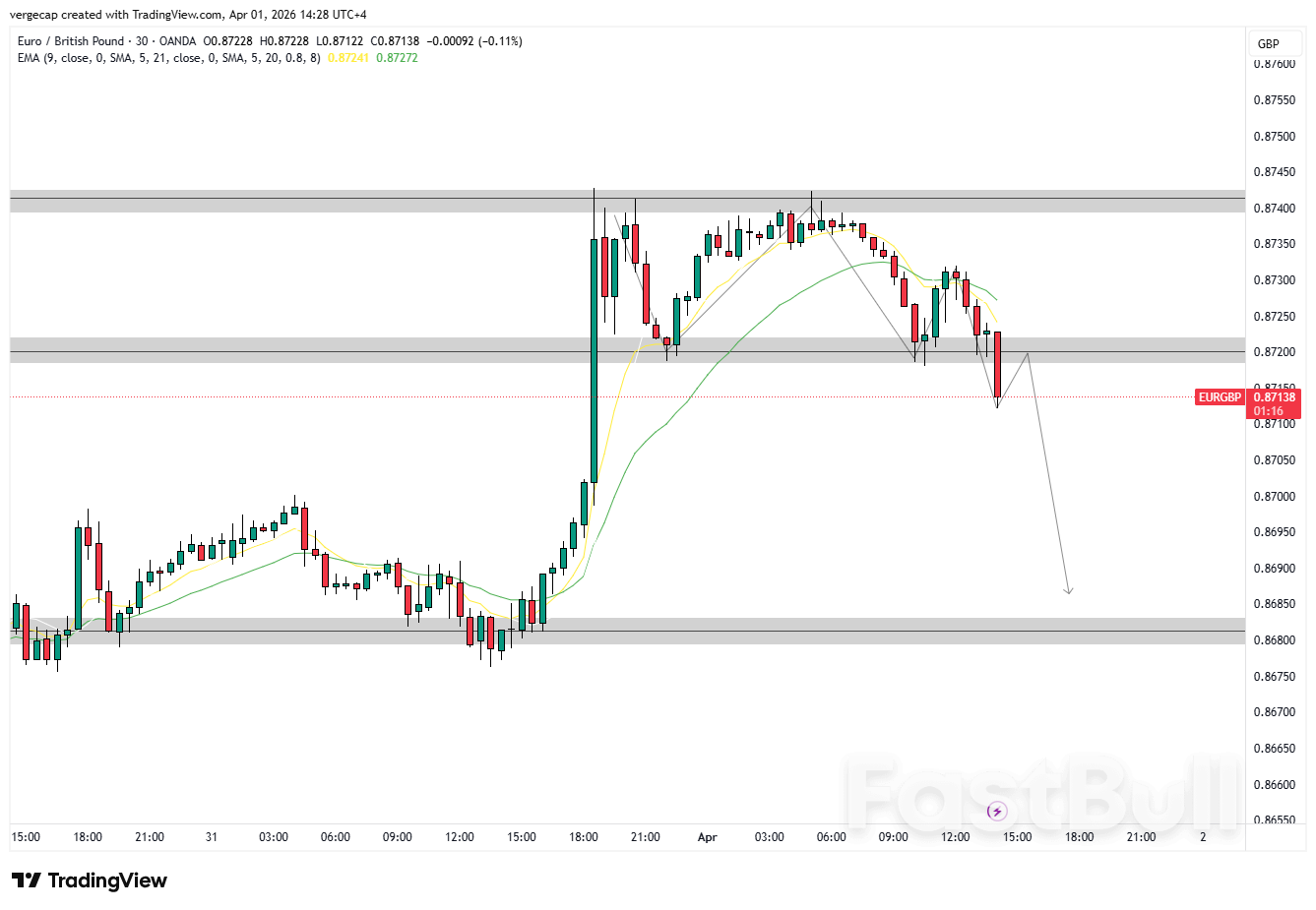
From a technical perspective, EUR/GBP is exhibiting a textbook bearish reversal structure on the 30-minute chart following a dramatic and unsustainable spike that carried price from the 0.8680 support base all the way to the 0.8740–0.8745 resistance ceiling in a near-vertical advance during the March 31 afternoon session. That spike — almost certainly driven by a sharp news catalyst or liquidity event rather than organic buying pressure — has now been comprehensively faded, with price surrendering the vast majority of those gains in an orderly but increasingly accelerating decline that has the hallmarks of a full mean-reversion move back toward the pre-spike origin.
The rejection from the 0.8740–0.8745 resistance zone was both swift and decisive. Price tagged this level twice — once during the initial spike and again during a secondary test in the early hours of April 1 — before sellers overwhelmed any remaining bullish interest and initiated a sustained decline that has progressively broken through every layer of intraday support. The 0.8720 horizontal band, which had briefly stabilized price during the mid-morning session, has now been violated with a sharp bearish impulse candle that pierced below it and extended toward the current price of 0.8714. This structural break of 0.8720 is the most significant near-term technical development on the chart, converting that level from support into active resistance and opening a clear path toward the lower end of the chart's range.
The 9-period EMA at 0.8724 and the 21-period SMA at 0.8727 have both rolled decisively lower and are now positioned above price, acting as a dynamic resistance ceiling that any recovery attempt will need to overcome before the short-term bearish bias can be neutralized. The inversion of the moving average stack — with price trading beneath both averages as they slope downward together — is a clean and unambiguous bearish signal on this timeframe. Critically, the gap between current price and the moving averages is widening rather than narrowing, indicating that downside momentum is building rather than fading at this stage.
The dotted horizontal line near 0.8715–0.8718 visible on the chart represents a minor intraday pivot that price is currently testing from above. A sustained 30-minute close below this level would confirm that the decline has sufficient momentum to extend toward the primary downside target — the 0.8680–0.8685 major support zone at the base of the chart, which represents the pre-spike origin and the most logical mean-reversion destination for the entire post-spike unwind. The projected move arrow drawn on the chart points precisely to this 0.8685–0.8690 area, a target of approximately 25–30 pips from current levels that is entirely consistent with the magnitude and structure of the failed spike pattern.
The 0.8680 level carries particular technical significance. It served as a consistent support base for the entirety of the March 31 pre-spike session and represents the area where institutional positioning was established before the news-driven move. A full retracement back to this level would complete the technical picture and confirm that the spike has been treated by the broader market as an overreaction to be faded rather than a genuine directional breakout. A sustained break below 0.8680 would extend the bearish narrative further toward the 0.8655–0.8660 area, but for the immediate session the 0.8685 zone represents the primary and most actionable target.
On the upside, any recovery attempt faces a formidable cluster of resistance between 0.8720 and 0.8730 — the confluence of the broken support level, the 9-period EMA, and the 21-period SMA. Only a clean reclaim and sustained 30-minute close above 0.8730 would begin to neutralize the immediate bearish pressure, while a recovery above the 0.8740–0.8745 resistance ceiling would be required to genuinely challenge the dominant post-spike selling narrative. Neither scenario appears likely given the current pace and structure of the decline.
The overall technical picture is clear and compelling. The spike has been rejected, the structure has broken down, the moving averages are bearishly aligned above price, and the measured move target points unambiguously lower. The path of least resistance for EUR/GBP in the immediate term is toward 0.8685.
TRADE RECOMMENDATION
SELL EUR/GBP
ENTRY PRICE: 0.8714
STOP LOSS: 0.8738
TAKE PROFIT: 0.8685


