The euro continued its downward grind against the British pound on Monday, slipping deeper into the recent range as traders brushed aside upward revisions to Eurozone growth data and braced for a key test of UK labor market resilience. The shared currency is struggling to find its footing after a firm rejection from the top of its multi-week downtrend channel, leaving it vulnerable ahead of a sparse economic calendar on both sides of the Channel.
As of midday trading in London, the EUR/GBP cross was hovering just below the 0.8700 handle, having been turned away decisively from resistance near 0.8720. This rejection at the upper boundary of the prevailing descending channel has shifted the technical focus back toward the downside, with the pair now probing the lower end of last week’s range at 0.8685. A sustained break below this immediate support level could open the door for further selling pressure, targeting the next psychological floor.
The price action reflects a persistent lack of bullish conviction for the euro, even in the face of fundamentally supportive data. On Friday, the pair dropped 0.3% despite the second estimate of Eurozone Gross Domestic Product (GDP) being revised slightly higher. The fact that the euro failed to garner any bids on the back of this revision underscores the prevailing negative sentiment toward the single currency, which remains sensitive to the widening growth differential with the U.S. and the cautious stance of the European Central Bank.
The session’s sole Eurozone data point is unlikely to provide the euro with any reprieve. Later on Monday, Eurostat is set to release Industrial Production figures for December, and the market consensus points to a worrying contraction. Economists expect factory output to have shrunk by 1.5% on a monthly basis, a stark reversal from the 0.7% expansion recorded in November. Such a print would reinforce the narrative of a struggling manufacturing sector in the bloc, dragged down by weak external demand and lingering energy cost pressures. This persistent industrial weakness serves as a critical headwind for the euro, preventing any sustainable rallies against its major counterparts.
Across the pound, the calendar is eerily quiet on Monday, leaving Sterling to trade on broader market flows and technical factors. However, the focus for GBP traders is firmly fixed on Tuesday’s highly anticipated UK employment report. The data release will be scrutinized for any signs of cooling in the labor market, particularly regarding wage growth, which remains a primary concern for Bank of England (BoE) policymakers.
With the BoE navigating a tricky path between sticky inflation and a slowing economy, the jobs report is expected to provide crucial guidance on the timing and magnitude of future rate cuts. A stronger-than-expected print, showing resilient wage pressures, could bolster the pound by reinforcing the BoE’s gradualist approach. Conversely, any sharp deterioration in hiring or a significant drop in pay growth would fuel speculation of more aggressive easing later this year, potentially capping Sterling’s upside.
Technical Analysis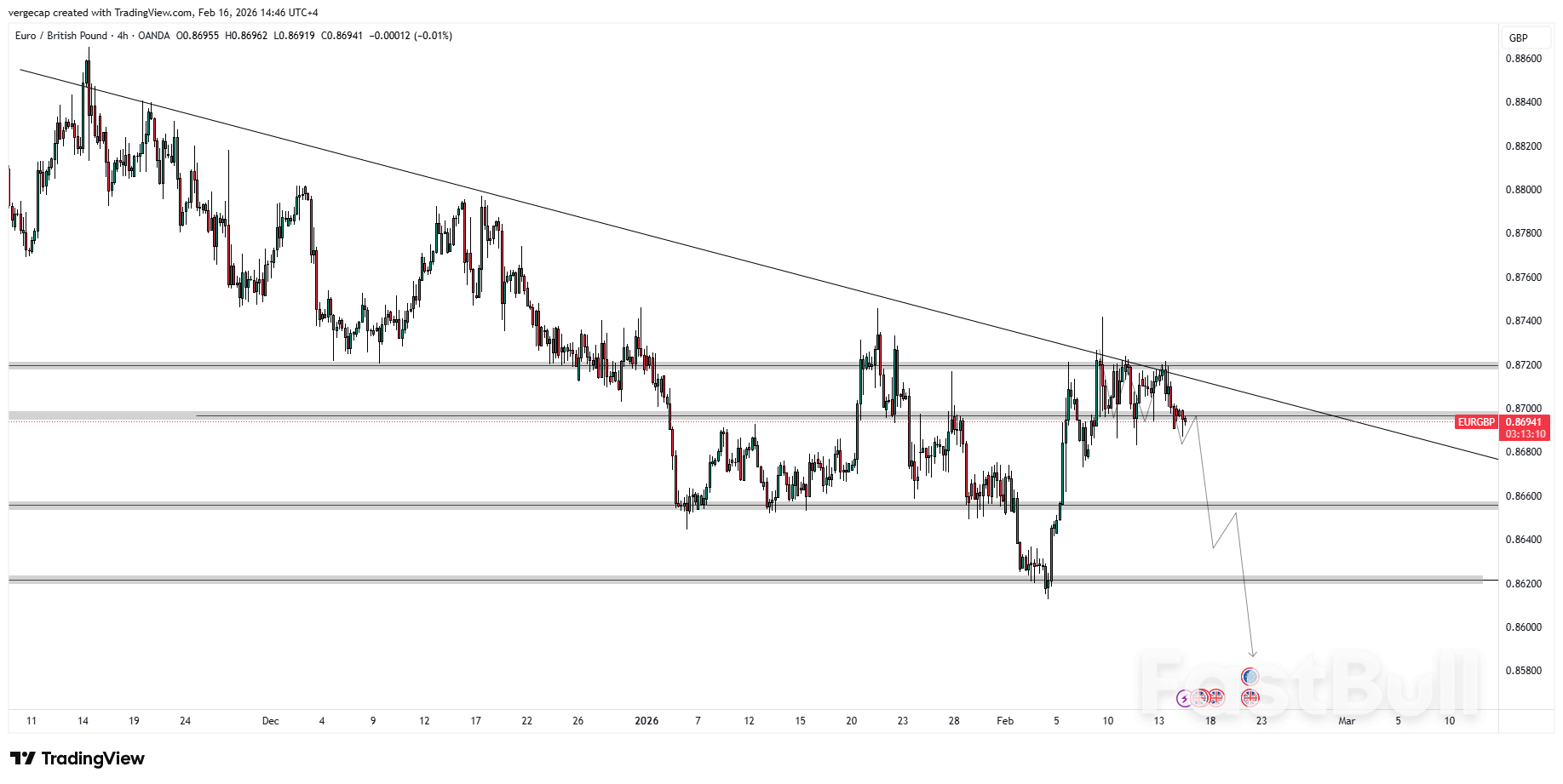
From a technical perspective, EUR/GBP remains confined within a broader bearish structure on the 4-hour chart, with price action continuing to respect a descending trendline that has capped rallies since mid-November. The market is currently consolidating beneath this dynamic resistance while oscillating inside a well-defined horizontal range, suggesting compression ahead of a potential directional breakout.
The descending trendline, now intersecting near 0.8715–0.8720, is acting as a near-term ceiling. Recent attempts to push higher have stalled precisely at this confluence zone, reinforcing it as a critical supply area. Despite several intraday spikes above 0.8700, sustained follow-through has been limited, indicating that sellers remain active at higher levels.
To the downside, immediate support is located near 0.8660, which has repeatedly contained pullbacks throughout February. Beneath that lies a stronger structural floor around 0.8615–0.8620, marking the February swing low and a key demand zone. A decisive break below 0.8660 would expose this lower boundary, and sustained trade under 0.8615 would confirm a bearish continuation pattern, opening the path toward the 0.8550–0.8500 region, as projected by the measured downside move shown on the chart. A move below 0.8500 would signal an acceleration of the broader downtrend.
On the upside, bulls would need a clean and sustained break above 0.8720, clearing both the descending trendline and horizontal resistance. Such a breakout would invalidate the immediate bearish bias and shift attention toward 0.8780, followed by the 0.8850 area, where prior distribution occurred. However, until that resistance is convincingly breached, rallies appear corrective within a larger downward framework.
Structurally, the pair continues to print lower highs beneath trendline resistance, reinforcing the bearish technical posture. The recent rebound from 0.8615 has been sharp but corrective in nature, retracing into resistance rather than establishing a new impulsive leg higher. This behavior typically precedes either a continuation lower or prolonged consolidation beneath supply.
Overall, EUR/GBP maintains a cautiously bearish outlook while trading below 0.8720, with the range gradually compressing under descending resistance — a setup that often resolves in the direction of the prevailing trend.
TRADE RECOMMENDATION
SELL EUR/GBP
ENTRY PRICE: 0.8690
STOP LOSS: 0.8735
TAKE PROFIT: 0.8550


