The EUR/CAD currency pair remained under sustained pressure during Friday’s Asian session, marking its third consecutive day of declines as it hovered near the 1.5920 level. The move underscores a broader shift in market sentiment, where geopolitical instability and diverging macroeconomic drivers are increasingly weighing on the Euro while underpinning the commodity-linked Canadian Dollar.
At the heart of the latest market moves lies a renewed wave of risk aversion tied to escalating tensions in the Middle East. Investors have grown increasingly cautious following comments from US President Donald Trump, who reaffirmed his administration’s intention to maintain a naval blockade of Iranian ports. The remarks come amid mounting uncertainty over the fate of the Strait of Hormuz, a critical artery for global energy supplies, with concerns rising that it may remain closed for an extended period.
Further complicating the geopolitical backdrop, Iran’s Supreme Leader Mojtaba Khamenei struck a defiant tone, signaling that Tehran would not relinquish its nuclear or missile capabilities. His stance effectively dampens any near-term hopes for diplomatic resolution and reinforces the likelihood of prolonged disruption in the region. For financial markets, this translates into heightened volatility and a stronger bid for safe-haven and commodity-linked assets.
From a European perspective, the Euro is finding little support from monetary policy developments. The European Central Bank opted to leave its key interest rates unchanged at its April meeting, holding the deposit rate at 2%. While the decision itself was widely anticipated, the accompanying tone revealed growing concerns within the Governing Council. Policymakers acknowledged that while the baseline economic outlook remains intact, risks have become increasingly skewed — with inflation facing upside pressures and growth prospects tilting to the downside.
In my view, this cautious stance from the ECB does little to inspire confidence in the Euro’s near-term trajectory. The central bank appears caught in a policy dilemma, balancing persistent inflation risks against a fragile growth environment exacerbated by geopolitical uncertainty. This lack of clear directional policy support leaves the Euro vulnerable, particularly against currencies with more tangible fundamental backing.
That contrast is evident in the performance of the Canadian Dollar. Despite some intraday volatility, crude oil prices remain elevated, trading near $102.40 per barrel. Although West Texas Intermediate opened with a bearish gap, it has managed to recover some ground and is on track for a second consecutive weekly gain. The resilience in oil markets reflects the same geopolitical concerns that are pressuring the Euro — namely, fears of prolonged supply disruptions stemming from tensions in the Middle East.
For Canada, a major oil exporter, higher crude prices translate directly into improved terms of trade and increased demand for the domestic currency. This dynamic continues to provide a firm underlying bid for the Loonie, effectively amplifying the downside pressure on EUR/CAD.
Technical Analysis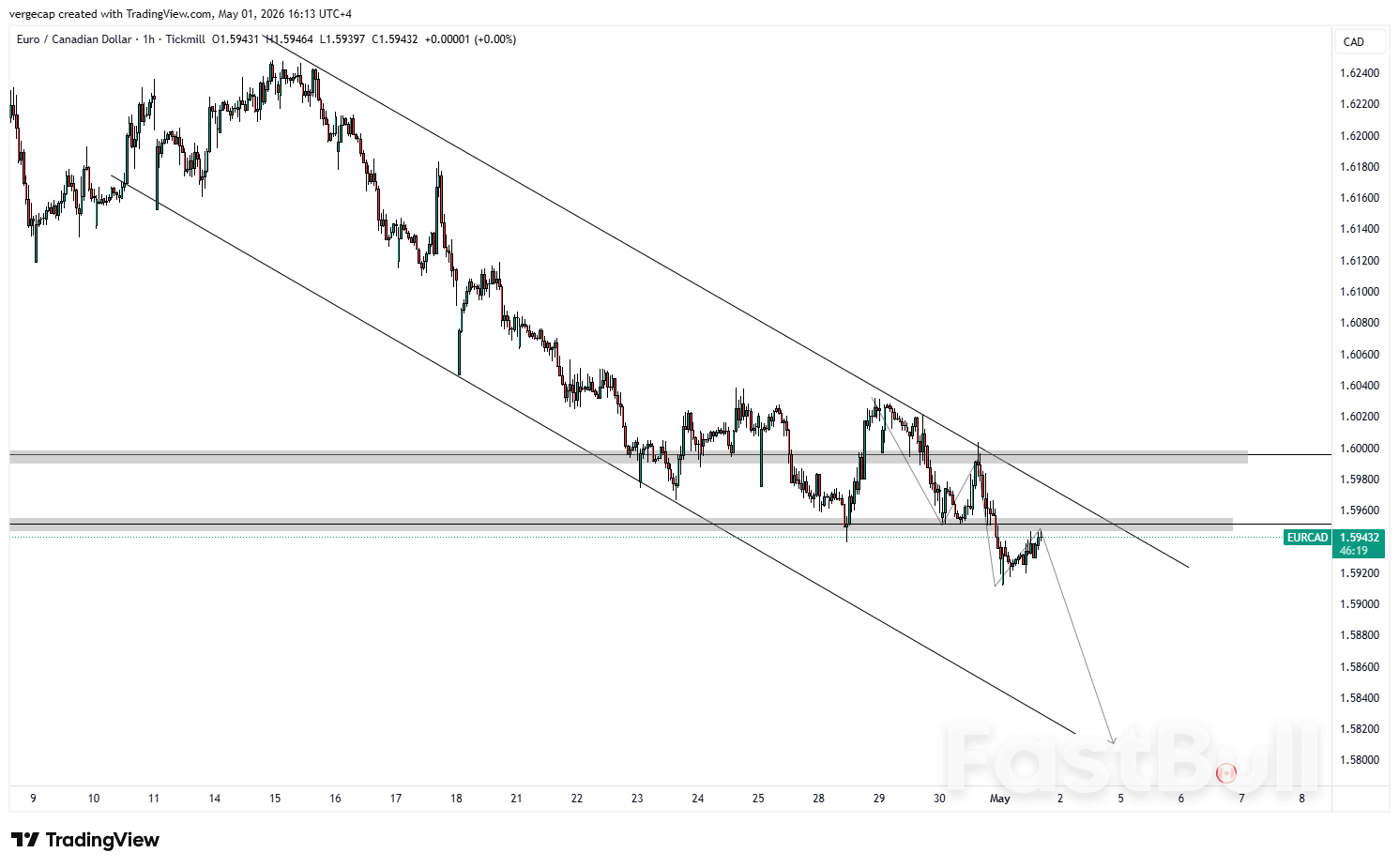
EUR/CAD continues to trade within a clearly defined bearish framework. On the 1-hour timeframe, price action remains confined inside a descending channel, marked by consistent lower highs and lower lows, reinforcing the prevailing downward trend. The pair is currently hovering around the 1.5940 area, staging a mild recovery after testing support near 1.5910–1.5920. While this uptick highlights some short-term buying activity, it does little to challenge the broader bearish outlook.
The upper boundary of the channel, positioned around the 1.5980–1.6000 region, serves as a key dynamic resistance zone. This level is further strengthened by a horizontal supply area, creating a strong confluence where selling pressure is likely to intensify. A rejection from this zone would reaffirm bearish dominance and increase the likelihood of further downside movement. However, a sustained break above 1.6000 could signal a shift in momentum, potentially paving the way for a recovery toward 1.6050 and higher.
On the downside, immediate support is seen near 1.5910, which has recently held firm. That said, repeated tests of this level tend to weaken it over time. A clear breakdown below 1.5900 would confirm continuation of the downtrend, exposing the next support zone around 1.5850–1.5820. A deeper move below this area would bring the 1.5800 psychological level into focus, indicating an extension of the bearish trend rather than a short-term pullback.
Even without visible moving averages, the price structure suggests a bearish bias, with rallies lacking strength and consistently being met with selling interest. The recent upward move appears corrective rather than impulsive, further supporting the view that the overall trend remains intact.
Momentum, while not directly indicated, appears to be stabilizing in the short term. The consolidation near support may reflect temporary exhaustion among sellers, but not enough to suggest a reversal. Instead, this type of price action often precedes another leg lower once support is decisively broken.
TRADE RECOMMENDATION
SELL EUR/CAD
ENTRY PRICE: 1.5940
STOP LOSS: 1.6005
TAKE PROFIT: 1.5830


