The Euro strengthened against the Canadian Dollar on Monday, with EUR/CAD rising more than 0.5% to trade near 1.5680 during Asian hours. The move extends the previous session’s modest advance, reflecting improved support for the single currency following fresh German manufacturing figures and pressure on the commodity-linked Loonie from declining crude prices.
Germany’s manufacturing sector delivered an encouraging signal, with the S&P Global Manufacturing PMI confirmed at 54.2 in October, up from 53.9 in September. The reading marks the sector’s second-strongest performance in nearly four and a half years, suggesting that industrial activity is holding up better than some of the broader economic concerns might imply. However, the improvement was not reflected across the wider economy. German retail sales fell 2.0% month-on-month in September, reversing August’s 1.2% increase and missing expectations for a 0.4% rise. Annual sales also declined by 2.3%, highlighting continued weakness in consumer spending.
This contrast leaves the Euro with a somewhat uneven economic backdrop. Stronger factory activity provides a positive signal, but the sharp decline in retail sales suggests that domestic demand remains vulnerable. For EUR/CAD, however, the immediate balance has tilted in favour of the Euro as developments in the energy market add pressure to the Canadian currency.
Crude oil prices have moved lower following the OPEC+ decision to maintain production targets at September levels for December. Saudi Arabia’s allocation stands at 10.478 million barrels per day, with Russia and Iraq assigned 9.949 million and 4.431 million barrels per day, respectively. The decision to keep output steady has contributed to the softer oil environment, reducing one of the key sources of support for the Canadian Dollar.
Geopolitical developments are adding another layer of uncertainty to the energy outlook. Markets are weighing continued diplomatic discussions between Qatar and Iran, aimed at securing an agreement to end the Middle East conflict, against the possibility of renewed US military action against Iran. The opposing forces are keeping traders cautious, although the recent decline in crude prices has so far offered little support to the Loonie.
Beyond currencies and energy, broader financial market conditions remain unsettled. Deutsche Bank strategists point to mounting doubts surrounding the AI investment theme, stress in French sovereign debt markets and rising energy costs as key pressures shaping recent market performance. Brent crude has gained 13.6% over the past month amid concerns about renewed US-Iran escalation, while European natural gas prices have climbed above €100/MWh for the first time since 2022.
These developments highlight the difficult environment facing investors, where geopolitical risks and higher energy costs are interacting with concerns about valuations and economic resilience. For EUR/CAD, the combination of improving German manufacturing activity and weaker oil prices has provided a near-term bullish impulse. Nevertheless, the sharp deterioration in German retail sales remains a warning that Euro strength is not supported by uniformly positive economic conditions. The sustainability of the advance will depend partly on whether oil prices remain under pressure and whether the latest improvement in German industrial activity translates into broader economic strength.
Technical Analysis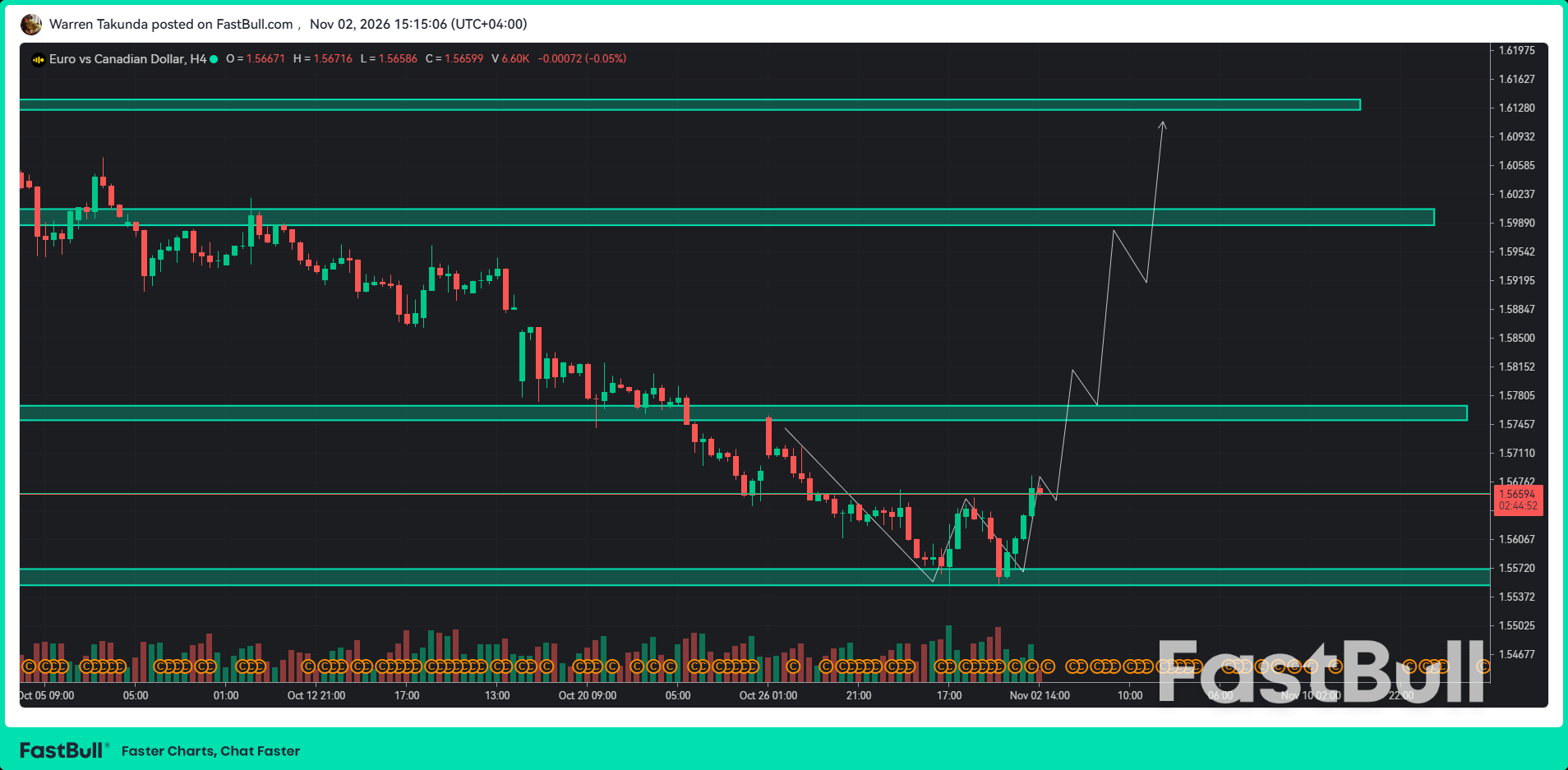
EUR/CAD is showing early signs of a bullish recovery after an extended decline from the 1.6000 region. The pair found strong buying interest around the 1.5540–1.5570 support zone, where sellers repeatedly failed to establish a fresh low. The subsequent rebound has pushed price back toward 1.5660, suggesting that buyers are gradually regaining control in the short term. The recent recovery also shows a developing higher low, which could provide the foundation for a broader corrective move higher.
The immediate focus is on whether EUR/CAD can sustain its position above the 1.5650–1.5660 area. A successful hold here would strengthen the bullish structure and open the way toward the 1.5750–1.5770 resistance zone. This is the first major upside hurdle, and a decisive break above it would signal stronger buying momentum, potentially exposing the 1.5980–1.6000 supply region. The chart's projected price path also points toward this sequence of resistance levels before a possible extension toward 1.6120.
However, the broader descending structure remains an important consideration. Failure to hold above the current recovery area could trigger another pullback toward 1.5570, with the 1.5540 support zone acting as the key level for preserving the bullish setup. A break below that demand region would invalidate the near-term recovery outlook and expose the pair to renewed selling pressure. For now, the rebound favours a cautiously bullish approach, provided buyers maintain control above the recent support structure.
TRADE RECOMMENDATION
BUY EUR/CAD
ENTRY PRICE: 1.5660
STOP LOSS: 1.5500
TAKE PROFIT: 1.5980


