EUR/CAD is not consolidating. It is not correcting. It is declining — relentlessly, consistently, and with increasing fundamental justification — for a seventh consecutive session, trading around 1.5980 during Thursday's European hours. On one side of this cross sits a Eurozone economy that is contracting faster than anyone expected. On the other sits a Canadian Dollar being turbocharged by oil prices that are rising on the back of a Middle East crisis that just escalated dramatically overnight. The directional pressure is not complicated. It is simply getting worse.
The preliminary HCOB Eurozone Composite PMI printed at 48.6 in April — missing the 50.2 consensus by a margin that demands attention and slipping decisively below the 50.0 expansion threshold after March's 50.7 reading had offered hope of stabilisation. The culprit is Services, which crashed to 47.4 against a forecast of 49.8 — a near three-point miss in a single month for the sector that represents the backbone of the Eurozone economy. When Services contracts at this pace, no amount of manufacturing improvement — the PMI there rose modestly to 52.2 — can compensate.
Germany delivered an equally uncomfortable message. The flash Composite PMI fell to 48.3 against expectations of 51.1, dropping back into contraction from March's 51.9. German Services PMI collapsed to 46.9 — nearly four points below consensus — signalling that Europe's largest economy is being squeezed hard by elevated energy costs and deteriorating consumer confidence simultaneously.
For the ECB, this data is a policy nightmare. The central bank was already navigating a delicate balance between above-target inflation and fragile growth. Thursday's PMI collapse gives the dovish Governing Council members powerful ammunition to delay the June rate hike that markets had been pricing with increasing confidence. A central bank moving away from rate hikes is a central bank with a weakening currency — and EUR/CAD's seven-day decline is the visible expression of exactly that repricing.
While PMI data was providing the justification for Euro selling, the overnight developments in the Strait of Hormuz were simultaneously providing an equally powerful reason to buy the Canadian Dollar. The Wall Street Journal reported that Iranian forces fired on three ships attempting to transit the Strait on Wednesday and escorted two of them into Iranian waters. Iranian media confirmed the IRGC was moving the vessels to Iran — a direct military seizure of commercial shipping that represents one of the most aggressive acts of maritime escalation in this conflict to date.
The political commentary was equally stark. Iranian parliament speaker Mohammad Bagher Ghalibaf stated that reopening the Strait would be "impossible" while the US naval blockade persists — a categorical declaration from one of Iran's most senior political figures that removes any near-term optimism about Hormuz normalisation. That word — "impossible" — deserves to be taken at face value.
WTI Crude has now risen for four consecutive sessions, trading around $93.40 per barrel — a sustained rally that reflects the market's rational repricing of an energy supply environment that is actively deteriorating. For the Canadian Dollar, the mechanics are direct: four days of oil gains equal four days of Loonie support, and that support is not going away while the Strait remains closed and Iranian forces are seizing ships.
Seven consecutive sessions of EUR/CAD decline with no meaningful recovery attempts tells you everything about the conviction behind this move. Sellers are not waiting for bounces — they are pressing at every level. The 1.5900 area is the next significant support, and I believe it will be tested before the week ends. A genuine Hormuz breakthrough or an ECB surprise could reverse the picture — but on Thursday's evidence, neither appears remotely imminent.
Technical Anlaysis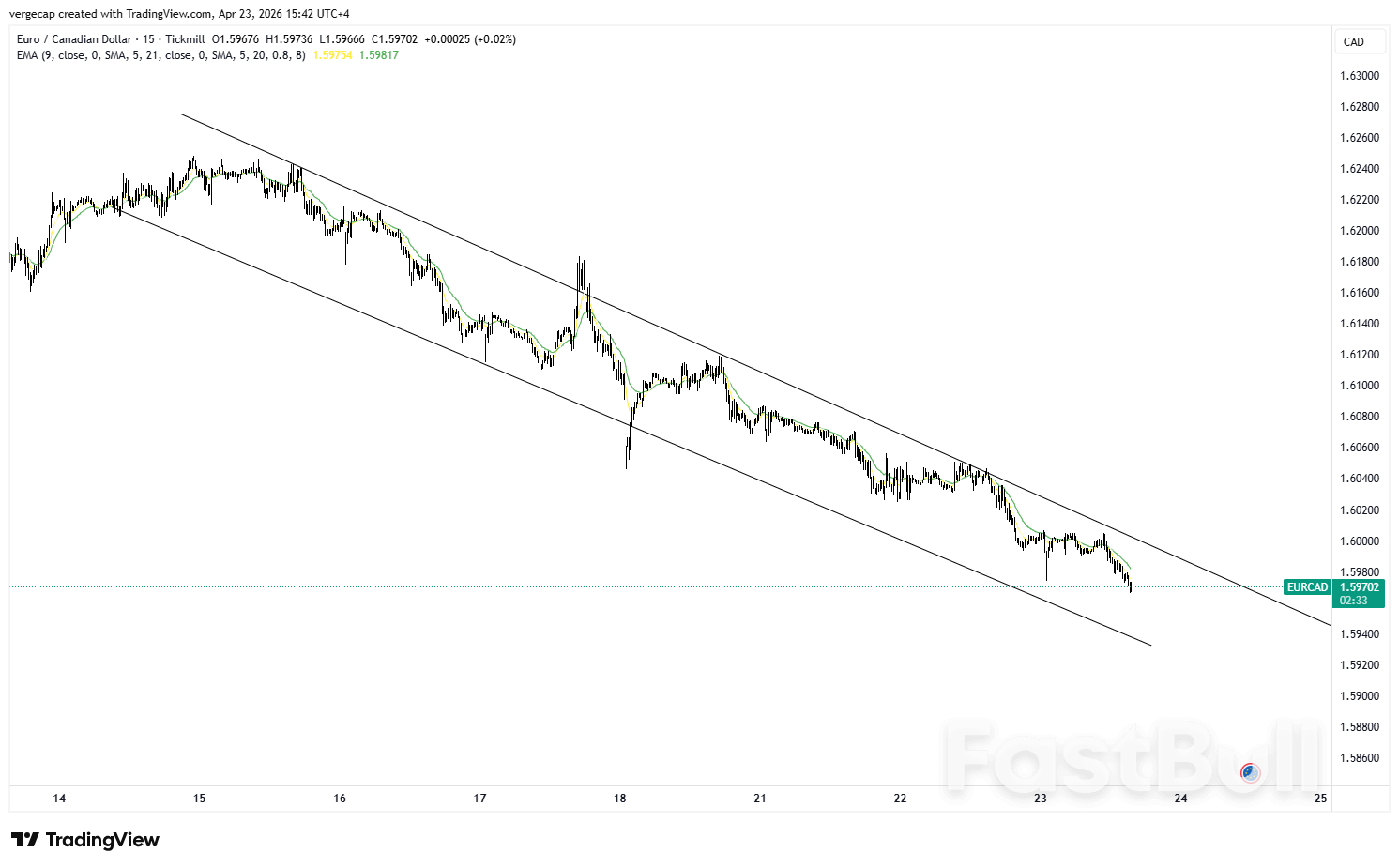
From a technical perspective, EUR/CAD is deeply entrenched within a well-defined and relentlessly bearish descending channel on the 15-minute chart — a structure that has been guiding price lower with remarkable consistency since April 14, covering nearly 300 pips of decline without a single meaningful structural violation. The channel is clean, well-proportioned, and has been respected on both its upper and lower boundaries across multiple tests, lending it a degree of technical authority that demands the bearish bias be treated as the primary directional scenario until a convincing break above the upper channel boundary occurs on a closing basis.
Price currently trades at 1.59702, pressing against the lower boundary of the descending channel — a zone that has arrested previous intraday selloffs and produced modest corrective bounces before the broader downtrend reasserted itself. The 9-period EMA at 1.59754 and the 21-period SMA at 1.59817 are both positioned above current price and sloping decisively lower in a tight bearish stack formation that has been in place throughout the entirety of this decline. This configuration — price beneath both declining moving averages with those averages converging as overhead resistance — is the textbook signature of a trending bearish market in full flow rather than one approaching exhaustion or reversal.
The upper channel boundary, currently descending through the 1.6020–1.6030 area, represents the definitive resistance ceiling for any corrective bounce. Every recovery attempt visible on the chart has found a ceiling at or near the upper channel boundary before rolling back lower — a sequence of lower highs that confirms sellers are actively using every rally as an opportunity to reload short positions rather than covering them. A corrective bounce toward the upper boundary — potentially toward the 1.6010–1.6020 area — that produces a rejection candle on the 15-minute timeframe would represent a high-probability short entry aligned with the dominant trend.
The lower channel boundary, currently intersecting near 1.5960–1.5965, is the immediate downside reference. Price is pressing against this level at time of writing, and its behaviour here will be the key near-term determinant of whether the channel produces another corrective bounce or accelerates into a breakdown. A sustained close below the lower boundary — particularly a 15-minute candle that closes with conviction below 1.5960 — would signal a channel breakdown and trigger an acceleration of the bearish move toward the 1.5940 area as the immediate target, followed by the 1.5900 psychological support level that represents the primary downside objective consistent with the channel's projected extension.
The 1.5900 level carries significant technical and psychological weight as a round number and a major horizontal support reference. Its breach on a sustained closing basis would open the path toward the 1.5860–1.5880 area — a zone that, given the current fundamental backdrop of collapsing Eurozone PMI data and surging Canadian Dollar oil premium, represents a genuinely achievable medium-term target rather than an aggressive projection.
The overall structure — a nine-day descending channel, declining moving averages in bearish stack formation, a relentless sequence of lower highs and lower lows, and a fundamental backdrop that is actively reinforcing the technical direction — presents one of the most comprehensively bearish setups currently visible across the major Euro crosses.
TRADE RECOMMENDATION
SELL EUR/CAD
ENTRY PRICE: 1.5975
STOP LOSS: 1.6030
TAKE PROFIT: 1.5900


