Overview
EUR/CAD has developed a relatively well-defined range during September, with repeated demand appearing around 1.6000–1.6030 and resistance building toward 1.6100–1.6120. The latest market data place EUR/CAD near 1.60888, only around 0.05% below the 1.60969 resistance pivot. This makes the proposed 1.6096 entry particularly sensitive: buyers are attempting to convert the upper boundary of the recent range into support.
The short-term technical backdrop is constructive. Investing.com currently reports a Strong Buy technical summary, with 12 moving-average BUY signals and RSI(14) at 62.04. MACD is also giving a BUY signal, while ADX is around 24, indicating that directional momentum is developing rather than remaining completely flat. This combination is more supportive of a breakout attempt than the neutral conditions seen earlier in the range.
However, the Canadian dollar side cannot be ignored. EUR/CAD remains sensitive to oil prices and broader CAD sentiment, while current USD/CAD analysis shows the Canadian dollar under pressure as USD/CAD attempts to establish itself above 1.4030. If CAD weakness persists, EUR/CAD can receive an additional tailwind, but a sudden oil rebound could limit the upside.
Market Sentiment
The current sentiment is moderately supportive of the BUY because EUR/CAD has advanced toward the upper end of its range without a major deterioration in momentum. The important distinction is that the pair has not yet produced a confirmed breakout. Current analysis identifies 1.60969 as a high-probability resistance zone, with 1.61184 as the next resistance and 1.60531 as the first meaningful support.
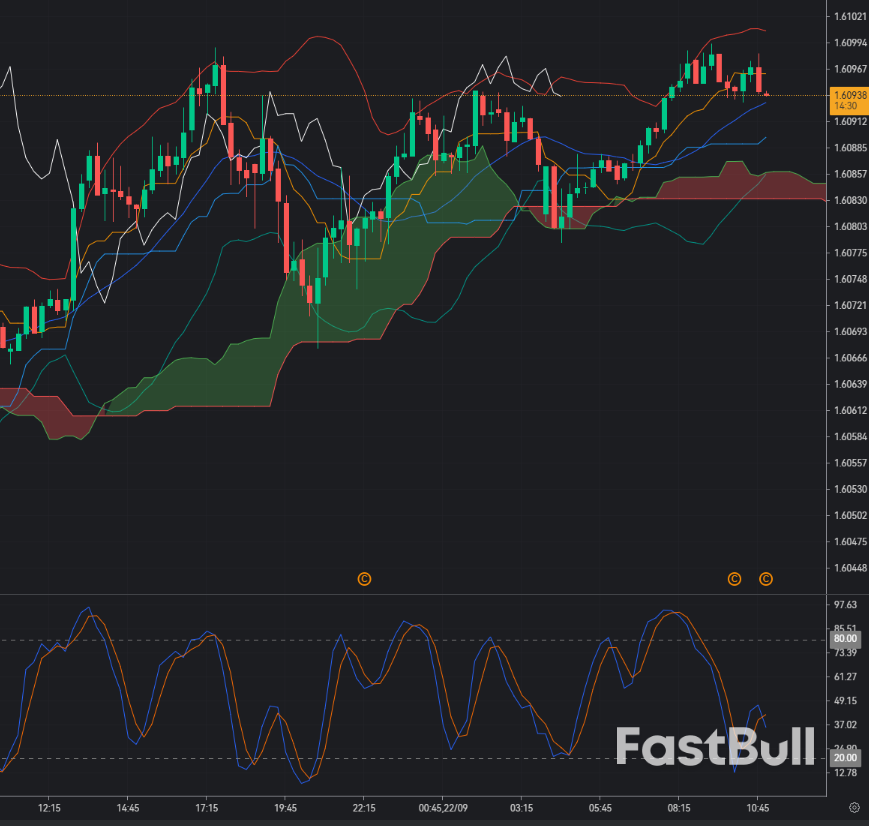
This creates a classic M15 breakout-versus-rejection situation. A move through 1.6096 followed by an M15 close above 1.6100 would suggest that buyers are absorbing the supply around the range ceiling. Conversely, repeated rejection around 1.6096–1.6100 would leave the pair inside the established range and expose the 1.6053 support.
Momentum is also beginning to look somewhat extended. RSI at 62 remains below the conventional 70 overbought threshold, which leaves room for additional upside, but StochRSI at 92.43 and Williams %R around -12.5 indicate that the short-term move is already stretched. Therefore, the better BUY structure is a breakout followed by a shallow retest rather than chasing a large M15 candle.
On M15, 1.6096 sits immediately below the 1.60969 pivot resistance and therefore functions as a breakout trigger. The next technical barriers are approximately 1.61184 and 1.61365, while downside support is concentrated around 1.60531 and 1.60217. A sustained M15 close above 1.6096 would therefore create room toward the upper range extension around 1.6118–1.6136.
With Bollinger Bands (20,0,2), the setup is strongest if price breaks the upper band and then retests the breakout zone without falling back through the middle band. Because StochRSI is already elevated, a temporary pullback toward 1.6085–1.6090 after the initial breakout would actually improve the risk structure rather than invalidate the bullish thesis.
For Ichimoku (9,26,52), buyers ideally need price above the Kijun-sen with Tenkan-sen maintaining a bullish relationship and the future cloud remaining supportive. The critical confirmation is not merely price moving above 1.6096 but whether the M15 candle structure can remain above the cloud after the breakout. A quick rejection back below the Kijun would indicate that the resistance has held.
The Stochastic (5,3,3) should be monitored carefully because momentum is already elevated. The strongest continuation signal would be a brief reset from the upper zone followed by a bullish cross while EUR/CAD remains above 1.6085. If Stochastic crosses downward while price simultaneously fails at 1.6096, the breakout setup becomes significantly weaker.
The first upside objective is 1.6120, close to the current R2 at 1.61184. A clean break could extend toward 1.6140–1.6150. On the downside, an M15 close below 1.6053 would indicate that the breakout has failed and return the pair toward the middle of the established range. The broader range remains approximately 1.6000–1.6118, so holding above the upper boundary is the key condition for the BUY thesis.
Trade Recommendation
Entry: 1.6096
Take Profit: 1.6135
Stop Loss: 1.6068