Fundamentals
Last week, Bank of Japan (BOJ) Deputy Governor Ryozo Himino told parliament that the central bank will watch currency moves carefully, as exchange rate fluctuations exert a growing effect on price trends. Compared to the past, changes in exchange rates are now more likely to affect domestic prices via import costs and, in turn, influence public expectations for future prices and the underlying inflation level. Himino noted that a weaker yen could heighten inflation as firms pass on rising import costs to consumers. While the BOJ does not directly target exchange rates, it will continue to examine their movements given their significant impact on the economy and prices. Meanwhile, Japanese authorities remain highly vigilant over recent market volatility. Finance Minister Katayama Satsuki stated that, amid escalating Middle East tensions and developments in Iran, global financial markets have shown notable turbulence. Japan is prepared to cooperate closely with overseas authorities and take action if necessary, while reiterating a warning against sharp yen depreciation. She said Japan is coordinating with G7 partners to counter the economic impact of the conflict and has prepared various measures, including a possible supplementary budget, to cushion the domestic economy. Widening Middle East conflict has pushed oil prices higher and disrupted global markets, putting pressure on Japan's economy, which relies heavily on energy imports. The nation imports about 95% of its crude oil from the Middle East, of which roughly 70% transits the Strait of Hormuz—a chokepoint that has been largely shut down due to the conflict. In a risk-off shift, Japan’s stock market posted its largest weekly drop in nearly a year as investors moved to cash from risk assets. The yen traded near 157.60 per dollar, gradually approaching the 160 level widely seen by officials as a potential trigger for intervention.
The U.S. labor market is exhibiting new signs of softness, while inflationary pressures from rising oil prices are mounting, confronting the Federal Reserve with a monetary policy dilemma: it must sustain elevated interest rates to contain inflation, yet may need to lower rates to support a decelerating job market. Currently, Fed officials are inclined toward a wait-and-see stance, despite financial market traders increasing bets on rate cuts commencing in June. Prior to that, Kevin Warsh, nominated by President Trump as a potential Fed Chair candidate, could replace incumbent Chair Jerome Powell. Following recent attacks by the U.S. and Israel on Iran, international oil prices surged to US$90 per barrel, with U.S. gasoline prices rising from US$3 to US$3.32 per gallon in a week. Concurrently, the Labor Department reported an unexpected drop in February employment, driving the unemployment rate up to 4.4%. Data indicates that private sector job growth for all of 2025 was below 300,000, the weakest performance since 2009, excluding pandemic years. San Francisco Fed President Mary Daly stated that policymakers had previously assessed the labor market as stabilizing, but current data suggests this may have been overestimated. With inflation still above target and oil prices climbing, the Fed's dual mandates of maximum employment and price stability are both under threat. She noted that February's weakness was partly influenced by healthcare strikes and federal government layoffs, cautioning against overinterpreting a single month's data. However, even when averaged with January's stronger figures, two-month employment growth remains below the roughly 300,000 jobs required to maintain a stable unemployment rate. The Fed's preferred inflation measure was 2.9% in December, and economists anticipate it holding at that level in January, compared to a 2% target. Over the past five years, the Fed has consistently failed to meet this goal. The confluence of conflict, rising commodity prices, and weak hiring has policymakers concerned about the risk of stagflation, which they had aimed to avoid.
Technical Analysis
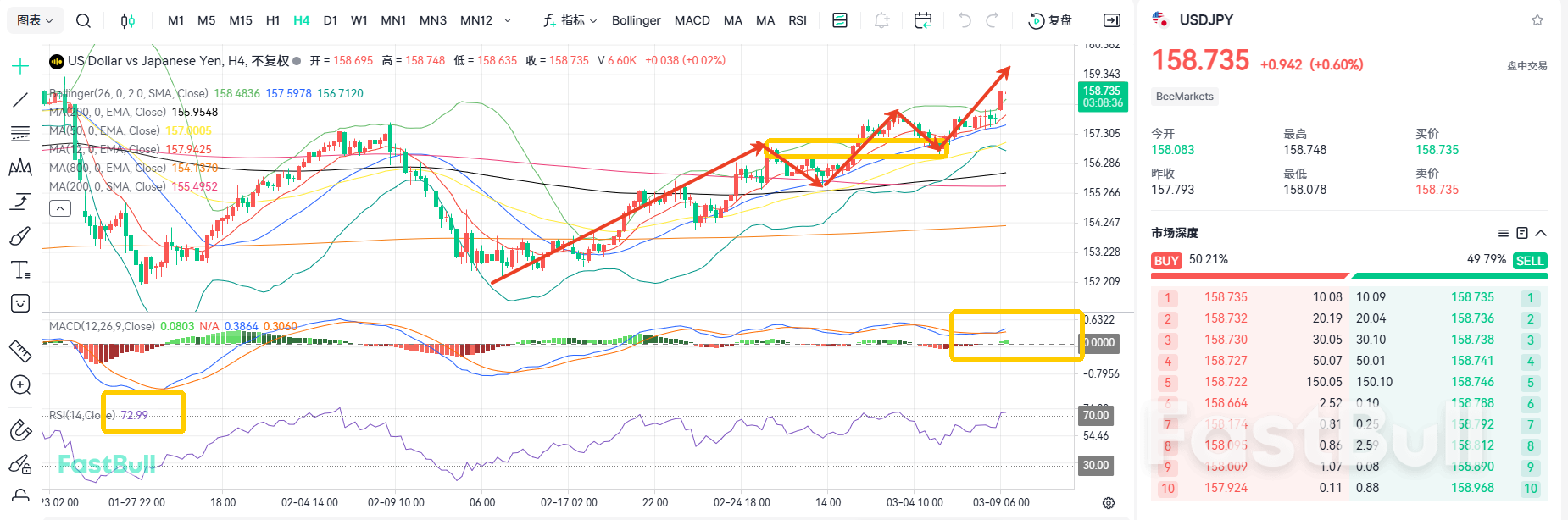
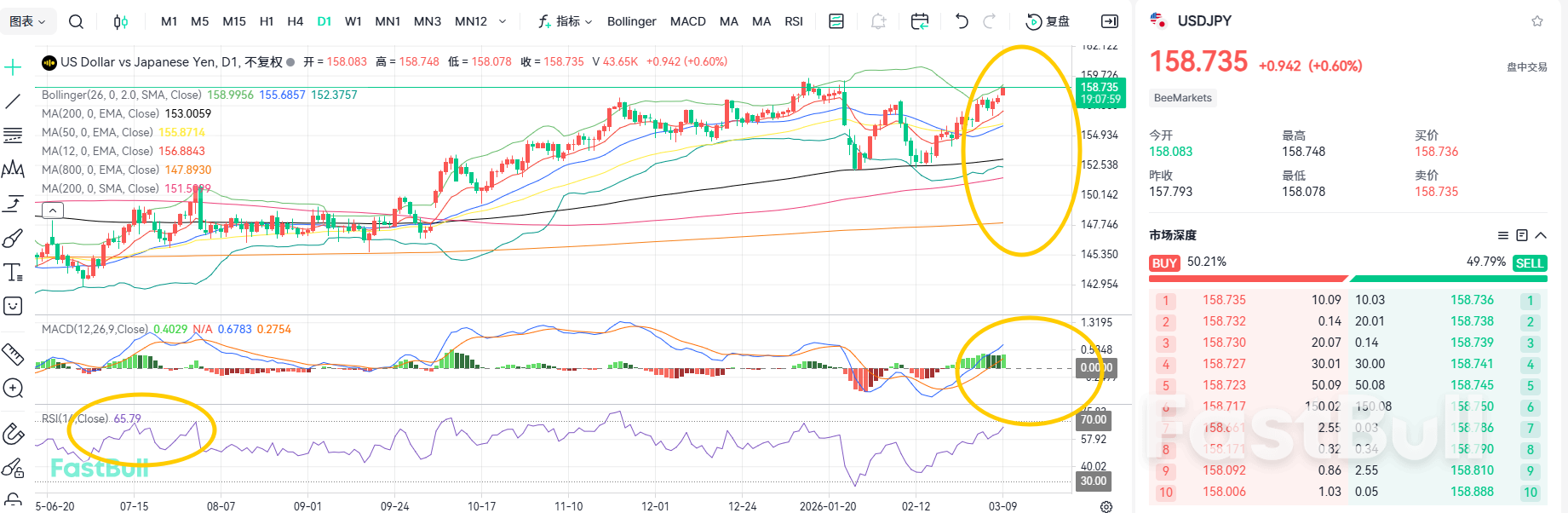
In the 1D timeframe, the Bollinger Bands are opening upwards, moving averages are diverging higher, and the price is consolidating higher along the EMA12 and the upper Bollinger Band. Following a MACD golden cross, both the MACD line and signal line have returned above the zero line, indicating a return to a bullish zone. After forming a small bullish candlestick last Friday, the price is highly likely to challenge the previous high at 159.4 and the key psychological level at 160. The RSI reading at 65 suggests the prevailing market bias is buying. In the 4H timeframe, the Bollinger Bands are opening upwards with diverging moving averages. The price's consolidation higher near the EMA12 and the middle Bollinger Band confirms the uptrend remains intact. Currently, the market is in an accelerating upward movement, with the MACD's MACD line and signal line operating above zero line, maintaining the overall bullish structure. An RSI reading of 72 indicates the market is in overbought territory. The strategy is to look for buying opportunities on dips.
Trading Recommendations
Trading Direction: Buy
Entry Price: 158.5
Target Price: 162
Stop Loss: 155
Support: 154, 152, 149.5
Resistance: 160, 161, 162


