Fundamentals
Data released by Japan’s Ministry of Health, Labour and Welfare showed that Japan’s real wages rose 1.4% YoY in January 2026, marking the first positive growth in 13 months. Real wages had declined throughout 2025, with a full-year decrease of approximately 1.3%. Nominal wages increased 3.0% YoY to an average monthly level of 301,314 JPY, the fastest growth in six months and higher than the 2.4% increase recorded in December 2025. This growth exceeded the consumer price index used to calculate real wages. Japan’s CPI rose only 1.7% YoY in January, the lowest level since March 2022, mainly reflecting continued government fuel subsidies and a slowdown in food price increases. From a wage structure perspective, base pay increased 3.0% YoY, the fastest pace since October 1992. Overtime pay rose 3.3% YoY, the highest level in about three years, while special payments such as one-off bonuses increased 3.8% YoY, also higher than the previous month. The return of real wage growth is considered an important signal for the Japanese economy, as the Bank of Japan (BOJ) closely monitors whether wage growth can sustainably improve household purchasing power when determining the pace of rate hikes. As the 2026 spring wage negotiations (Shunto) approach their conclusion, Japan’s largest labor federation Rengo has demanded an average wage increase of 5.94%, extending the strong trend from the 5.25% increase recorded in 2025. If this year’s negotiations maintain similarly strong results, the likelihood of real wages remaining positive in the coming months will increase significantly, providing support for further policy tightening by the central bank. On monetary policy, the BOJ is currently in the process of gradually exiting its ultra-loose policy framework. Since ending its long-standing large-scale stimulus in 2024, the BOJ has raised interest rates several times and lifted the short-term policy rate to 0.75% in December 2025, the highest level in around 30 years. Most economists expect the BOJ to keep rates unchanged at the March policy meeting, although roughly 60% of surveyed economists anticipate that rates could rise to 1.0% in the second quarter of 2026. Among economists providing specific timing forecasts, some believe a hike could come as early as April, while many consider June or July more likely. At the same time, policy relations between the Japanese government and the BOJ have attracted renewed attention. Recent media reports suggested that Japanese Prime Minister Sanae Takaichi expressed caution about further rate hikes during a meeting with BOJ Governor Kazuo Ueda, leading to speculation that the government may prefer a slower pace of policy tightening.
In the United States, lawyers representing Fed Chair Jerome Powell stated during a meeting with the US Department of Justice in January that Powell could remain a member of the Fed Board of Governors after his chairmanship term ends in May. The possibility breaks with the long-standing practice that former Fed chairs typically leave the Board after their term concludes. The information was revealed in court documents unsealed on Friday. The documents relate to a case in which the Fed attempted to block a subpoena issued by the Department of Justice as part of a criminal investigation. The investigation concerns Powell’s decisions related to the renovation of the Fed’s Washington headquarters. A US district court judge ruled on Friday in favor of the Fed, preventing the subpoena from being issued. Justice Department lawyers stated in court filings that Powell’s lawyers told US District Attorney Jeannine Pirro during a January 29 meeting that Powell might remain on the Fed Board if he were still under criminal investigation when his chairmanship ends. If no investigation were ongoing, he might instead step down and focus more on family matters. The filings also indicated that Powell’s lawyers noted that President Donald Trump currently lacks sufficient votes in the Senate to confirm a new Fed chair. Trump’s preferred nominee, former Fed Governor Kevin Warsh, is facing resistance during the Senate confirmation process. Powell, who is 73 years old, has not publicly stated whether he will remain on the Board after his chairmanship ends. If he chooses to stay, his position could become a key swing vote within the Fed’s seven-member Board of Governors, giving him significant influence. Meanwhile, the US–Israel conflict with Iran has entered its third week. US officials predicted on Sunday that the war could end “within weeks.” Despite Iran stating that it remains “stable and strong” and prepared for self-defense, US officials believe the conflict may conclude within weeks, potentially allowing energy costs to ease. The remarks were intended to calm economic uncertainty triggered by rising oil prices. US President Donald Trump over the weekend threatened further strikes on Iran’s main oil export hub at Kharg Island and said he was not yet ready to agree to a ceasefire. The conflict has disrupted shipping through the strategically important Strait of Hormuz, sending shockwaves through global energy markets.
Technical Analysis
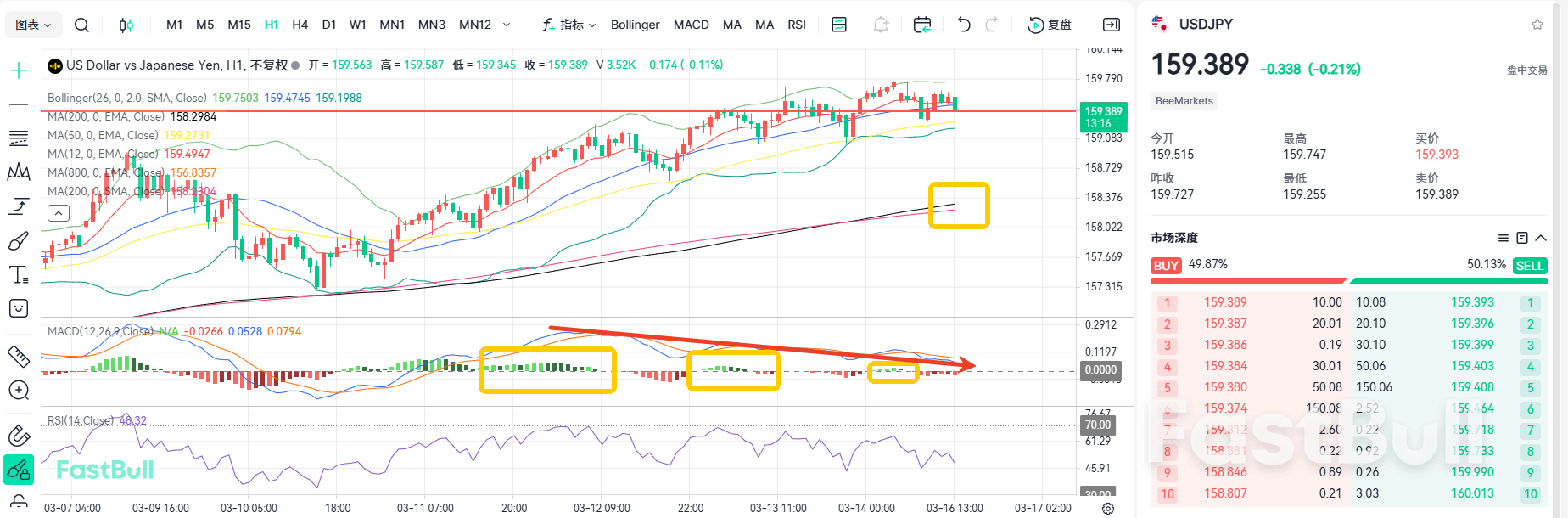
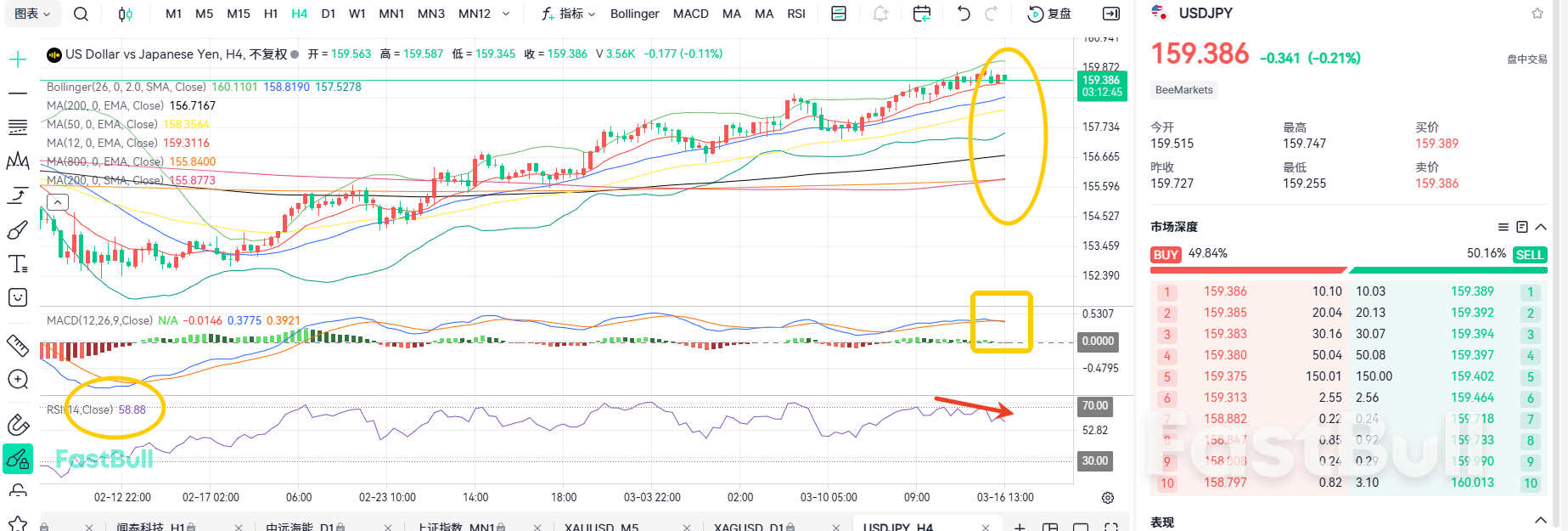
From the one-hour timeframe, the Bollinger Bands are narrowing and moving averages are flattening. Price is fluctuating around EMA12 and the Bollinger midline. The MACD has formed a bearish crossover, indicating that upward momentum is weakening. This represents a bearish divergence signal, suggesting a potential pullback. Prices are likely to decline toward the Bollinger lower band and the EMA200, located near 159.1 and 158.2 respectively. The RSI reading is 48, with declining highs, indicating that selling pressure currently dominates market positioning. From the four-hour timeframe, the Bollinger Bands are expanding upward while moving averages continue to diverge higher. Price is moving upward along EMA12 and the upper Bollinger Band, although bullish momentum has weakened, indicating the possibility of a pullback at any time. Price is currently near the previous high, where selling pressure is likely to emerge. MACD is approaching a bearish crossover, but both signal lines remain above the zero axis, suggesting the broader bullish trend remains intact. The RSI stands at 58, indicating generally optimistic market sentiment. Strategically, buying on dips remains the preferred approach.
Trade Recommendations
Trade Direction: Sell
Entry Price: 159.3
Target Price: 157
Stop Loss: 161
Support: 158 / 157 / 155
Resistance: 160 / 161 / 162


