Fundamentals
The November Ivey Purchasing Managers' Index (PMI) for Canada fell below the growth-contraction threshold, indicating the first contraction in economic activity in six months, with concurrent weakening in employment. Seasonally adjusted data also showed a significant decline, reflecting widespread sluggishness in corporate procurement activities. Simultaneously, the auto loan default rate continues to rise, particularly among the youngest and oldest borrower demographics. Supply chain disruptions during the pandemic drove up prices for new and used vehicles, while the sharp interest rate hikes since 2022 significantly increased financing costs. Under the combined pressures of high inflation and housing cost burdens, more households are struggling to service their debt. To reduce monthly payments, many borrowers are extending loan maturities, which inadvertently elevates future financial risks; some vehicle owners now face loan balances exceeding vehicle values, increasing pressure on lenders and automakers. Amid economic and household financial stress, uncertainties surrounding U.S.-Canada trade relations further amplify risks. U.S. Trade Representative Greer revealed that President Trump may opt to withdraw from the United States-Mexico-Canada Agreement (USMCA) next year, potentially negotiating bilateral agreements with Canada and Mexico separately. Trump has also hinted that if the three countries cannot reach consensus during upcoming review processes, the current agreement could be allowed to expire or be subject to renegotiation, introducing additional volatility into an already fragile business and investment climate. Trade outlook uncertainties have prompted more cautious market expectations for the Canadian dollar. Some analysts suggest that if trade negotiations proceed slowly and economic recovery lacks clear momentum, the Bank of Canada may be compelled to further cut interest rates. The central bank has already lowered its policy rate to the lower bound of the neutral zone and hinted at a possible pause in rate cuts; however, given weak economic data and rising external risks, forthcoming policy decisions will be increasingly challenging.
Based on data from the Chicago Mercantile Exchange (CME) FedWatch Tool, the probability of Federal Reserve rate cuts has been reduced by 25 basis points to a target range of 3.50%–3.75%. The Fed's resolutely dovish stance is driven by worsening conditions in the U.S. labor market and expectations that inflation triggered by tariffs implemented under President Donald Trump will not be sustained. Despite significant declines in recent data, the overall labor market remains in a state of "stagnation": layoffs across various sectors are maintaining a relatively steady level, with recruitment efforts subdued. Reports indicate that in November, companies planned to lay off 71,321 employees, a 53% month-over-month decrease; however, total layoffs in the first eleven months of the year reached approximately 1.171 million, representing a 54% increase compared to the same period in 2024, with the technology sector particularly prominent due to integration of artificial intelligence into certain roles. The U.S. Bureau of Labor Statistics' scheduled employment report, originally set for release on Friday, was delayed until December 16 due to the government shutdown. Economists generally believe the current labor market is in a phase of neither significant layoffs nor active hiring. Factors such as reduced labor supply, AI-driven job automation, and uncertainty stemming from Trump's trade policies are all viewed as suppressors of corporate recruitment.
Technical Analysis
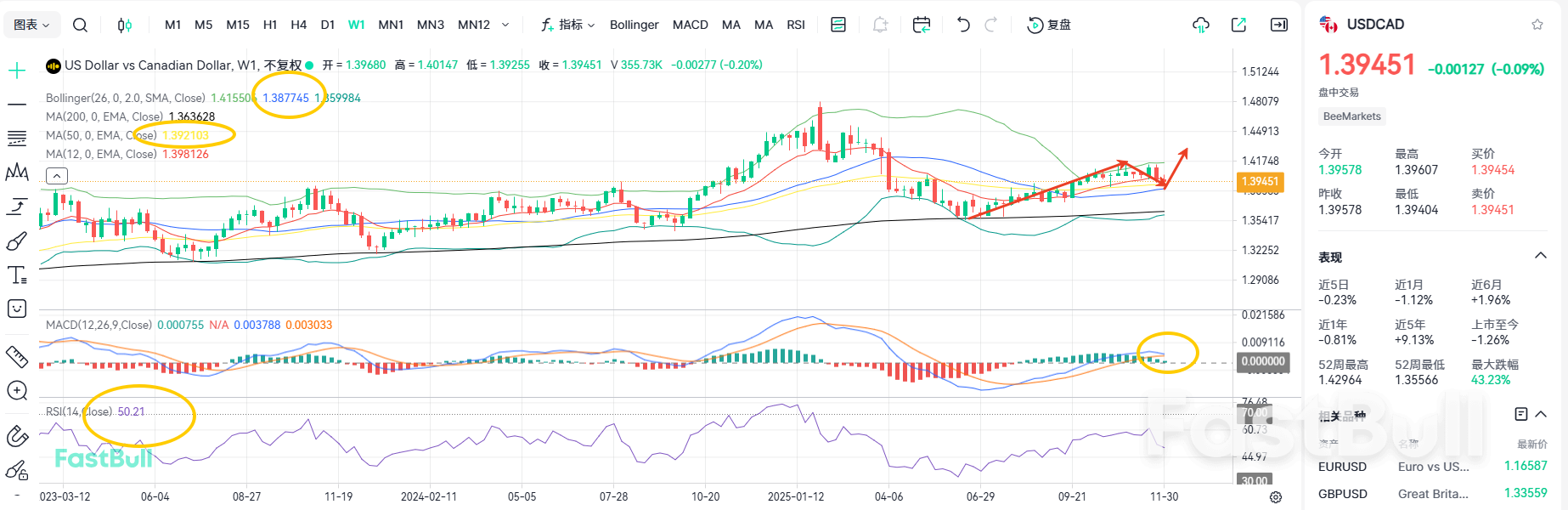
In the 1W timeframe, the USDCAD exhibits a dark cloud cover candlestick pattern, with the price breaking below the EMA12. This suggests a high probability of further decline toward the EMA50 and the middle Bollinger Band, approximately around 1.392 and 1.388. The Bollinger Bands are contracting, and the short-term EMA12 is flattening, indicating consolidation near the EMA50. The MACD shows diminishing bullish momentum as its MACD line and signal line approach a death cross. The RSI is at 50, reflecting market indecision and indicating that the short-term correction is ongoing. In the 4H timeframe, the Bollinger Bands are widening downward, with divergences among SMAs. After a MACD golden cross, the rebound momentum is weak, confirming bearish dominance. Support levels are near previous lows and round numbers at approximately 1.392 and 1.39. The RSI at 36 signals a pessimistic market sentiment. Therefore, it is recommended to go short before going long later.
Trading Recommendations
Trading Direction: Buy
Entry Price: 1.39
Target Price: 1.42
Stop Loss: 1.38
Support: 1.392, 1.39, 1.38
Resistance: 1.414, 1.42, 1.44